The first week of real cold arrives, the heat has been running for days, the wooden stairs have started to creak, and the little meter on the shelf reads in the twenties. The furnace is the obvious suspect, and dry air in winter heating gets pinned on it everywhere, yet a furnace takes no water out of the air at all. It warms air that came in from outside carrying almost nothing, and the same few drops of vapor, spread through warm air with far more room, read as a much lower percentage. How dry air feels in a person is a question for a doctor, and no meter answers it; this article stays with the house: the reading, the leaks, the glass and the unit.
Below you will find what the furnace does to the number, which setups really do lower it, how much the windows will let the house hold, what a furnace humidifier can and cannot do, and what to try in rooms with no ducts.
Quick Answer
The furnace is not pulling water out of the air. It heats cold outdoor air that carries almost no moisture, so the same vapor reads as a lower percentage once warmed. Read the room’s relative humidity first; the first fixes are the leaks and the ducts, not a new humidifier.
The Furnace Adds No Water and Takes None Out
Blame the furnace and you are half right. It is guilty of warming the water, which is enough to move the number a long way, and innocent of the water itself. Two numbers prove it, and a third tells you where your own room stands.

Warm Air Holds More Water, So the Same Water Reads Lower
Relative humidity is a ratio: how much water the air carries, measured against how much it could carry at that temperature. Warm air can carry far more than cold air, so heating the same air without adding any water lowers the ratio. That is the rule behind North Dakota State University Extension’s winter humidity target, and the extension puts the aim plainly: “You should strive for relative humidity levels around 40 percent in the winter.”
A furnace has no cold coil that condenses water out of the air the way an air conditioner does. It burns fuel or runs a heating element, moves the warmed air around the house and leaves the water alone. If you want the full account of where a heated house loses its moisture, the two numbers that explain a dry winter house cover it; this page deals with the heating side of that story.
What 20°F Outdoor Air Reads Once It Reaches 70°F
Take air at 20°F (−7°C) that is close to saturated, as winter air often is. Let it into a house and warm it to 70°F (21°C) without adding a drop, and it reads roughly 13 to 15 percent. Near 0°F (−18°C) the same arithmetic lands in single digits. The colder the day, the lower the same air reads once the heat has had it.
The house never sits that low, because cooking, showers, laundry and plants put water back. But every leak and every exhaust fan swaps some of that water for air from the arithmetic above, and the reading on the shelf is wherever those two pulls settle. A warm room, a low reading and an outdoor dew point in the teens add up to air behaving as it should, with no fault in the furnace. The wood floor gives the news before the meter does: gaps open between the boards and the stairs start to talk.
Where to Read the Number and Which Band to Read It Against
A small hygrometer is the cheapest instrument in this whole article and the only one that settles an argument. Set it at chest height in the room you care about, away from the supply register and the kitchen, and give it twenty minutes to settle before you trust it. A cheap one can sit off by a few points, so read it for the direction and the trend, and treat a single reading as a rough one.
Then read it against a band. The EPA’s indoor humidity guidance says, “If possible, keep indoor humidity below 60 percent (ideally between 30 and 50 percent) relative humidity.” Under 30 you are in dry-air territory; over 60 the mold has the water it needs.
Winter pushes the practical aim toward 40 percent, and as the next sections show, the windows can pull the ceiling lower still. Relative humidity is not the only way to count the water: absolute humidity, the actual weight of vapor in a cubic foot of air, barely changes when the furnace runs, which is the whole point of this article. The seasonal swing of the same reading is laid out in why the same house reads lower every January.
Which Heating Setups Really Do Lower the Number
If heating only warms the water, something else in a heated house must be pulling the reading down. The list is short, it is mostly about air moving through the house, and the first items on it cost nothing to check.
Air That Leaks In Gets Warmed and Reads Dry
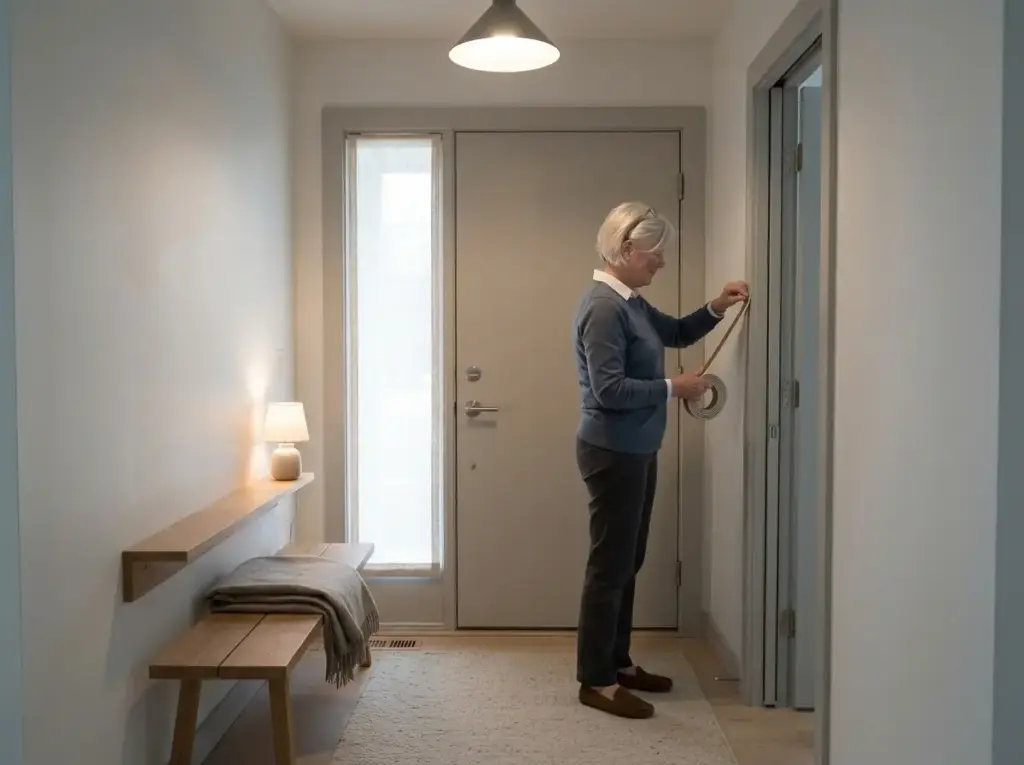
Every cubic foot of cold air that slips in gets heated by the furnace and arrives in the room reading in single digits. The usual doors for it are recessed can lights under an attic, outlet and switch plates on outside walls, the frame of an unused sliding door and the gap around the attic hatch. Caulk, weatherstripping and a can of spray foam close most of them.
ENERGY STAR’s guide to sealing air leaks walks through the common spots and puts the saving from sealing and insulating at up to 10 percent on annual energy bills. Sealing keeps the heat in and the water in with the same tube of caulk.
This is also why opening a window for relief backfires in January: you are inviting the driest air of the year into the room, which adds cold dry air to the reading and gives the heat more to warm.
Pick a cold, windy day and hold a strip of tissue paper against an outside-wall outlet cover, then against the rim of a recessed light. If it flutters, that gap is feeding the house air that will read in single digits once it is warmed, and it is the first thing to seal.
Combustion Air, Exhaust Fans and a Heat Pump on Long Cycles
A gas or oil appliance, a fireplace and a wood stove all draw air for burning, and that air has to come from somewhere: through the same leaks, then up the flue.
Bathroom fans, a kitchen range hood and a clothes dryer pull house air out the same way. An air-to-air exchanger does it on purpose; NDSU describes it as bringing dry air in and sending warm, moist air out.
None of these removes water from the air in the room. Each one replaces the room’s air with outdoor air, and the replacement is where the low reading comes from. The fans and leaks that drain a house first look at the same drain from the reading side.
A heat pump deserves its own note. It warms gently, on long low cycles, instead of firing in bursts, so the house gets steady heat with a different rhythm from a furnace. The water arithmetic is the same and the meter is read the same way; what changes is how a furnace-mounted humidifier behaves, which comes in a later section.
A tall room shows all of this at its worst. In a big house with a vaulted room and a loft, several room humidifiers on the floor barely move the number, because the warm air climbs into the loft and the leaks around it keep exchanging the air. The answer in a house like that is sealing, and one more unit helps nothing.
Ducts and Equipment Outside the House’s Walls
A return duct that leaks inside an attic or a crawlspace pulls cold, dry air straight into the loop, and the blower then spreads it through every room. Ductwork and equipment that sit outside the heated walls are the hidden leaks of a heating system, and they outrank any humidifier purchase because the check costs nothing and the repair is a roll of mastic tape or foil tape.
Look at the seams at the furnace, at the joints along the return trunk and at the boot where each duct meets a register. A seam you can see daylight through, or a section of flex duct that has pulled apart, is the repair. If the ducts run through a space you cannot reach or the equipment sits in an unconditioned attic, an energy audit with a blower door test finds what a flashlight cannot, and that is the right call for the building, and no humidifier will fix it. Duct sealing with mastic matters most for ducts in an attic or a crawlspace, where every leak pulls in the coldest air of the house.
How Much Water the Windows Will Let the House Carry
With the leaks accounted for, the next move is to raise the number, and the glass answers first. Forty-five percent is a summer target. The winter ceiling steps down with the cold, and the windows are what set it.

Why 45 Percent Is a Summer Number
Glass is the coldest surface in a heated room, and water in the air turns to liquid wherever the surface sits below the air’s dew point. That makes the window a gauge for how much water the house can carry. NDSU Extension’s window condensation guidance says that at 40 percent indoor humidity, double-pane glass begins to condense when the outside drops below 0°F (−18°C), and triple glazing holds out to about −40°F (−40°C).
A single pane tells first and tells loudest. Chase the textbook target in a cold snap and you trade a dry house for wet glass, wet sills and, if it is left, stained trim.
The Steps Down as the Outdoor Temperature Falls
Window makers’ own condensation charts are more cautious than that one extension figure, and they cover every glass type. They step the ceiling down as it gets colder: not over 40 percent at 20 to 40°F (−7 to 4°C), 35 percent at 10 to 20°F (−12 to −7°C), 30 percent at 0 to 10°F (−18 to −12°C), and 25 percent below 0°F (−18°C). Where the extension and the charts disagree, the glass in your house decides, and the charts are the safer place to start. Humidistat dials on furnace units carry marks for the same thing, and they are there for this reason.
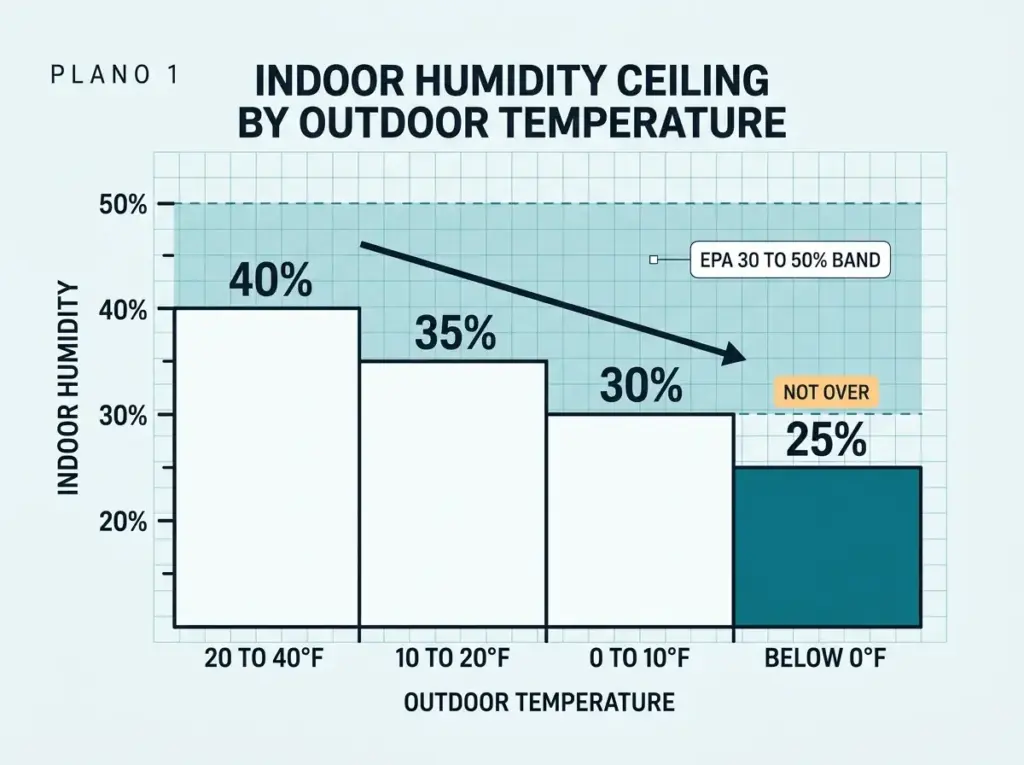
Notice what the steps do to the EPA band: by the time the outside is below 0°F, the ceiling sits at the very bottom of it. For the whole table, indoor humidity by outdoor temperature, step by step lays it out.
What to Do the Day the Glass Starts to Sweat
The first beads along the bottom edge of the glass in the morning are the ceiling talking, and the same bead pattern differs between a single pane and a double pane.
How to read a window that sweats covers what the pattern of beads means.
The response is a sequence. Lower the humidistat or the room unit’s set point first. Run the bathroom and kitchen exhaust fans for a while. Then read the meter again, and only move a second thing if the first was not enough.
Over-humidifying with room mist units leaves water marks on walls and trim long before it fogs a window, and the marks on a unit’s dial that tie the setting to the outdoor temperature are the warning. The humidistat goes down as the outdoor temperature drops. It never goes up.
Write the set point on a piece of tape next to the thermostat and move it down a notch each time the outdoor temperature drops into the next band of the chart. Glass is slow to warm and quick to sweat, so the first morning of beads on the sill means the notch was due a day earlier.
A Furnace Humidifier Only Makes Water While the Burner Runs
With the leaks sealed and the ceiling known, the reader is ready to add water. The device most owners already have, or are about to buy, is tied to the furnace’s heat call, and that changes how much water it can make.
What the Heat Call Does to the Water
A bypass or fan-powered unit is wired to run while the burner fires. In a mild winter, in a tight house, or with a heat pump running long low cycles, the furnace fires for few hours of the day. The pad stays wet, the drain drips, the tank looks full, and the room sits at 25 because the unit was only ever making water in short bursts.
The cheapest change is at the thermostat. Switching the fan from auto to on lets a unit that works whenever the blower runs get far more hours than the heat call alone gives it. Read the meter after a few days of that before touching anything else. When the unit runs and drips and the room still reads flat, what to check when a furnace humidifier runs but the room stays flat goes through the valve, the damper and the nozzle one by one.
Bypass, Fan-Powered or Steam: What Each One Can Hold
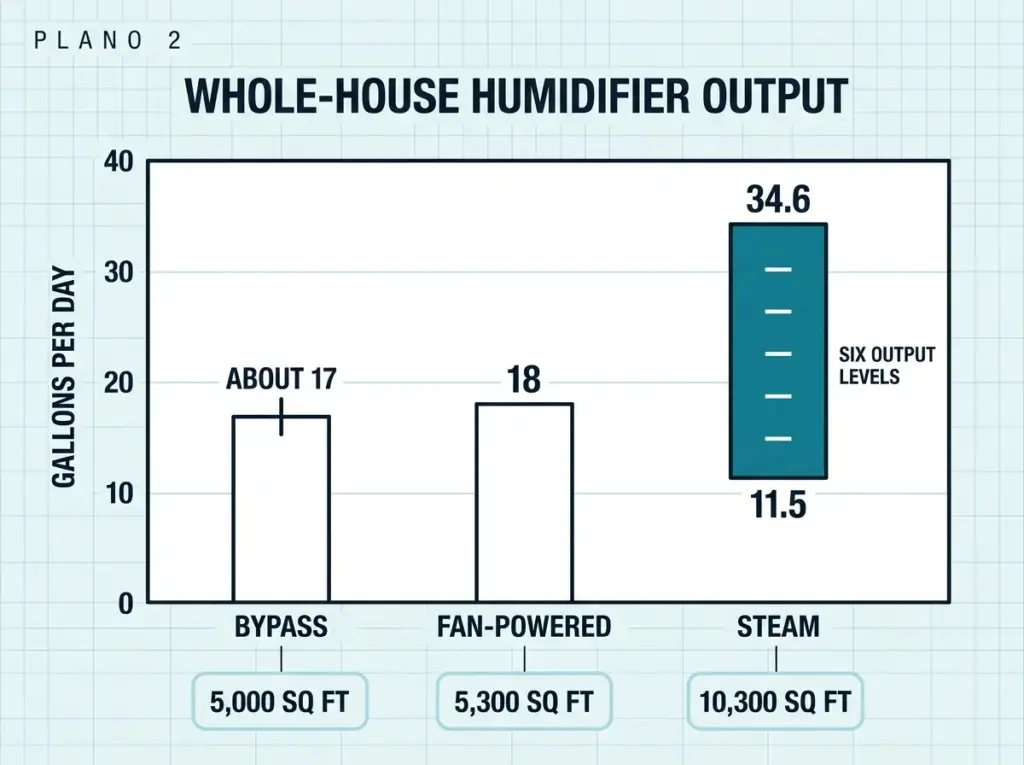
Whole-house capacity is rated in gallons per day, and the tank size of a room unit tells you nothing here. The AprilAire 600 is a bypass unit: about 17 gallons per day, up to 5,000 square feet, with outdoor and indoor sensors that let it back off as it gets colder, which builds the window ceiling into the control. The sensor-driven control and the completeness of the kit are its soft spots, and as a bypass it still makes water only while the furnace runs. A bypass unit tends to stall around the mid-thirties at 70°F (21°C), whatever the dial says.
A step up, the AprilAire 700M carries its own fan, so it does not lean on duct pressure to push air across the pad. It is rated at 18 gallons per day for up to 5,300 square feet. It draws a lot of water, much of it going down the drain, and it too depends on how long the furnace runs.
The top of the ladder is steam. The AprilAire 800 makes 11.5 to 34.6 gallons per day across six output levels and covers up to 10,300 square feet.
It is the only type that holds a high number through a cold snap in a tight house. It is expensive for the result, needs its own 240-volt circuit, and its canister is changed about once a year. That cost is the reason to rule out leaks and ducts first. The full set of options, each with its flaw, is in the whole-house picks, each with its flaw.
The Pad, the Valve and the Dial That Lies
A humidistat dial sets the reading at which the unit shuts off, and it does not set how fast water goes in. Turning it to the top gives you the same humidifier waiting for a number it may never reach. The winter setting and the dial that lies covers how to set it against the glass; the rule from the last section holds, so the dial comes down with the temperature outside.
Before buying a bigger unit, check four things. The bypass damper should be open for winter and the saddle valve on the water line fully open. A new water panel should be presoaked and set level, so water reaches every inlet hole instead of channeling down one; a dry, crooked or worn-out panel can hold a house several points below what the unit could reach. And the set point should sit where the window allows.
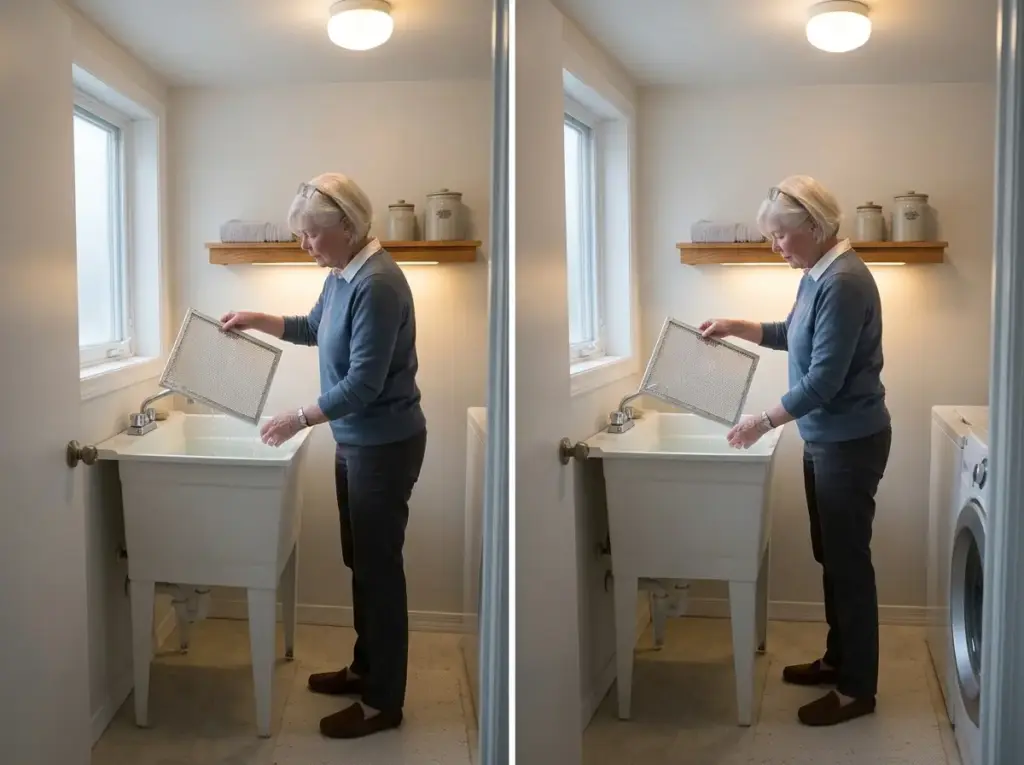
A working pad is damp at the top and dry at the bottom, because the water evaporates as it runs down. Take it out after a few weeks and feel it: soaked all the way through means the water is not evaporating, and a pad in that state is the one to replace right away.
By month two the pad is the part that tells you what the unit is doing. Panels are changed about monthly through the heating season and cannot be cleaned, and a steam canister is changed about yearly. The signs that a unit is working are a drip at the drain and a pad wet only at its top, while a room that sits flat with the tank full points back to the heat call.
When There Are No Ducts, or Only One Room Stays Dry
Everything so far assumed a ducted forced-air heat system. Radiator or baseboard heat, a boiler or a rental has no heat call to wire anything to, and a house that is fine except for one room needs a smaller answer, sized in square feet and gallons instead of furnace terms.

Radiators, a Boiler or a Rental With No Ducts
Start with what is free. A pan of water on top of or beside a radiator, or a couple of wet towels draped over it, adds a little moisture for no cost, and the meter will show whether it was enough. The next step is a large evaporative console set beside a return or in the middle of the open floor.
The AIRCARE Space Saver 831000 is that kind of unit: a 6-gallon tank, rated for up to 2,700 square feet, with a digital humidistat that shuts it off at the set reading. Its noise varies, and reliability and durability are the weak point, with units that stop after a few hours and a thin tank. In a dry house a large tank runs out in roughly a day, so the refill is a daily chore, and the wick is changed about monthly and cannot be cleaned.
The Room That Stays Dry With the Door Shut
One bedroom with the door closed is a small enough job for a room unit. The VENTA LW25 is an evaporative disc unit with no filter or wick to buy and no mist cloud, safe with tap water and rated for up to 430 square feet with a 2-gallon tank. Its output is mixed, and some units fail within months.
For a fraction of that cost, the Levoit Classic 300S is an ultrasonic cool-mist unit with a 6-liter tank and a built-in humidity sensor. Its output is also mixed, some units shut off unexpectedly, and there are leak and durability reports; ultrasonic units can leave a white mineral dust on the windowsill beside them when the water is hard, which is why a tank is rinsed and descaled on a schedule. A pot of water or a damp towel does the same job in a smaller way for nothing, so confirm the room really needs a unit first. How to size a unit in gallons a day instead of tank size explains why the rated output matters more than the tank.
The Free Moisture That Is Already in the House
The bathroom door left open after a shower, a pot of water brought to a boil, laundry dried on a rack indoors, a few houseplants and a bowl of water beside a register each add a little. None of them is a large step, so read the meter after each one and keep the ones that move it. The order of fixes for raising the reading puts these in sequence with the harder fixes.
Put the free moisture to work in the room that reads lowest, with the door shut to hold it, and note the meter before and an hour after. A step that moves the reading by a point or two is earning its place, and one that moves nothing can be dropped from the routine.
What remains is the decision of whether to add water at all, and with which control. A room unit and a furnace unit answer different houses, and whether a room unit or a furnace unit suits the house is the comparison to open next. The leaks and the ducts from earlier come before either.
Read the Meter, Seal the Leak, Then Decide Whether to Add Water
The furnace warms the water in the air and removes none of it, so the number to trust is the one on the meter in your room, read against a band that falls as the outdoor temperature does. A leak or a duct outside the walls outranks any purchase, because it is free to check and it drains moisture from every room at once. A furnace unit makes water only while the burner or the blower runs, and a house with no ducts is sized in gallons and square feet.
What drifts is predictable. A water panel needs looking at after the first month or two. A console’s tank wants filling daily and its wick monthly, and the glass needs reading through the first hard cold week, when the ceiling drops the furthest. If the reading overshoots, what to do if the reading overshoots goes through the free fixes in the opposite order.
For tomorrow, read the number on the meter, check the return duct and the can lights, and set the thermostat fan to on if a furnace unit is installed. Then read the meter again in three days. If it moved, you found the cause; if it did not, the next fix on the list is waiting.
Frequently Asked Questions
01What can fix dry air in a house during winter?
Read the room first, then seal the leaks and check the ducts, then set the thermostat fan and the set point against the window ceiling, and add water last. Take a reading after each step.
02How do I stop central heating from drying out the air?
Heating does not remove water; it warms air that carried little, so the percentage falls. Cut the leaks that bring that cold air in, and add water only once the reading sits below about 30 percent.
03How do I add moisture to a dry house?
Start with what is free: an open bathroom door after a shower, laundry dried indoors, a bowl of water by a register. Then use a room unit or a furnace unit, sized in gallons, with the set point below the window ceiling.
04What should indoor humidity be in winter?
The EPA says keep it below 60 percent, ideally between 30 and 50. In a cold snap the glass sets the ceiling lower: about 25 to 35 percent once the outside is under 20°F (−7°C).
05Why does my whole-house humidifier run but the room stays dry?
A furnace unit makes water only while the burner or blower runs, and the dial sets only when it shuts off. Switch the thermostat fan to on, check the damper and the pad, and lower the set point to what the window allows.