The weather app says the outdoor humidity is 84 percent, the little meter on your shelf says 19, and neither one is lying. So, is outside air dry in winter? Yes, in the amount of water it carries: cold air has room for very little, and a night that looks nearly saturated holds about a quarter of what a mild room could.
Heat that same air to 70°F (21°C) and the percentage collapses without a drop leaving. What dry air does to a person is a question for a doctor, not a meter, so this guide stays with the house: what outdoor air carries, what heat does to the reading, the ceiling the cold sets for your windows, the order of the fixes, and the cases where the weather is not the culprit.
Quick Answer
Yes. Winter air is dry in the water it carries, whatever the weather app’s percentage says: a near-saturated 32°F (0°C) night holds about a quarter of the water a mild room can. Heated to 70°F (21°C), that air reads close to 20 percent, and the outdoor temperature sets how high indoors can safely go.
What a Cubic Meter of Winter Air Really Carries
Two readings that look like a contradiction usually come from the same air. A percentage is a fraction of a container, and in winter the container shrinks, so the useful question gets asked in grams of water, not in percent.
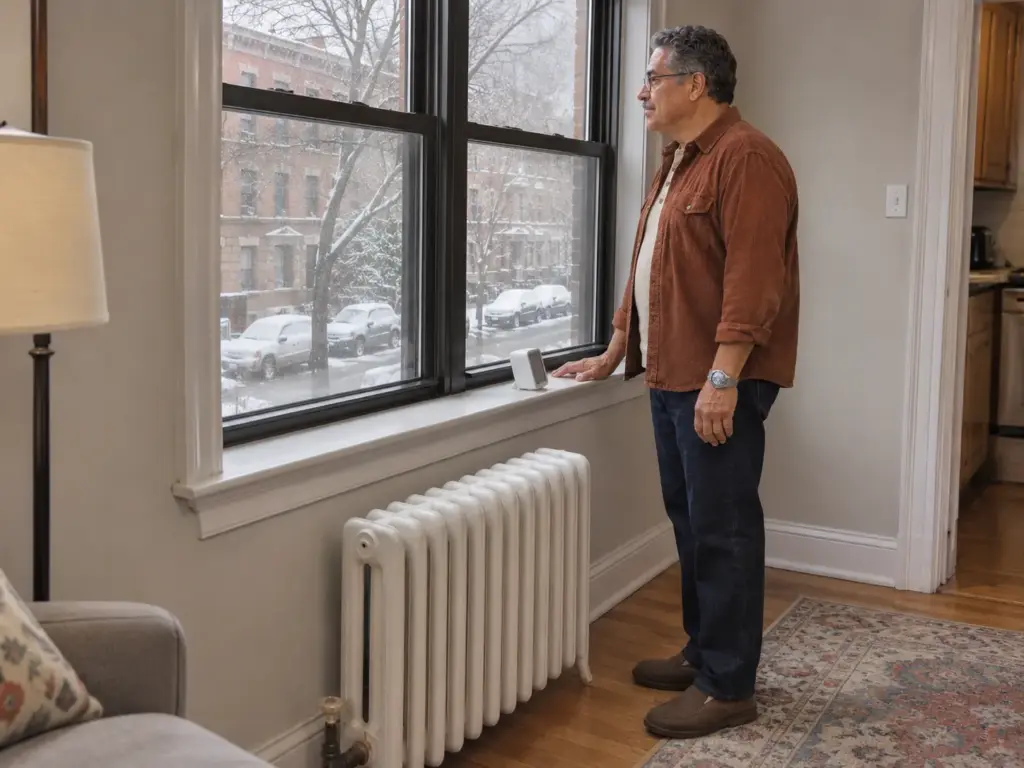
Cold Air Holds Less Because the Capacity Falls, Not Because Water Left
According to the EPA’s own page on moisture in the home, “As the temperature goes down, the air is able to hold less moisture.” Read that as a statement about the capacity of the air. Nothing is taken out of a cold night; the vessel gets smaller, so the same water fills more of it and the percentage on the app climbs. How a heated house ends up reading so low is the subject of the two numbers behind a dry winter house, so here the focus stays outside the walls.
Grams per Cubic Meter: Freezing Against a Mild Room
Saturated air at 32°F (0°C) holds about 4.85 grams of water per cubic meter, and saturated air at 68°F (20°C) holds about 17.3 grams, according to the saturated vapor density table from Georgia State University’s physics department. At freezing, the outdoor air tops out at roughly a quarter of what a mild room can carry. That gap in grams of water is the whole reason a winter night is dry, and no percentage on a phone shows it.
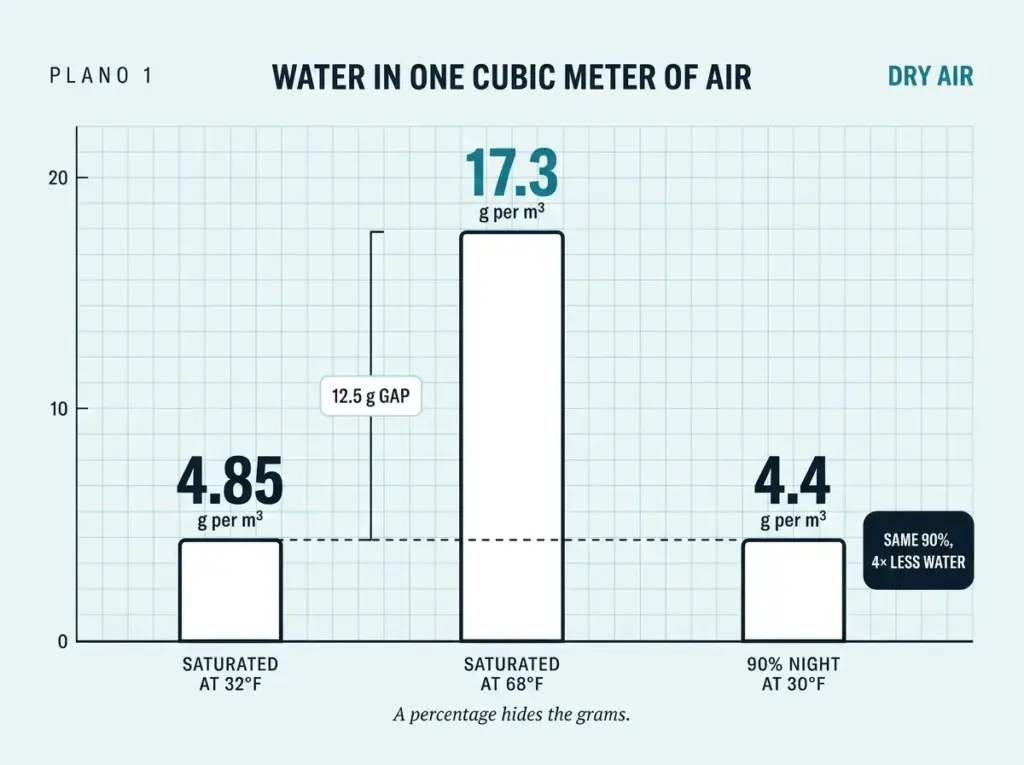
Why 90 Percent Outside Is Still Dry Air
Multiply the two figures and the paradox dissolves. At 32°F (0°C) the air tops out near 4.85 grams, so 90 percent humidity means about 4.4 grams per cubic meter, the absolute humidity that matters.
A mild 77°F (25°C) afternoon at 40 percent carries about 9.2 grams, so the “humid” night holds less than half of it. A high number on the app means a small container filled to the brim, and nothing more. And the percentage tends to climb on the coldest nights, when the air is nearly saturated and holds the least, so the more humid the app claims it is, the less the house has to work with.
Next to the humidity percentage, most weather apps list the dew point. Unlike the percentage, it does not swing with the temperature, so it is the one outdoor number that tells you how much water is actually out there. A dew point in the teens or single digits means very little.
What Heating That Air Does to the Reading
With the outdoor water in hand, the second half of the story is the furnace. It changes the number without adding or removing a drop, which means you can predict tonight’s meter with one multiplication.

Same Water, Bigger Container: 4.4 Grams at 70°F
Carry those 4.4 grams indoors and warm them to 70°F (21°C). The ceiling at that temperature is about 18 grams per cubic meter, so the same water now reads about 24 percent. Picture a small cup of water poured into a much bigger glass: the amount never changed, only how full the glass looks. At 5°F (−15°C) the outdoor air tops out near 1.6 grams, and heated to 65°F (18°C) it reads about 10 percent before a humidifier has run at all.
Heating does not remove moisture, whatever the falling number suggests; why the furnace takes no water out of the air has the full explanation. The water vapor is all still there, spread through a bigger capacity.
Predict Tonight’s Reading Before You Turn Anything On
The recipe is three steps. Take the outdoor humidity percent, multiply it by the grams a saturated cubic meter holds at the outdoor temperature, then divide by the grams a saturated cubic meter holds at the indoor temperature. An 84 percent night at 32°F gives about 4.1 grams, and at 70°F that reads in the low twenties. If the shelf says 19, the leftover gap is the house leaking a little extra or the gauge sitting a few points low.
Run it again on a mild week and the same house reads in the twenties; on the coldest night it slides into the teens, though nothing indoors moved. The outdoor temperature moved the number; the heat stayed put. The house reports it before the meter does: a static shock from the doorknob, floorboards that open a hairline gap, dry wood furniture that creaks and cracks.
Read the Number First: Where the Meter Goes and What the Band Is
Put a small meter in the room you care about, at chest height, away from the kitchen and the supply register, and give it time to settle; where the meter goes and how long it needs to settle covers the placement. For the band, the EPA’s indoor humidity guidance says to “Keep indoor relative humidity below 60 percent indoors, and ideally between 30-50 percent.” That band is the all-year picture, and the next section shows why January aims lower.
The Govee Smart WiFi Thermometer Hygrometer H5051 is the one purchase worth making before any machine, because it logs the whole day and lets you see the low point of the night and check the arithmetic on your own house. Its rated accuracy is ±3 percent, so a 45 percent reading can be 42 or 48.
The Wi-Fi link can drop, some units read off from the day they arrive, and the battery may last only about a month. For how far to trust a cheap meter, a cheap meter and how far to trust it goes deeper on that trade. Get it on the shelf from Amazon here.
The Ceiling the Outdoor Temperature Sets for Inside
Once you trust the reading, the natural move is to aim at 40 or 45 percent. In January the safe number is set by the outside, and the glass is the instrument that tells you when you have overshot.
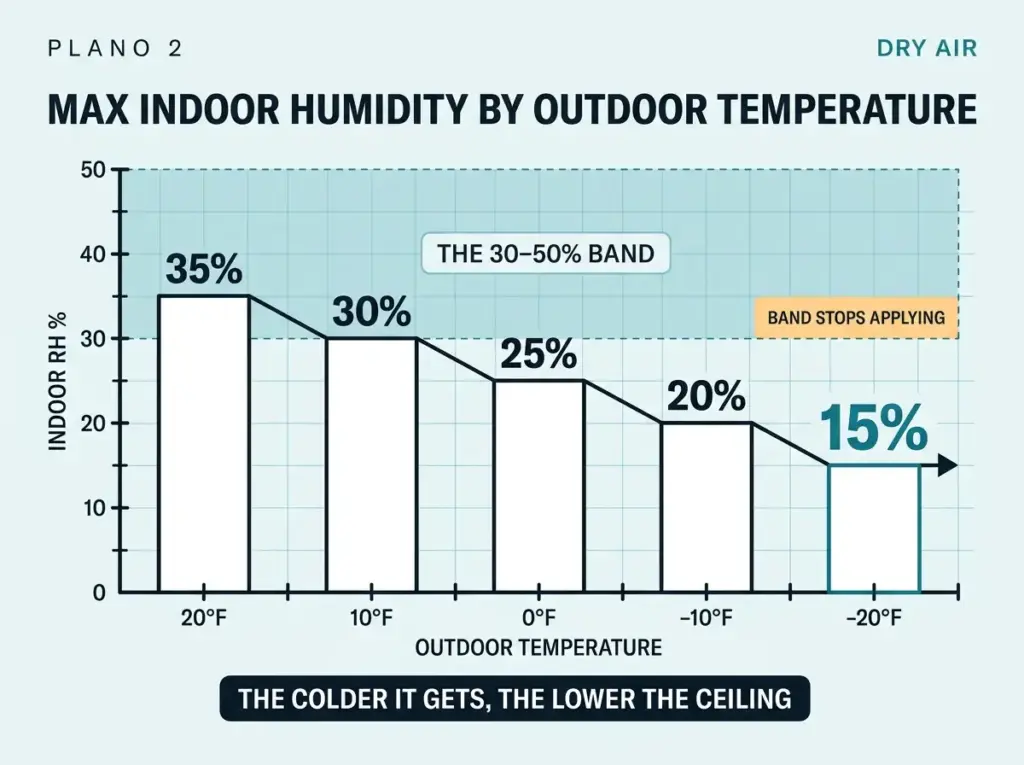
The Band Is Not the Target in January: EPA’s Table by Outdoor Temperature
EPA’s winter ceiling table, credited to ASHRAE and AHAM, pairs each outdoor temperature with a maximum indoor humidity: 20°F (−7°C) goes with 35 percent, 10°F (−12°C) with 30 percent, 0°F (−18°C) with 25 percent, −10°F (−23°C) with 20 percent and −20°F (−29°C) with 15 percent. Treat them as maximums, never as goals. The cold pushes the safe number down, and the 30 to 50 percent band stops applying once the outdoor temperature drops below the twenties. The in-between temperatures are in the full table of indoor humidity by outdoor temperature.
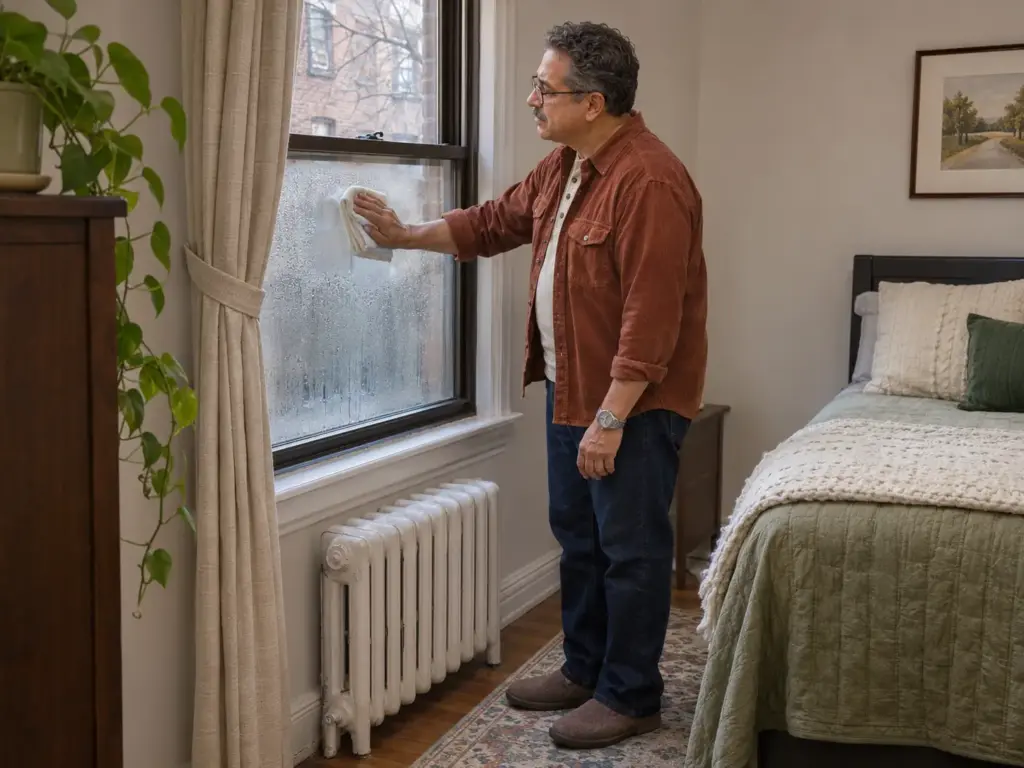
The Glass Is the Coldest Surface, So It Overrules the Dial
The window is the coldest surface in the room, so window condensation shows first: the water the room cannot carry condenses there first. The EPA’s own test is simple: a humidistat is set too high when moisture collects on windows and other cold surfaces. Hold a setting that fogs the glass and the pattern escalates from fog to frost, to condensation that keeps coming back and, over a season, rot at the sill and the frame, which is what the Building America guidance for cold-weather humidity describes.
The dial on a furnace humidifier often has a printed table of outdoor temperatures beside it that comes with no explanation. So it sits at 45 in January, and the windows are sweating by the weekend.
A wipe test beats the dial’s own number: note which pane fogs first and what hour it clears. To read what the fog means, how to read the fog on a pane walks through the pattern. A household that settles near 40 percent in early winter ends up closer to 25 or 30 in the teens, and that drift is the table doing its job.
Write the outdoor temperature on a sticky note beside the meter each morning and look up its ceiling in the table. After a cold snap arrives, the ceiling falls overnight and the dial has to follow, because the glass will not wait for you to notice.
The Mild-Day Exception: When Outside Air Adds Water
The outside air is not always the driest thing around. On a mild, damp day the outdoor dew point can sit above the indoor dew point, and then air coming in adds water instead of taking it. That is the only condition under which a window helps, and the full mechanics are in how a window behaves when the air outside is this dry. The method for the two dew points on a given day is in comparing the indoor and the outdoor dew point.
Seal First, Then Humidify by Gallons a Day
With the target set by the outside, the fixes come in order: free first, cheap second, a machine last. A leaky house is re-humidifying air that has already left, so the machine is sized by what it puts out in a day.
Free First: Hold the Setting to the Outdoor Number and Close the Leaks
Start with the dial. Set the indoor number to EPA’s ceiling for tonight’s outdoor temperature, read the meter the next morning, and leave it there for a few days. If the humidistat (the hygrostat on older units) senses the wrong room, see what to set the dial to when it lies.
A tight, energy-efficient house holds more moisture inside, as the EPA notes, and the reverse holds for a leaky one, where air leakage carries the water out. According to the Building America guidance on sealing and humidity, air sealing around wiring, ducting, flues and other penetrations through the wall and ceiling reduces the leak. The gap that lets the heat out lets the water out with it, so a seal is a humidity fix as well as a heat fix. And don’t overheat the house to compensate: with the same water, a higher thermostat setting only lowers the percentage again.
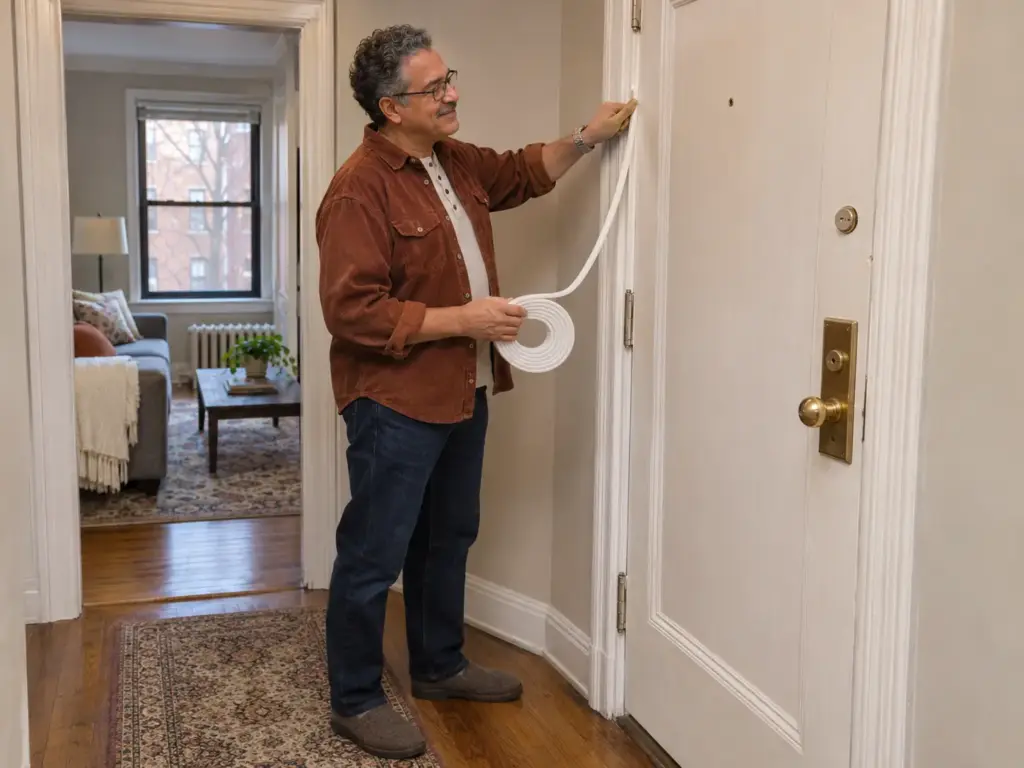
The Kanzzy Weather Stripping Kit is the cheapest item in this article: 39 feet of self-adhesive rubber strip plus a 43-inch door sweep, aimed at the drafty window and door gaps you can feel with a hand, which makes it a fit for a rental where nothing can be drilled.
The adhesive is where weatherstripping like this fails; on some doors the bottom strip peels within days, and on others the seal makes the door hard to close. For the one gap you can feel, a tube of caulk and a plain door sweep does the same job. If you want the kit, it is on Amazon. Seal the gaps, then read the meter again before adding any water.
One Room: A Machine Sized by What It Puts Out, Not by Its Tank
For a single closed small bedroom, the spec that decides is output per day. Humidifier output decides what reaches the air; tank size only buys fewer refills, not more water in the room.
The Levoit Classic 300S Ultrasonic Smart Top Fill Humidifier is an ultrasonic humidifier with a 6-liter top-fill tank and puts out about 300 milliliters an hour, under 2 gallons a day even if it never stopped, enough for a room in the 215 to 505 square foot range. It is rated at 30 decibels or less on its quietest setting, draws 26 watts, and its auto mode holds a set number instead of misting flat out.
Leaks are the repeated failure of this model, and some units quit inside two months, so a smaller 2 to 3 liter unit is the cheaper alternative if the output is enough for the room. The division for any room is in how to size a humidifier by gallons a day. The listing is on Amazon.
For the first day of a new machine, run it a notch above your target. The drywall, the wood floor and the furniture soak up water first, so the reading lags for days. Once the room catches up, dial the humidistat back down to the ceiling number so the windows do not pay for it.
A Whole Floor or a Leaky House: the Console and the Evaporative Unit
A house with a furnace-mounted whole house humidifier and two large console units running flat out can still sit under 30 percent in a cold snap, because the water leaves as fast as it arrives. A bypass unit delivers nothing during a mild week, since it only works while the heat runs. The cause is the air exchange: the house replaces its air, in air changes per hour, faster than the machine fills it, so a sealed window moves the reading more than a bigger machine does.
The Vornado Evap40 Evaporative Humidifier is the step up from a room unit. It is evaporative, so tap water does not leave white dust, with dual 4-gallon tanks rated at 4 gallons a day for up to 1,000 square feet, a real humidistat dial and 43 watts. Fan noise on high and units that quit around month four are the weak side, and a single-tank evaporative unit for one room is the lighter option. It is here on Amazon.
For the house whose reading will not move, the AIRCARE MA Whole-House Console-Style Evaporative Humidifier (MA1201) is rated by the maker at up to 12 gallons a day, with a 3.6-gallon tank, up to 3,600 square feet and a digital humidistat. That 12 gallons is the maker’s rating, so read it as a ceiling for the unit.
Its wick is the weak point: it loads, dries between cycles and cuts output, and the console is hard to clean; the Vornado above, or two smaller evaporative units, are the alternatives. After the first cold week, the wick decides whether the console keeps up, and soaking it through or replacing it restores the output. The unit is listed on Amazon. Choosing between a room unit and a whole-house unit for your floor plan is the next decision, and a room unit against a whole-house unit goes through the trade.
When It Isn’t the Outside Air: the House, the Building and the Gauge
You have the numbers and the order. The last case is a house that reads dry for a reason other than the weather, and the honest check there is to doubt the gauge before the air.

Exhaust and Ventilation That Swap Your Air for Winter Air
Every cubic foot of house air that goes out through a fan is replaced by winter air that comes in. A bathroom fan or range hood run long, combustion air for a gas furnace, and a ventilator that brings in cold outdoor air all do it; a ventilator whose core returns the water loses less than one whose core does not. The cold-weather advice in the Building America cold-weather list for exhaust fans and the dryer tells you to run the fans only as long as needed and to send the dryer vent outdoors. The same mechanism from the indoor reading’s side is in fans and leaks to check before you blame the weather.
A Tight House Reads Dry for the Opposite Reason
A newer, tighter house limits natural infiltration, and in cold spells the incidental air exchange falls because the doors stay shut, according to the same Building America source. The older house leaks its water out; the new one has almost no air moving at all. Two houses read dry for opposite reasons, and the cure for one makes the other worse. The drafts of a leaky house also change how a room feels, a point picked up in why a drafty room and cold glass feel colder than the thermometer says.
A Gauge That Lies Comes First, and What the Second Month Looks Like
Before buying any machine, put a second meter next to the first for a day. A consumer meter’s accuracy is a band: the Govee H5051 mentioned earlier is rated ±3 percent, so a reading of 45 can mean 42 or 48. A salt test settles the argument: a cap of table salt dampened to a slush, sealed in a jar with the meter (not touching it) overnight, holds the air near 75 percent at room temperature, and a meter that reads far from that is off.
Two meters that disagree by 3 points are doing their job. If they disagree by 10, trust neither and run the salt test on both. Note the offset of the one you keep on the back of the meter so the next reading corrects itself.
Water on the walls, frost that freezes a window shut or condensation that keeps returning and rots a sill belongs to a contractor, and a humidifier will not fix it. A machine only adds more water to a building that is already letting it in or out.
The second month looks different from the first. A pad that dries between heating cycles is the usual reason a console stops working in week three, and a unit that held its number for two weeks may not pass 30 percent once the cold deepens. After a cold snap, check the meter and leave the tank alone.
Read the Meter, Write Down the Outdoor Temperature
The percentage on the weather app hides the water; the grams are the real number, and a night at 90 percent can carry less than a mild afternoon at 40. Heating changes the reading without removing a drop, the outdoor temperature sets the ceiling, and the glass enforces it. The free fixes go first, the setting and then the gaps, and a machine is chosen by gallons a day, never by the size of its tank. A meter that reads off, or a house that swaps its air all day, is not the weather.
After a hard cold snap, take the reading again: the ceiling falls with the outdoor temperature, and a machine that kept up last week may not now. A pad deserves a look after two or three weeks of running, and the glass after the first fog. For the bottom of the band and the caveat for a leaky house, see how low is too low for a house.
Tomorrow morning, set the meter in the room, write the outdoor temperature beside it, and compare the two against EPA’s table. After any change, take the same reading, from the same shelf, the next morning. Once the meter confirms the room really is low, the next step is in raising the humidity once the meter confirms it is low.
Frequently Asked Questions
01How do I fix dry air in a house in winter?
Read the meter first, then hold the setting to EPA’s ceiling for tonight’s outdoor temperature and close the leaks you can feel. Add a humidifier sized by gallons per day last, and check the meter after each step.
02At what temperature does air become dry?
There is no single temperature; what matters is how much water the air carries against what the temperature lets it hold. At 32°F saturated air carries about 4.85 g/m³ against about 17.3 g/m³ at 68°F, so it reads dry once it is heated.
03Why does my meter say 19 percent when the weather app says 80 percent outside?
They measure different containers. The app gives a percentage of cold air’s small capacity; the meter reads the same water in warmed air, where the capacity is much larger, so the percentage falls without a drop leaving.
04Is the air outside drier than the air inside in winter?
In grams of water, usually yes, which is why a leaky house reads dry. On a mild, damp day the outdoor dew point can sit above the indoor one, and then the outside air adds water.
05Can I leave my air conditioner on dry mode all night in winter?
Dry mode pulls water out of the air, the opposite of what a winter house needs when the meter already reads low. It belongs to the humid months, and the meter tells you which side of the band you are on.