The sky is bright and cold, and the small meter on the living-room shelf reads 19 percent. Is dry air common in winter, or is this house doing something wrong?
For a heated house across most of the US it is the ordinary condition, and the number that says whether yours is ordinary is the indoor percentage read against tonight’s outdoor temperature. Cold winter air carries very little water and central heating adds none while it warms that air, so the percentage collapses by itself: McGill University’s worked example takes air at 57 percent outside and shows it reading 7 percent once it is heated to room temperature. What dry air does to anyone breathing it is a question for a doctor, so this article stays with the house: the number, the glass, the leak and the machine, in the order you would check them.
Quick Answer
Yes. Dry indoor air is what a heated US house does in winter, and an ordinary reading sits in the mid-teens to low twenties percent. Whether yours is normal depends on the outdoor temperature: the EPA’s ceiling is 35 percent at 20°F (−7°C) and 25 percent at 0°F (−18°C).
Why a Heated House Reads Dry Even When Nothing Is Wrong
A low number on a shelf feels like a verdict, and in January it is mostly arithmetic. The percentage on a meter says how full the air is, and winter keeps handing the house a very small bucket. What follows shows how far that arithmetic goes, so that “common” becomes a number instead of an adjective.
Same Water, Warmer Air: 57 Percent Becomes 7
How much moisture air can hold depends on its temperature, and as the temperature goes down the air holds less, a point the EPA’s own page on moisture in the home makes in nearly those words. Cold air holds less moisture, so outdoors in a cold snap even air that reads humid is carrying only a few drops of water. Bring that air inside and heat it: the water content (the absolute humidity) stays exactly where it was, but the warmer air could hold far more, so the percentage drops. Heating dries the air only in that sense, by making the same water a smaller share.
McGill University’s Office for Science and Society works it through with real figures. Air outdoors at 16°F (−9°C) and 57 percent relative humidity has a dew point of 3°F (−16°C), and it reads only 7 percent once it is warmed to 68°F (20°C), with not a drop of water added or removed along the way. The longer account of the two numbers that make a heated house read dry is a separate guide; what matters here is how far the arithmetic can go.
The Ordinary Heated-House Range Is the Mid-Teens to Low Twenties
REHVA, the federation of European heating and ventilation associations, writes in its journal that in modern heated homes indoor relative humidity can drop to just 15 to 20 percent in winter. That is the ordinary zone of a heated house, not an outlier, so an indoor humidity level of 19 on a bright cold morning is the expected result of heating cold air.
The house shows the number in ways a meter does not: a static shock off the light switch, trim and hardwood floors that shrink and open a hairline gap between boards, window glass that stays perfectly clear all season. None of these has an official threshold, so none of them gets a percentage here. They are effects to notice, and the fix gets tied to the EPA’s band further down instead of to a guess. And the same reading means different things in a leaky old house and a tight new one, a split that matters in the section on houses sitting far below the rest of the street.
Why the Weather App Says One Thing and the Meter Another
A phone can say 50 percent outside while the bedroom meter says 16. Neither is broken. The app reports a percentage of cold air, a small bucket that happens to be half full; the meter reports a percentage of warm air, a large bucket holding that same small amount of water. On a cold day, a high outdoor percentage says almost nothing about how much water the house has to work with.
The extreme version of the confusion, why a 90 percent outdoor day is still dry air, gets its full explanation in a separate guide. The reverse puzzle, where the indoor number runs higher than the street’s, is covered in how two dew points explain indoor air that is wetter than the street.
The Ceiling That Makes Tonight’s Reading Normal
With the baseline in hand, the target needs fixing, because it does not stand still. The same house is normal at 20 percent on a bitter night and too wet at 20 percent on a mild one, and the glass decides which. This section gives the scale that moves with the cold and the bands that circulate, each checked against whoever owns the number.
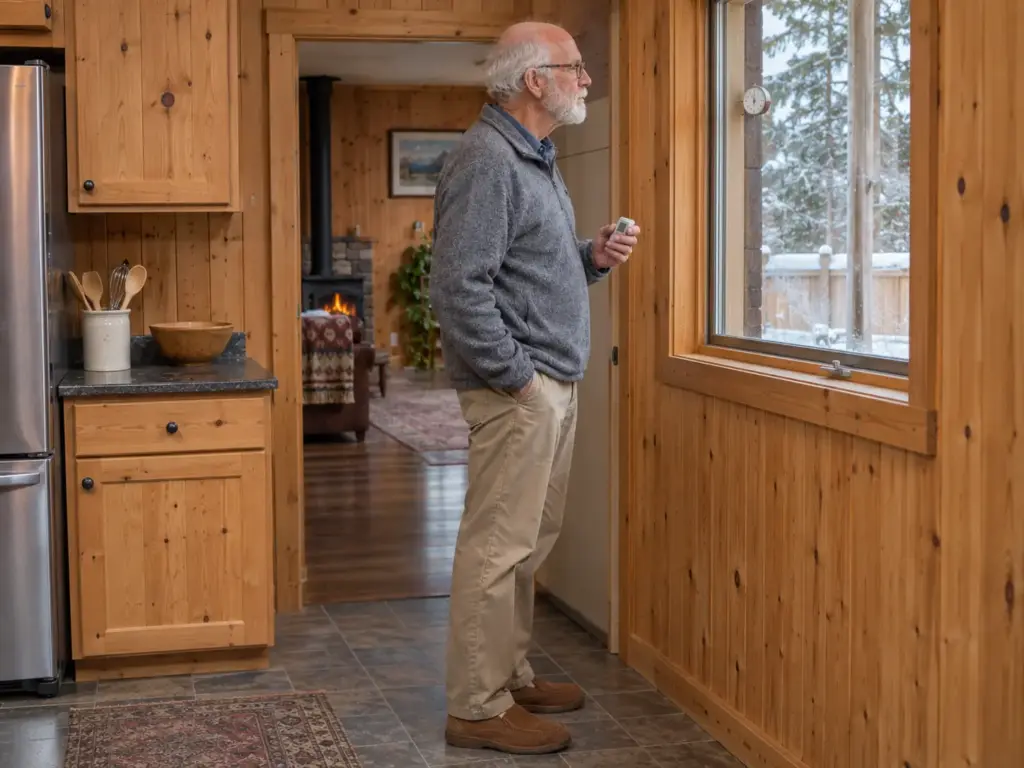
The Table the Whole Band Hangs On
A winter house cannot carry a fixed amount of humidity, because windows and exterior walls are cold, and warm moist air that touches a cold surface leaves water behind. So the limit slides down as the outdoor air gets colder. The EPA prints a table, credited to ASHRAE with figures from AHAM, of the most humidity a house can carry: 35 percent with the outdoor air at 20°F (−7°C), 30 at 10°F (−12°C), 25 at 0°F (−18°C), 20 at −10°F (−23°C) and 15 at −20°F (−29°C).
On a 0°F night, a house reading 20 to 25 percent is at or under what its own windows and walls allow, and that is the working definition of normal. The same scale, from 40 percent down to 15 by outdoor temperature, is laid out in full in its own guide.
Why 30 to 50 Is Not One Fixed Dial
According to the EPA’s mold and moisture guidance, “If possible, keep indoor humidity below 60 percent (ideally between 30 and 50 percent) relative humidity.” The Department of Energy’s building-science guidance on winter humidity puts the ideal at 35 to 50 percent instead, and treats visible condensation or frost on windows and cold wall surfaces as the sign a house has gone too high for that weather.
So two federal sources disagree by five points on the floor, and both are describing mild weather. Put them next to the table and the picture changes: at 0°F the ceiling is 25 percent, which sits under both floors, and a perfectly normal winter house therefore reads below the 30 to 50 percent “ideal” band for weeks. The 40 to 60 percent printed on some pages is a summer band, where anything above 60 is the point a house has to act. Carried into January it sends the dial somewhere the glass will not accept, and why the right setting shifts with the cold is the one-sentence version of the whole seasonal story.
What the Glass Says About the Setting
The EPA’s wording about the dial is blunt: “Your humidistat is set too high if excessive moisture collects on windows and other cold surfaces,” it says on its page on controlling moisture in the home. The glass is the coldest surface in the room, so the first sign shows on the lower corner of the pane, a film of water on the room side, well before any meter moves.
A setting pushed past what the outdoor temperature allows brings on window condensation first and, in the worse version, water on the walls and trim. The first very cold night is when it shows. If the sill is wet, check the setting for that night’s temperature before suspecting the device, and why the room side of the glass sweats covers the same rule from the other direction.
Read Your Own House Before You Decide Anything
The ceiling is a table; the house is a reading. A verdict of “normal” needs two numbers taken on the same evening, and the instrument that takes them is the cheapest purchase in this article.
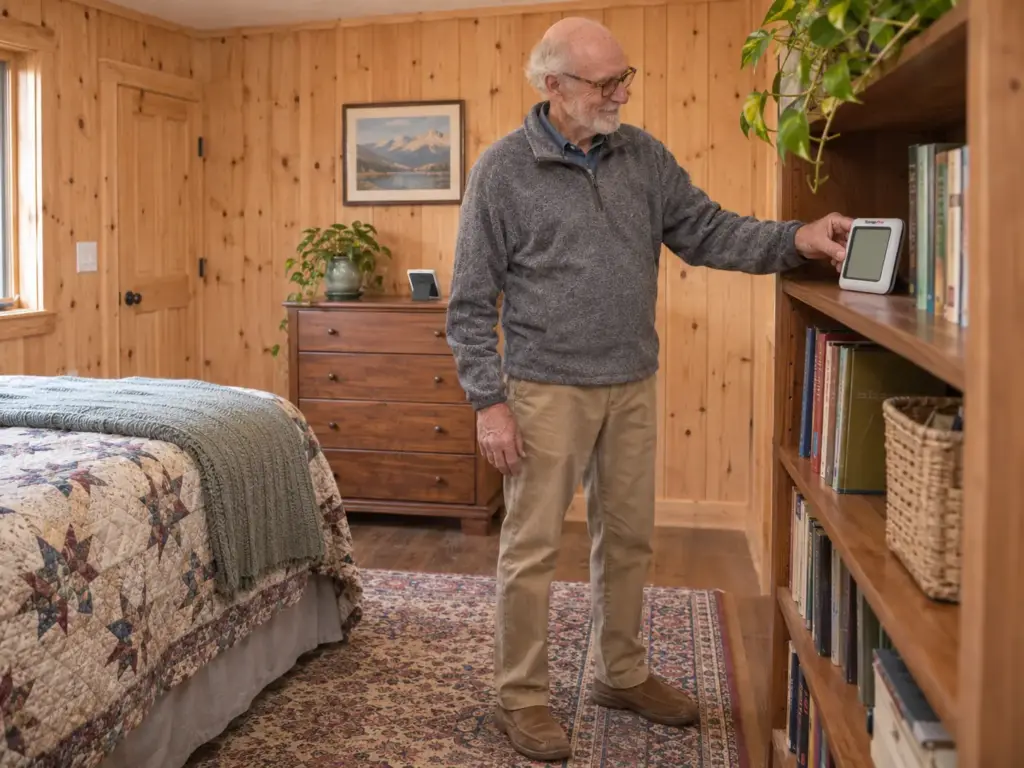
Two Numbers on the Same Evening: Indoor Percentage and Outdoor Temperature
Put the meter at chest height in a room people actually use, away from the vent and away from the window, and write the outdoor temperature next to the reading. Then check the pair against the EPA’s table. A reading at or under that night’s ceiling is normal; a reading far below what the same weather gives other houses belongs to the section after this one. How to take the reading with one meter walks through the placement step by step.
The TempPro TP50 is the first step here: a digital hygrometer and thermometer with a whole-percent display, a memory for the highest and lowest reading, one AAA battery and no app, rated to within 2 to 3 percent either way. Some units quit inside the first month, so a second reading from another meter is the check on any number that looks wrong.
There is a second number worth knowing. The National Weather Service describes the dew point as the temperature to which air must be cooled to become saturated, a measure of the actual water vapor in it, and the percentage cannot be worked out from it alone. The dew point says how much water is in the air; the percentage on the room meter says what the house is doing with it. Two numbers, both honest.
The Meter With a Memory: the 24-Hour Low and the Week’s Curve
The reading at breakfast is one moment. The number worth carrying into the EPA table is the lowest reading of the last 24 hours, set against the coldest outdoor temperature of the same stretch. A meter that remembers makes that easy, and one that keeps a week of history makes the difference between a normal house and one losing moisture visible as a shape instead of a hunch.
The Govee H5051 is the one for that job: Wi-Fi and Bluetooth, about two years of history that exports as a spreadsheet, readings accurate to ±3 percent and ±0.54°F, and an alert when the reading crosses a value you set. Wi-Fi dropouts happen, and some units read a few points off, so the same second-meter check applies. A cheaper Govee model, the H5075, is Bluetooth only and shows whole-number readings; it is the lower step if the curve matters less than the figure.
Two Rooms and Two Meters Beat One Reading
The same house, on the same evening, can read about 16 percent in one room and about 26 a floor up. That gap is the strongest clue that the problem is not the weather but where the air is coming from, because the weather is the same for both rooms. One reading in one room cannot show it.
A meter that drifts shows itself when a second one sits beside it for an hour: if the two agree within their stated few points, both are fine; if they differ by more, one of them is wrong and the number it showed should not drive a purchase. How to trust a cheap meter with a second one covers the check and the drift. And what stops the shock off the light switch has a separate fix, since static electricity is an effect worth noticing but not a number worth chasing.
Write the pair of numbers, indoor percentage and outdoor temperature, on one note taped near the thermostat, one line per evening for a week. A gap between two rooms that holds steady is a source in the house. A gap that widens on the coldest nights is winter doing its work.
When Normal Is Not the Answer
Most readers can stop at the last section: the number sits at or under the ceiling, and the house is doing what the houses around it are doing. A minority has a reading far below what the same weather gives the rest of the street, and that points at a source in the building. This section is how to tell which group a house is in.
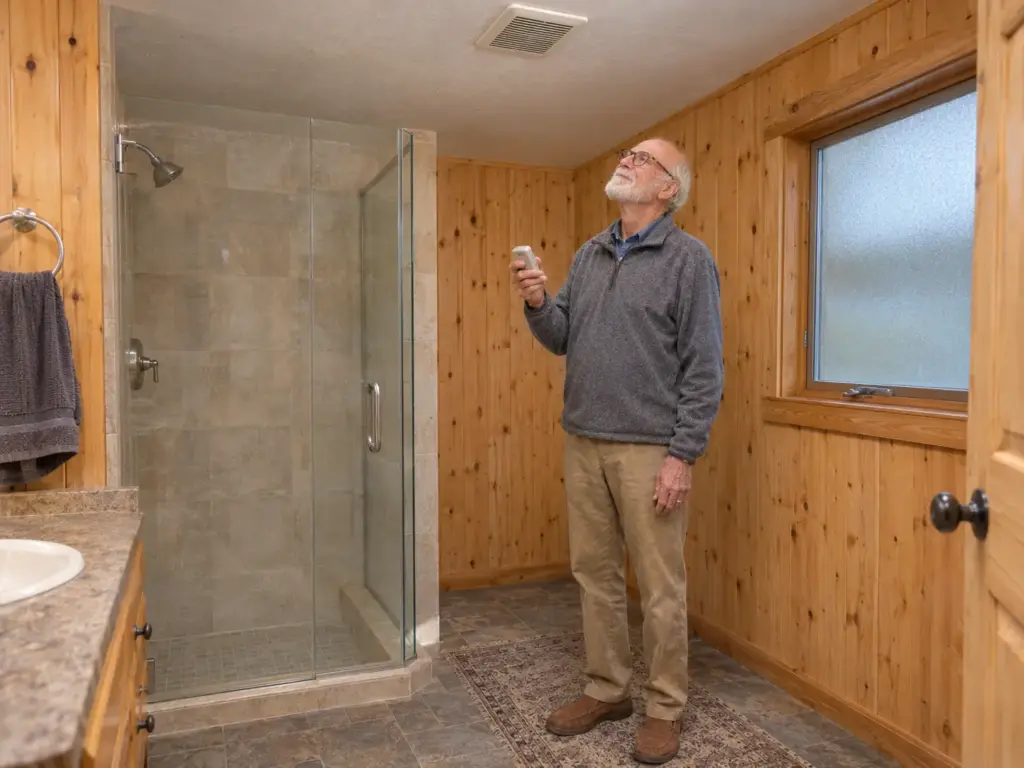
Two Rooms, One Evening: the 16 and the 26
The test is a comparison made under identical weather: the same evening, the same outdoor temperature, one room against another, and the house against what a neighbor’s meter reads or against the same week a year ago. A gap between two rooms that stays the same all week means the air is arriving from, or leaving to, somewhere specific; a gap that moves with the weather is winter.
The room that reads lowest points at where air is leaving or being replaced, so the comparison between two rooms tells more than the single lowest number does, and a second reading a week later says whether the gap is steady. A low absolute number alone cannot say that, and how low is too low for the house itself treats the question from the house’s side.
The Sources That Are Not the Weather
The usual suspects are mechanical. A bathroom exhaust fan or a dryer that vents into the attic or the crawlspace instead of outdoors moves house air out in a steady stream. Duct leaks in the ductwork of an unheated space do the same job quietly.
An open chimney damper, an attic hatch that does not seal and window and door frames with worn weatherstripping that let cold air in all replace the house’s air with the driest air of the day. The fans and leaks to check first when the number is low gives that list in order.
A house that already owns a whole-house humidifier adds a fourth suspect. A scaled humidifier pad, a stuck solenoid or a humidistat that is not calling for water produces a reading no different from the neighbors’, which is the picture of a house with a unit that does nothing. What to check when the furnace unit is on and the reading does not move goes through it. The fan, the duct and the pad are the building’s problem, and a technician who works on the HVAC system is who sorts them out.
Before paying for a blower-door test, ask the local utility about a free or cheap energy audit, and have an infrared pass run over the walls. That is the order of money: the cheap look first, the expensive measurement after it points somewhere.
Tight House, Leaky House: Which Way the Reading Goes
A leaky 100-year-old house can sit near 20 percent all season even with help from a humidifier. A tight, well-insulated house with a fresh air system can end up dehumidifying in winter to stay under 50 percent. The number alone does not say whether the house is old or new, which way it is off, or whether anything is wrong.
That is why the pair of numbers from the section before matters more than either one alone. The same reading on the same 20°F night can be a tight house sitting at its ceiling or a leaky house holding on with help, and only the comparison with the rest of the street tells them apart.
The Free Moisture Already in the House
Once the pair of numbers says normal winter, the question is how hard to chase it. The ordinary house has moisture to put to work before any money is spent, and it pays to be exact about how few points each source is worth.
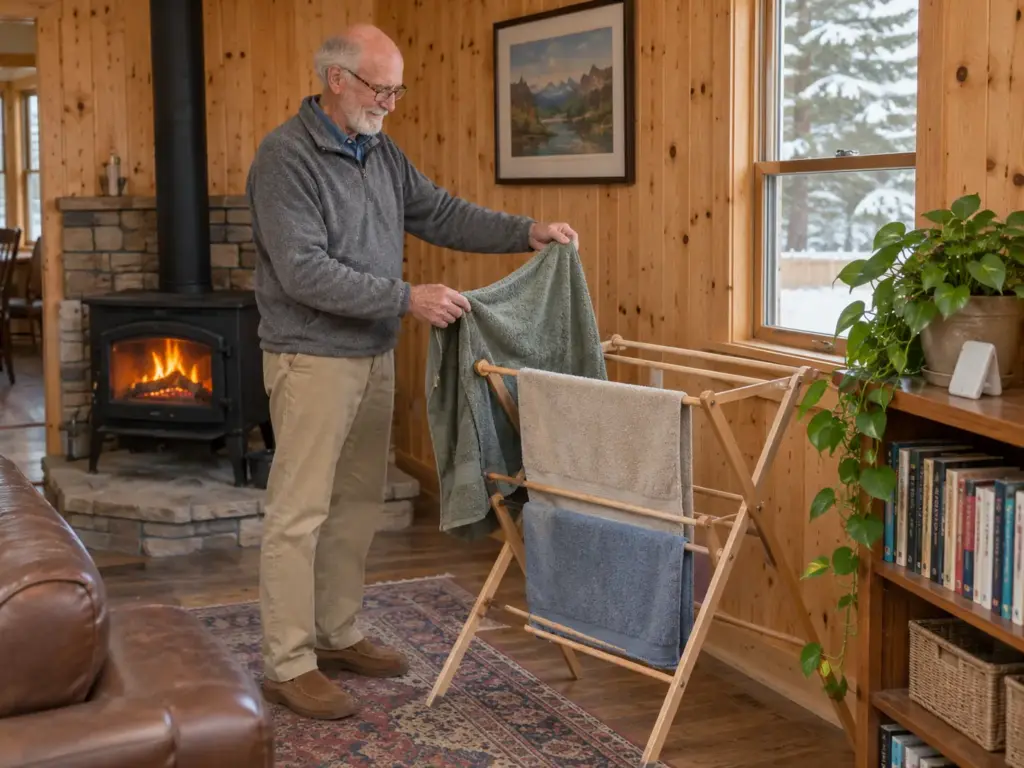
Close the Gaps That Swap the House’s Air
Start with the paths, because cold air replacing the house’s air is what drags the number down. Air leaks at window and door frames (weatherstripping is the cheap cure), the attic hatch, a chimney damper left open, a dryer that runs and exhausts: close or reduce one, then read the meter again before touching the next. A change you cannot attribute is a change you cannot repeat.
An open window is the next thing most people try, and in a cold snap it swaps humid house air for the driest air of the day, so the reading falls. Whether cracking a window helps is settled in its own guide.
Use the Water the House Already Makes
A shower door left open after the shower, a rack of damp laundry, the transpiration of a few houseplants: each lifts one room by a few points for a short while, and none of them lifts a house. A pot of water on the stove belongs in the same class; it is a few points for an hour, not a humidifier.
The scale is worth stating plainly. A portable humidifier running in one shut room moves the meter a point or two, because walls, floors and furniture absorb water for days before the air reading follows. A week of running is the fair test, not one night. And holding a New England house at 40 to 45 percent with a console evaporative unit goes through three to four gallons of water a day, which is also above what the EPA’s table allows at 0°F: the water is the honest price of the band, and the free fixes come first for that reason.
Why Turning the Thermostat Down Does Not Fix a Low Reading
Lower the thermostat and the percentage rises, because cooler air holds less. The amount of water in the air has not changed at all, only the air’s ability to hold it. A lower thermostat therefore trades a low reading for a colder house without moving the number that matters.
The loop runs the other way too: a drafty, dry house feels colder, the thermostat gets turned up, and the percentage falls further. Why the thermostat gets turned up and what that does follows that loop, and why the furnace removes no water covers the mechanism underneath it.
One Room or One Floor, Sized by Gallons a Day
The free fixes have run out of reach when the reading stays low a week after they were done. A device has to be sized by what it puts into the air in a day, not by the tank it carries, and the right size is a room or a floor, not a house.
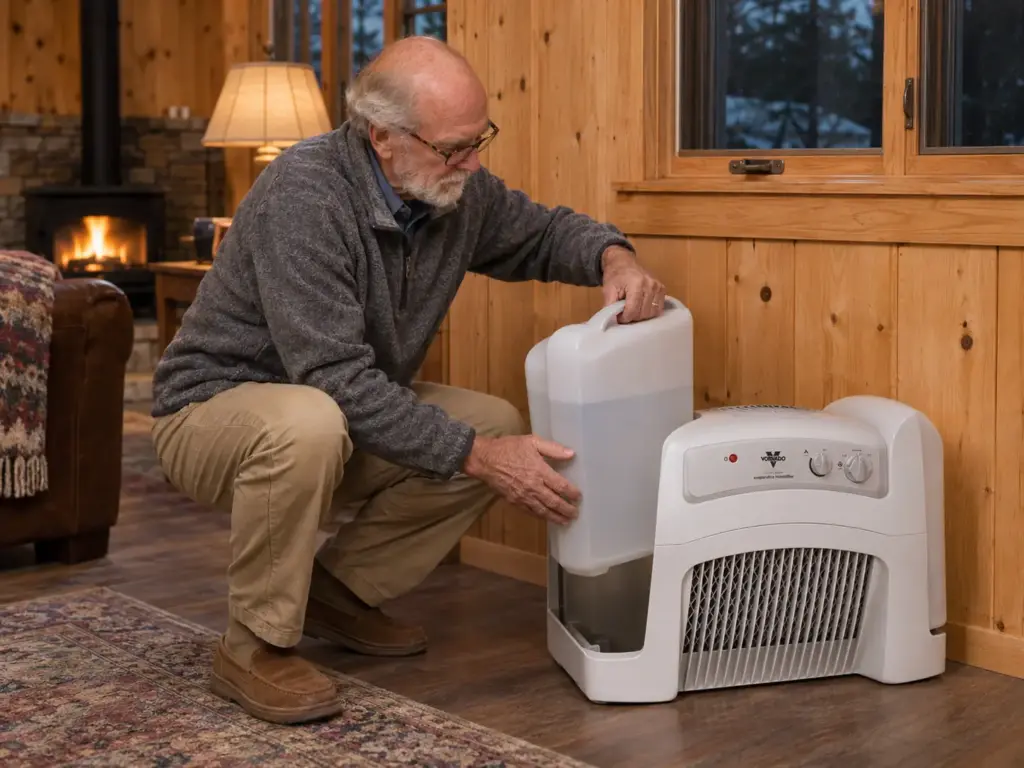
One Closed Bedroom: Warm Mist for a Night
For one closed bedroom, the Vicks Warm Mist Humidifier V745 is the simple answer: one gallon, no filter to buy, a rating of up to about 600 square feet and roughly twelve hours per tank. It draws 248 watts, so a full night is about 3 kilowatt-hours; multiply by your rate for the running cost of a night. The warm mist keeps mineral dust out of the air when the tap water is hard.
It has no humidistat of any kind: on or off, nothing to set and no way to stop at the band, so the meter on the shelf is the only control and the plug is the switch. In a shut bedroom the reading usually moves a point or two overnight, and the week-long test from the last section applies in full.
Count tank refills per day for the first week. Refills times tank size is the real output of the machine in the real room, and a number that falls day by day is the sign that the walls and furniture have stopped soaking up the water.
A Floor or a Big Room: the Evaporative Unit With a Dial
The Vornado Evap40 lifts a floor rather than a tabletop: evaporative, a dual tank that holds 4 gallons, up to 1,000 square feet, three fan speeds and a dial humidistat that stops it at a setting. Tap water is fine and there is no white dust. It runs at 48 decibels on high.
The tanks are too narrow to reach into for washing, and a glug every few hours is part of the sound. The setting dial is only as dependable as the motor behind it, and month four is when a weak one tends to give out.
An Open Plan or a Whole Floor: Output in Milliliters per Hour
The Levoit Superior 6000S is the only unit here that prints its output in milliliters per hour, 1,500, and its sensor accuracy, ±5 percent. That is about 0.4 gallon an hour at full output, so its 6-gallon (23-liter) tank lasts about 15 hours at that rate; the maker’s 72 hours is for the low setting. A 12-by-14 bedroom, 168 square feet, is a small fraction of its 3,000 square-foot rating, which makes it too big for one room.
Volume is what swallows the water. Three large portables in a house with a vaulted great room barely dent a reading sitting in the low twenties, because the air they are working on is too much for their combined output. The 6000S is built for that kind of space. It is heavy when full and stands 26.8 inches tall, so it is a floor appliance; the Vornado above does the same job when the room is smaller than this rating.
Which device fits depends on whether the water should be carried or piped, and a room humidifier against a whole-house unit is the decision that comes after this one.
The Whole-House Unit and What Month Two Does to It
The floor unit has a ceiling, and it is the whole house. A furnace-mounted unit is the answer only when the ducts and the reason are both there, and every device in this article tells the truth in its second month, not its first week.
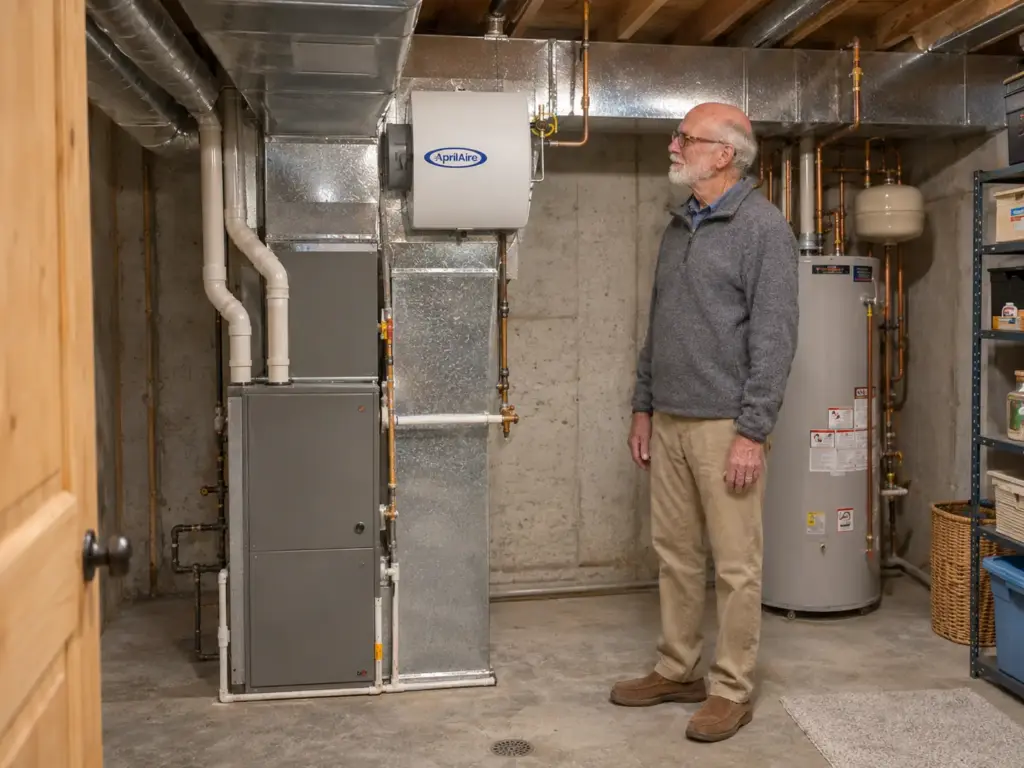
When the Ducts and the Reason Are There
The AprilAire 600 is a bypass humidifier, the whole-house kind, that mounts on the furnace duct: 17 gallons a day, up to 5,000 square feet of a tightly built house, a model 35 water panel, and an automatic control with an outdoor sensor. That control tracks the temperature outside and follows the EPA’s ceiling instead of a fixed dial. It makes sense when the house has ducts, the reader is tired of carrying water, and the first four sections have said the reading is a house reading.
The automatic control is the part that reads mixed, and some units arrive with parts missing. The panel is a yearly consumable the dial cannot skip. Without ducts, a console evaporative unit such as the Levoit does the job, because the whole-house unit is not the upgrade of the room unit. In a well-sealed home with a fresh-air system the problem flips and the house may end up dehumidifying in winter, in which case this section is not for it.
The Water Panel Is the Consumable
The water panel is replaced about once a year, and an indicator light says when. It is also the part hard water destroys first, and a scaled pad is the most common reason a house with a whole-house unit reads like one without it.
Every device in this article has a month-two version of the same story. Evaporative humidifier wicks need washing on a schedule; the Levoit’s own care text asks for the wick every two weeks and the tank every three days. An ultrasonic humidifier leaves mineral deposits as a white film on whatever is nearby. And the indicator light is not the same thing as the panel passing water: a white crust on the pad, or a reading that stops following the dial, shows up earlier.
Look at the pad itself two or three weeks into the season. White crust on the surface is a scaled pad, and it means the reading will soon stop following the dial even though the light is still off.
The Setting Has to Come Down on the First Hard Night
The reading finally follows the machine around the second week, once the walls and furniture have stopped taking in the new water. That is also when the setting has to come down for the next cold night, because a setting that never came down leaves the water on the glass instead of in the air. The EPA’s rule, printed on the sill instead of the dial.
What to set the dial to when it lies covers the number to start with once a unit is in the house.
Read the Meter Tomorrow Morning, Then Again After the First Hard Freeze
Dry indoor air is the ordinary condition of a heated house in winter, and the ceiling follows the outdoor temperature down to 25 percent at 0°F. The reading is a pair of numbers taken on the same evening in more than one room. A house far below the rest of the street has a source, and some of those sources belong to a professional. The free fixes are small and come first, a device is sized by gallons a day, and the second month is when the pad, the film and the setting decide how the season goes.
Read the meter again after the first deep cold snap, when the outdoor temperature falls and the ceiling falls with it. Two or three weeks into any humidifier, look at the glass and at the pad: water on the lower corner of the window means the setting is overdue to come down, and a crust on the pad means the reading is about to stop following the dial.
Tomorrow morning, put the meter in the room, write the outdoor temperature beside it and compare the two against the EPA’s table. After any change, take the same reading the next morning, from the same shelf. If the number is normal, you are done; if it is low and the house needs a device, choosing between a room unit and a whole-house unit is where the sizing and the flaws are set out in full.
Frequently Asked Questions
01Does humidity drop in winter?
Outdoors the percentage is often high, but the air holds very little water, because cold air is a small bucket. Indoors, heating that air makes the percentage fall: an ordinary heated house reads in the mid-teens to low twenties on the coldest days.
02Why is cold air dry?
Cold air can hold far less water than warm air, so what it carries is small even when the percentage reads high. Warming it to room temperature adds no water, so the percentage falls without a drop leaving the room.
03Is 63% humidity in a house a good level?
No. The EPA says to keep indoor humidity below 60 percent, ideally between 30 and 50, and in winter a reading of 63 means water on the glass and a setting that is too high for the outdoor temperature.
04Is dry air common in winter in a tight new house too?
Less so. A well-sealed, insulated house with a fresh-air system holds more moisture and may even need to dehumidify to stay under 50 percent, while a leaky old house can sit near 20 percent all season.
05Does keeping the AC on reduce humidity?
In cooling mode, yes: the coil pulls water out of the air as it cools it. A house in winter is not cooling, so the air conditioner is not the reason the number is low then.