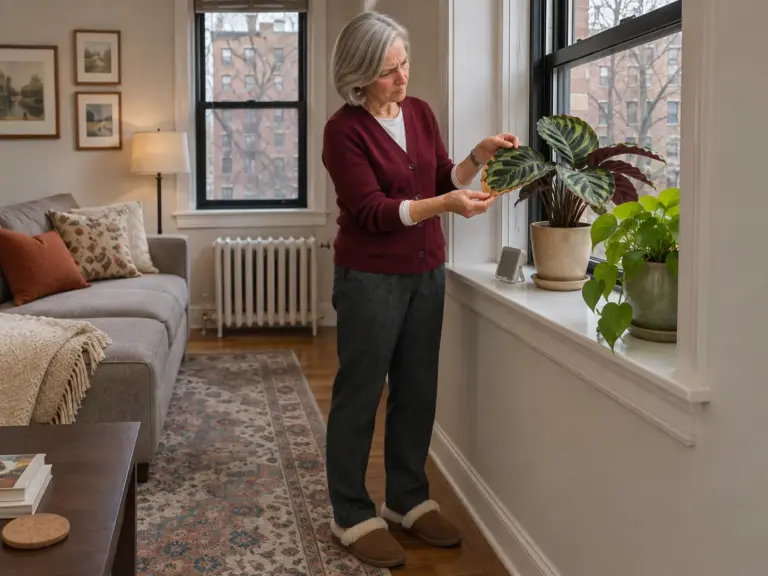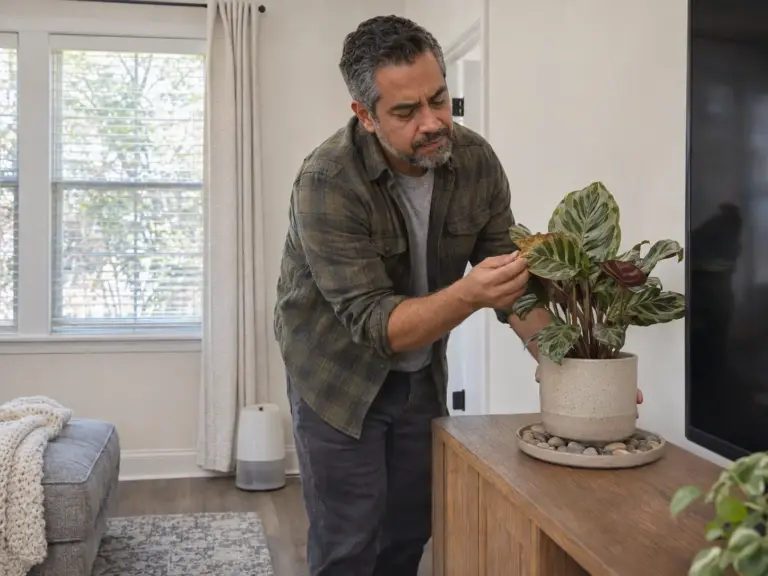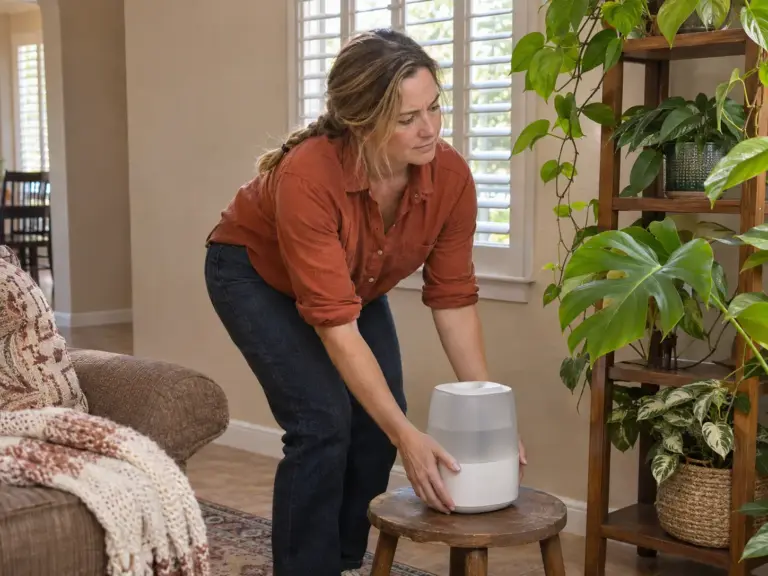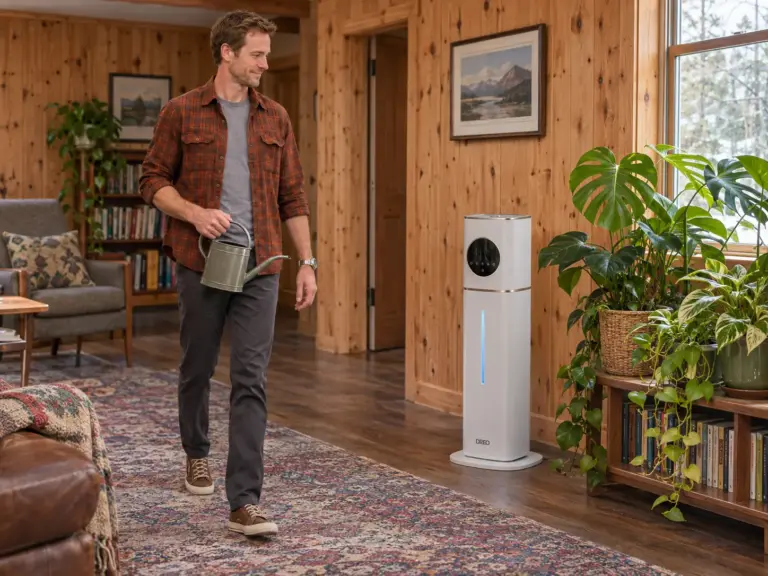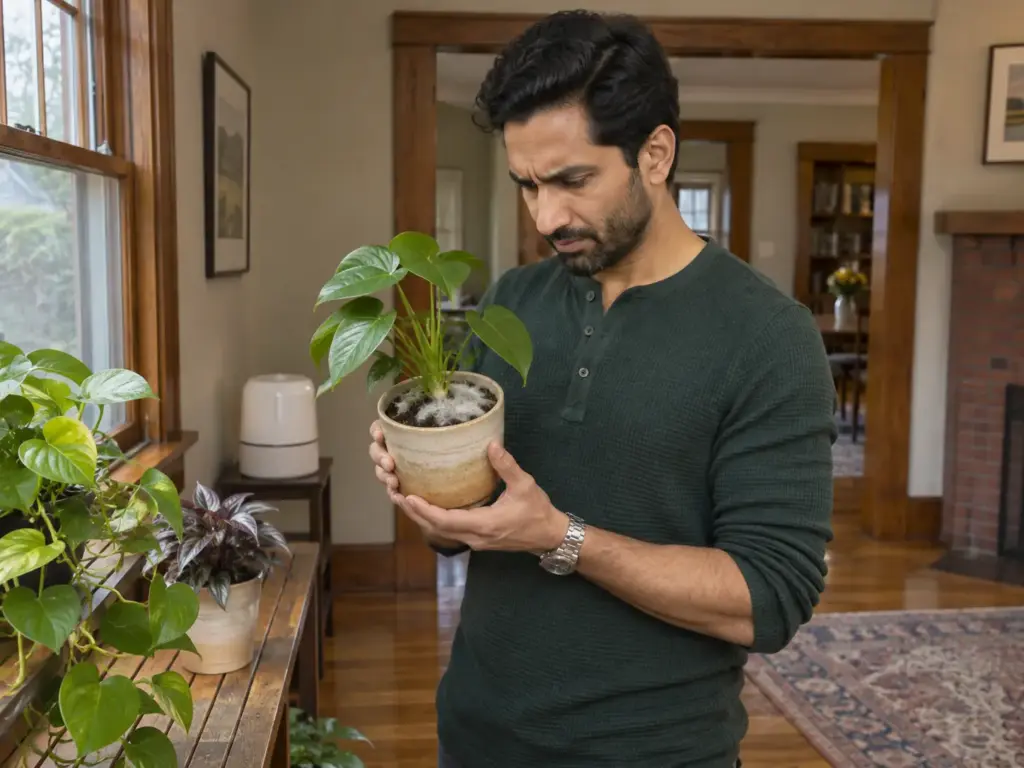
You moved a humidifier next to the houseplants three weeks ago, and now two pots wear a fuzzy white film on top. The machine is the newest thing in the room, so it takes the blame, and the first impulse is to switch it off or shop for another one. Whether humidifiers for plants cause mold has a short answer and a longer one: the mist is water vapor, and mold needs a surface that stays wet.
In a plant room the top inch of the potting mix stays wet on the watering schedule whatever the room reads, while a humid room only wets a wall or a pane when that surface is colder than the room’s dew point. The sections below take the pot first, then the reading at the leaves, the glass behind the shelf, which mist lands on the leaf, what the machine itself does by month three, and when one shelf needs no machine at all.
Quick Answer
No. A humidifier adds water vapor, and mold needs a surface that stays wet. In a plant room that surface is usually the potting mix, kept wet by the watering schedule, the saucer and the cachepot. The room’s air only wets the coldest glass or wall, and only when the room sits above about 50 to 60 percent relative humidity.
The Mist Is Vapor, and Mold Needs a Wet Surface
The film looks like the machine’s work because the machine is the thing that changed, but what a humidifier puts out and what a film needs are two different things. The unit is in the room for a reason (why a dry room is hard on the plants in the first place), and the reason an indoor plant shelf got a humidifier still stands. What has to be settled before anyone touches a dial is which surface in the room stays wet.
What Mold Actually Needs
Mold begins when spores land on a wet surface, and none of it grows without water or moisture. A material that is wet and then dried within 24 to 48 hours will, in most cases, never grow mold, a rule that sits in the EPA’s mold and moisture guidance for a home. That window is the whole game, and how quickly a wet surface turns into growth is easier to see on a bedroom wall than on a pot.
A humidifier supplies vapor, and vapor is not a wet surface. Air only wets something when that something is colder than the room’s dew point, which is why the glass behind the shelf matters later in this article and the mist itself matters much less than it looks.
The Fuzz on the Top Inch of the Pot
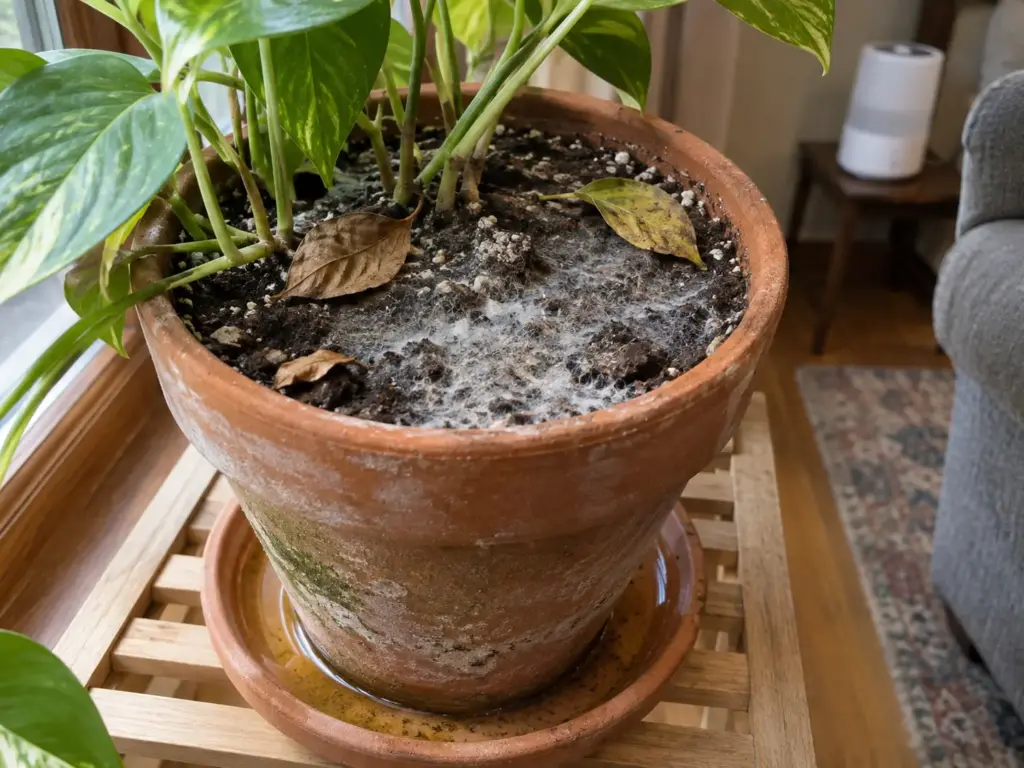
What gets called white mold on soil is a fuzzy growth on the soil surface, and the extension service sorts it into two kinds.
On potting mix, fungi form a white to grayish layer under moist conditions and algae form a greenish one. Both are described in the University of Maryland Extension’s note on growth on potting media, which says plainly: “Their growth isn’t usually detrimental to plants.” A flat, dusty film can be left alone. A fluffy mat deserves a fork.
A mat stops being cosmetic when it dries crusty and blocks water from soaking in, and when it starts feeding fungus gnats and shore flies. The film usually starts on the dead leaves lying on the surface, and on the pots potted before the mix was lightened. Pots with a heavy, dense mix are the ones that hold their surface wet longest.
The Two Places the Water Can Come From
Picture a shelf where every pot grew something in three weeks while the walls, the sill and the bathroom grew nothing. The water is coming from the pots. A film that shows up on pots alone points at the watering can, the saucer and the drainage.
Water on the glass, the sill or the frame points at the other source: the room’s air, meeting a surface colder than its dew point. One reading tells which source is at work, and the two fixes do not overlap. The pot side comes first because it is free and it is the likelier one.
The Pot Is the Wet Surface More Often Than the Room
If the film is on the pots and nowhere else, the free fix sits in the watering can, and no humidifier setting will make it for you. The steps below run in the order to try them, each with the reading it should leave, so the room’s number in the next section is taken on pots that have had their chance to dry.
Let the Surface Dry Between Waterings
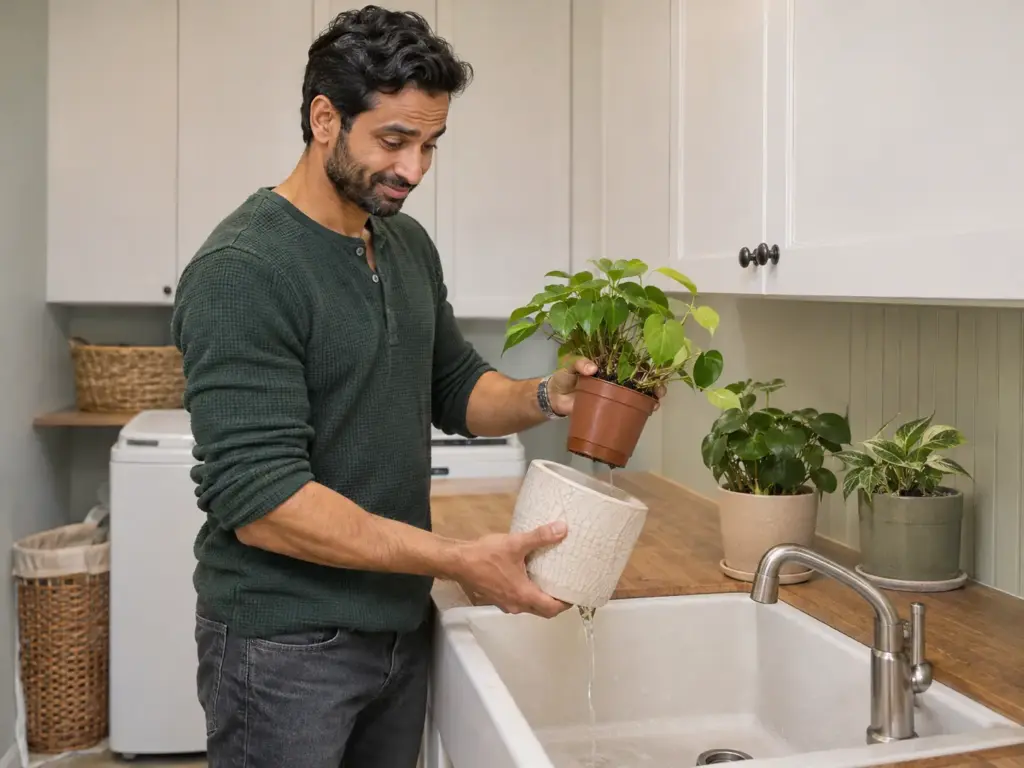
The frequency keeps the surface wet, far more than the volume does. A small fixed amount on a fixed day means the top inch never finishes drying before the next dose arrives, so the pot grows a fresh white mat every few days. That is overwatering by schedule, and it happens even with a fan running and a spray bottle of surface remedies at hand. Stop watering by the calendar and water when the top of the mix has dried, so the surface gets the chance to air dry, which is also what the extension service lists first: let the surface dry between waterings and keep air moving between the pots.
If a mat has already formed, break it up with a fork or lift the top layer off. The reading to expect over the next one to two weeks is a paler, drier surface and a film that returns smaller, if at all. A plant that wilts between waterings has overshot, and the watering day moves back by one.
The Saucer and the Cachepot Hold the Water the Pot Drained
A plastic pot dropped inside a decorative cachepot with no hole turns the cachepot into a bowl at the bottom of the pot, and the saucer that has not been emptied since the last watering does the same job. Lift the pot out, empty what it drained, and put it back only when it has finished draining. A pot with no drainage hole at all gets the same fix in a worse form, because the water has nowhere to go.
The reading to take afterward is the underside of the pot and the floor of the cachepot on the next watering day: both should be dry. If they are not, the pot is still being fed from below.
A Chunkier Mix and Moving Air
A chunkier, perlite-heavy mix dries at the surface faster, and the pots that grow the mat are the ones potted before the mix was lightened. Repotting is the heavier move and it belongs after the watering day and the saucer have had a few weeks. Air moving between the pots helps a little, and not enough when the water is coming from the pot, which is the usual result of putting a fan in front of a wet surface.
A mat that returns after being scooped off and after surface remedies is a mix that never dries, not a spore problem. After a few weeks of a fast-draining mix and real airflow, the growth goes back to a patch the size of a dime and stays there. That is the outcome to expect, and a sterile pot is not.
Heft a pot the day after watering and again three days later. A pot that still feels heavy on the third day is the one whose surface will stay wet, and the pot to move to a lighter mix first.
Read the Room at Leaf Height Before You Touch the Dial
With the pots drying properly, what remains is the room, and that is one reading taken at the leaves, never at the machine. The unit’s humidistat only knows the air at its own housing, and that spot can sit several points away from the shelf.
Four Numbers That Disagree, and Which One to Obey
The numbers in circulation for a plant room do not agree. The EPA’s house band is below 60 percent relative humidity, ideally 30 to 50 percent. The EPA’s page on running a humidifier is stricter, and the EPA’s walkthrough on running and cleaning a humidifier says it in one line: “Do not humidify to indoor relative humidity levels exceeding 50 percent.”
The CDC’s home humidity guidance agrees on the ceiling, no higher than 50 percent, all day. And the tropical-plant advice asks for 60 percent and above, a figure that what the plants themselves ask of a room caps for exactly this reason.
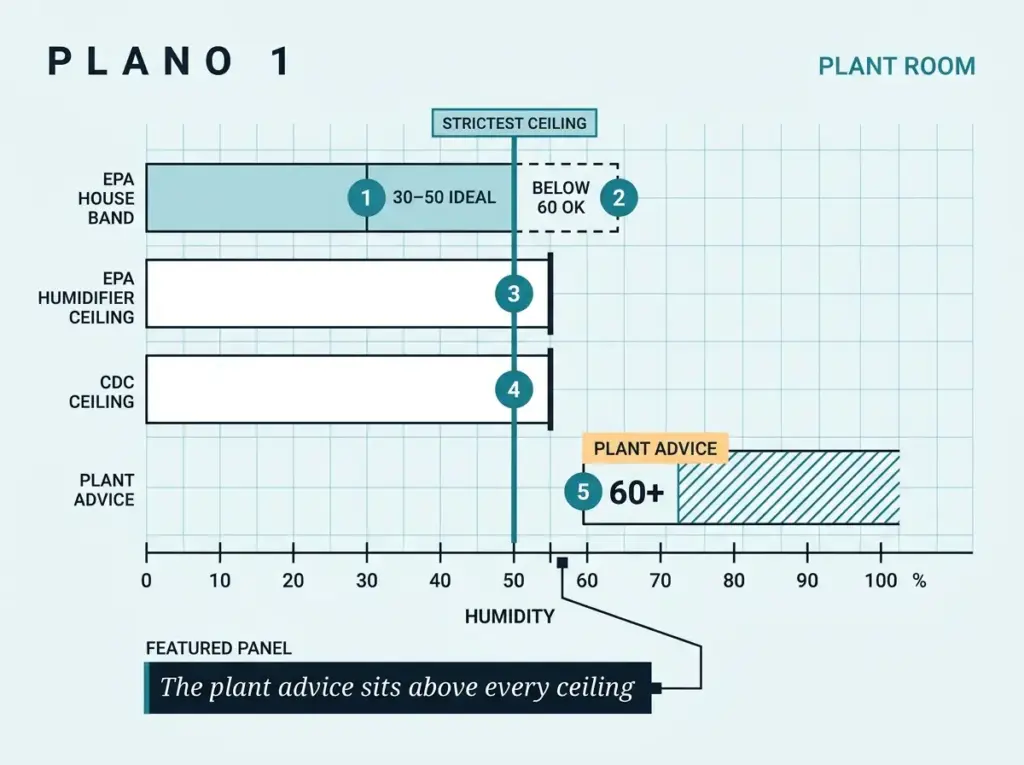
When pots and a humidifier share a room, the stricter ceiling is the safe one to obey: 50 percent. The plant advice sits above every agency number, so a room that chases it ends up past the point where the coldest surface starts to sweat.
What the Reading Tells You to Do
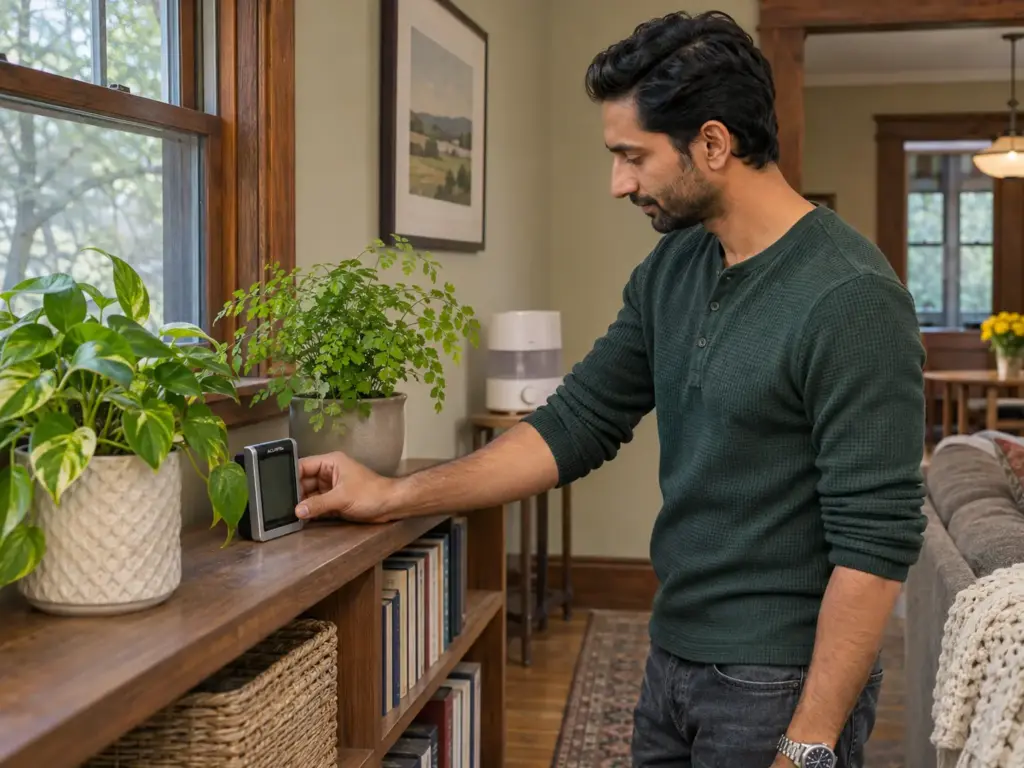
Take the reading where the plants live: on the shelf at leaf height, out of the unit’s output, and read the day’s high and low instead of the instant number (how to take the reading at the shelf, three places and one meter). The humidifier’s own display and a meter two feet away at the leaves can differ by several points, and the meter at the leaves is the one the plants live in.
Then act on what it says. Over 50 percent: lower the dial or move the unit. At or under 40 percent: the room is not the problem and the humidifier is cleared. In between, read again after the pots have had a week or two of proper drying.
The cheapest way to see the high and the low is a small meter with a memory (the room monitors worth a look), such as the AcuRite 00613 thermometer and hygrometer. It keeps the two numbers a humidistat hides: the peak at night with the unit running and the dip by day with it idle. Readings differ from one unit to the next and some units stop working within days, so a second meter on the same shelf settles any doubt.
What a Cheap Meter Cannot Tell You
A small meter reads conditions and never the growth itself. A shelf at 45 percent with fuzzy pots has already answered the question: the pot is the surface. A shelf at 58 percent with clean pots and a sweating window has answered it the other way.
Set two meters side by side for a day before trusting either, and treat a single reading that jumps several points as a failing unit.
If one end of the shelf reads several points above the other, the room has a still corner. That corner is where the pane will sweat first, and where the next pot to go fuzzy will sit.
Why 60% for the Plants Can Wet the Window Behind Them
The number tropical plants want is the number the coldest surface in the room cannot take, and the dial cannot tell which surface that is. This is the one place where the room’s air does wet something, and the move is airflow and distance from the glass, with the plants left as they are.
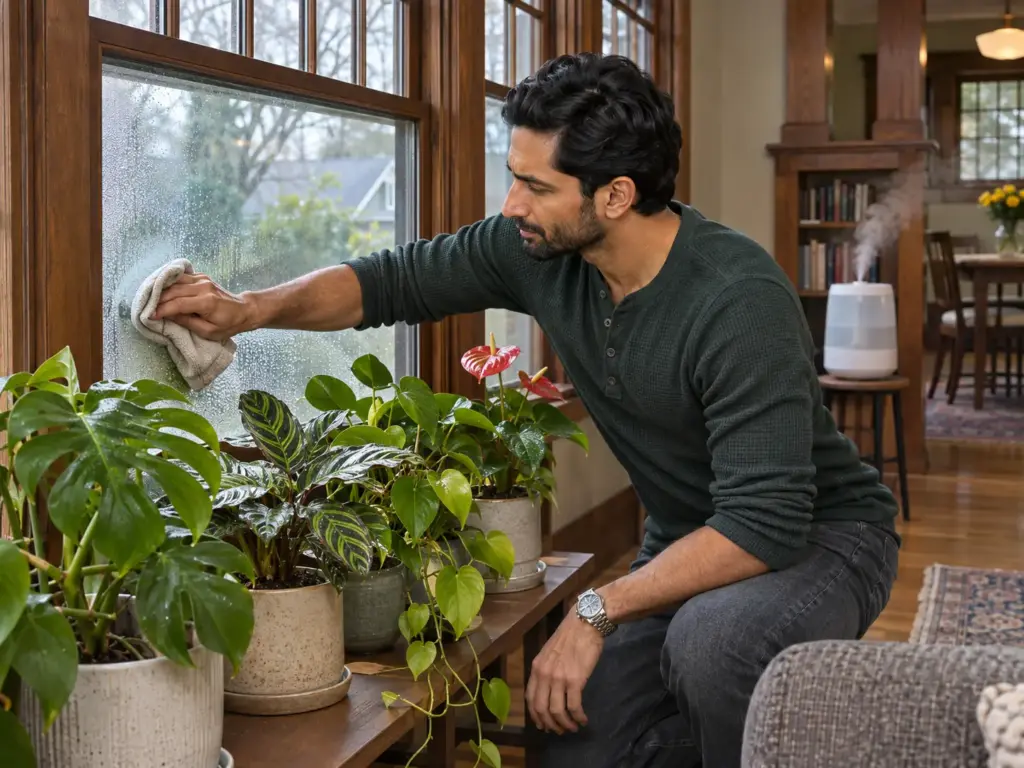
The Pane Behind the Shelf Is the Coldest Thing in the Room
A room at 70 °F (21 °C) and 60 percent relative humidity has a dew point near 55 °F (13 °C), a figure from the psychrometric relation in the ASHRAE Fundamentals handbook. Any surface colder than that, window glass or a cold wall, collects water. Single-pane glass on a 30 °F (-1 °C) night is wet for hours, and a 65 °F (18 °C) wall behind the same shelf is not.
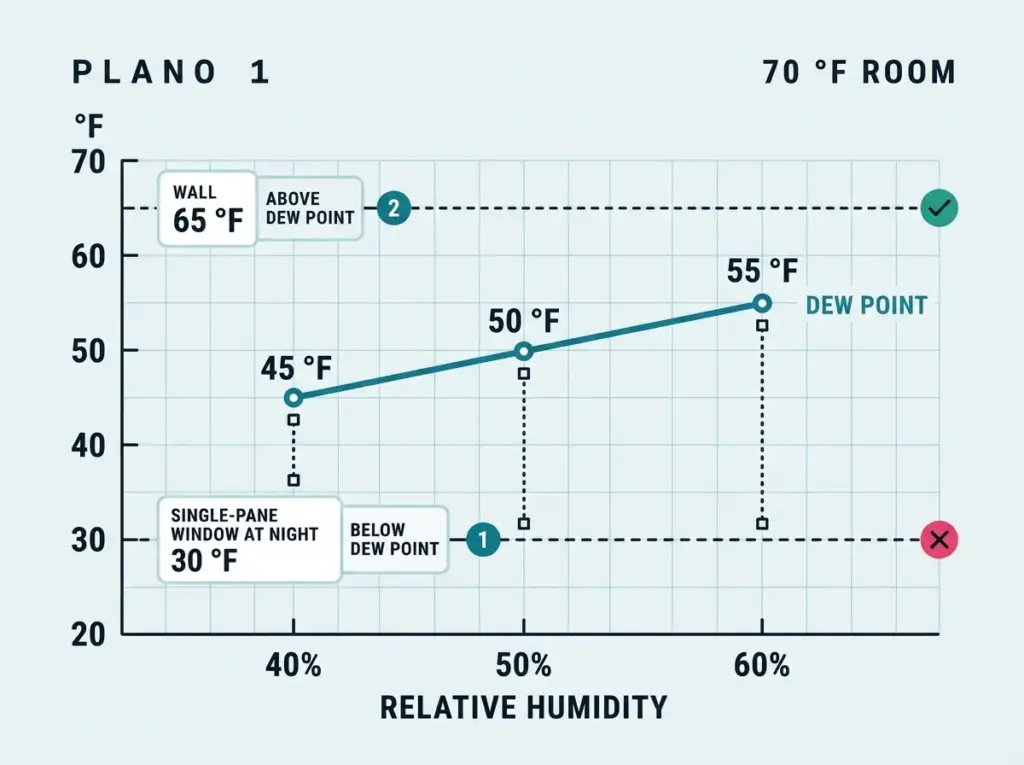
The glass fogs first at the lower corner, where the air is stillest and coldest, hours before a wall shows anything (why the glass sweats on the room side in winter). The EPA’s instruction when water condenses on windows, walls or pictures is to move the unit or lower its humidistat. The free move behind that instruction is airflow and the distance between the shelf and the glass.
The Wipe Test, and What a Wet Pane Does Not Mean
Wipe the pane and look again later. A pane that stays dry is a wet pane that dried, and a wet pane is a reading and nothing more. Growth on the frame or the sill that comes back after wiping is the case to take seriously, and when condensation on a window is only water and when it stays draws that line in more detail.
The plants do not need the machine pointed at the glass. They need the reading at the leaves, and a unit that fogs the window has been given a number the room cannot carry.
When the Wall Stays Damp, It Is a Building Question
If a wall stays damp with the machine off for days, or a leak sits behind the plants, the source is the building and the answer is a building professional, not a smaller humidifier. Cold, still or wet, the same three causes on a bedroom wall apply to a wall behind a plant shelf as much as to a bedroom, and a single high reading is worth tracing with how to find where a high reading is coming from before the machine takes the blame for it.
Which Kind of Mist Lands on the Leaf
Once the room’s number is known, the type of humidifier decides what the mist leaves behind on the soil and the leaves. The room wants the vapor, the plant does not want to be rained on, and the three types differ in exactly that.
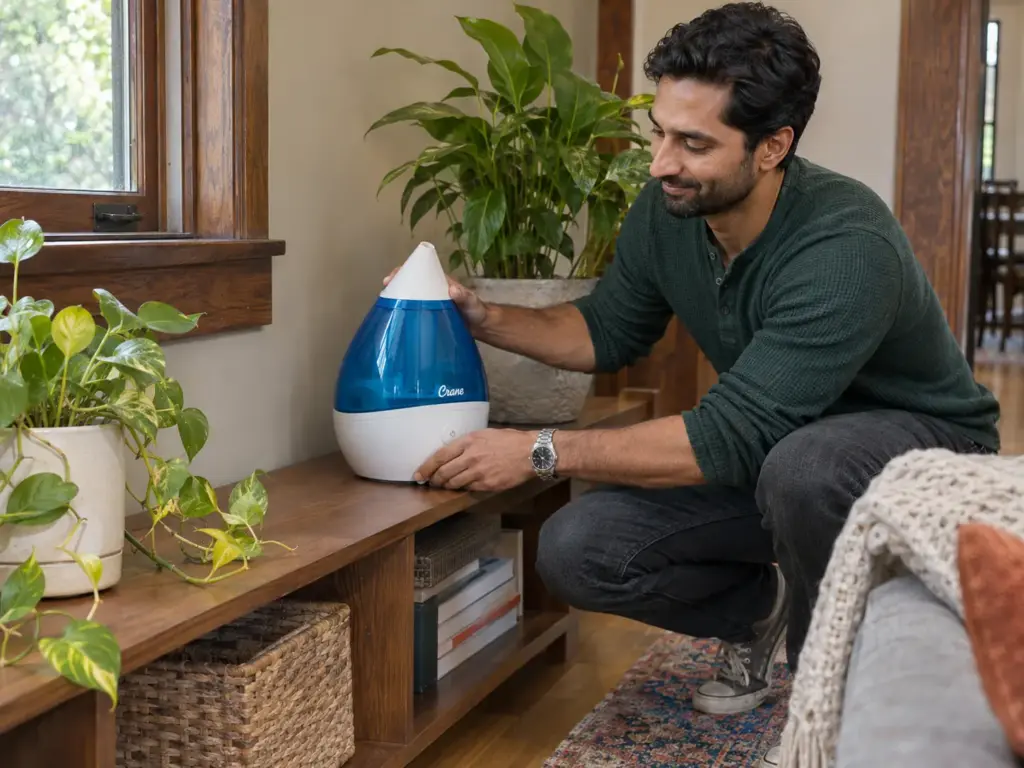
Ultrasonic Puts Droplets and Their Minerals in the Air
Ultrasonic and impeller units disperse the microorganisms and minerals in the tank water into the air, the EPA’s humidifier page says. The mist output of a small ultrasonic unit aimed along a shelf delivers that load to whatever stands in its plume, and the first leaf in the line is the one that dries last.
The Crane Droplet EE-5302 is the unit a plant shelf most often buys, a 0.5 gallon (1.9 L) ultrasonic cool mist model sold for plants and home, and it is the budget pick of this comparison. Durability is where it slips: a unit can break inside the first week or stop working after a month.
Warm Mist and Wick Units Put Vapor in the Air
Warm mist and evaporative units are the other end of the comparison. A warm mist unit is a type of steam vaporizer in the EPA’s terms, with the steam cooled before it leaves. Both kinds put water vapor in the air, and the EPA expects neither to disperse substantial amounts of minerals.
The Vicks V745 is a 1 gallon warm mist unit, filter-free, rated up to 600 square feet, drawing 248 W while it heats. It condenses inside the housing and not on the leaves, so it does not rain minerals on the mix. Leaks are what repeat with this model, noise is mixed, and some units fail after a month.
Which unit can keep up with a big room is its own question (the output each mist type can keep up with in a big room), and the answer shifts when the room is the only thing that matters at the shelf.
A Leaf That Stays Wet Is the Other Surface
A nozzle aimed at foliage leaves wet leaves and a damp top of the soil, and a leaf that stays wet is where leaf spots start. The University of Maryland Extension’s page on leaf spots names the remedies: lower the humidity, shorten the time a leaf stays wet, increase air circulation, water early in the day and space the plants so air moves between them.
Tape a strip of card at leaf height in the mist’s path. If the strip is damp an hour later while the room reads under 50 percent, the plume is landing on the leaf, and the unit moves along the shelf instead of the dial moving down.
What the Humidifier Does Cause by Month Three
The machine does not make mold in the room, but it makes three things if it is left alone, and none of them shows in week one: scale, a tank that was topped up and never emptied, and a wick that stays damp between runs.
The White Film and the Crust Are Not Mold
With an ultrasonic or impeller unit and tap water, a white dust settles on surfaces. Distilled or demineralized water, or a demineralization cartridge, is the remedy, because scale inside the tank is itself a surface that microorganisms grow on. The same minerals land on the leaves as a film and on the soil as a crust.
A white crystalline crust on the soil or the pot rim is mineral and fertilizer salt from hard water, and it can burn plant tissue. The extension service’s fix, in the University of Maryland Extension’s page on mineral and fertilizer salt deposits, is a leach with at least three times the pot’s volume of water every 4 to 6 months. A hard crust that does not give under a fork is mineral. A soft gray mat is the growth from the first section.
A Tank That Is Topped Up Is a Culture
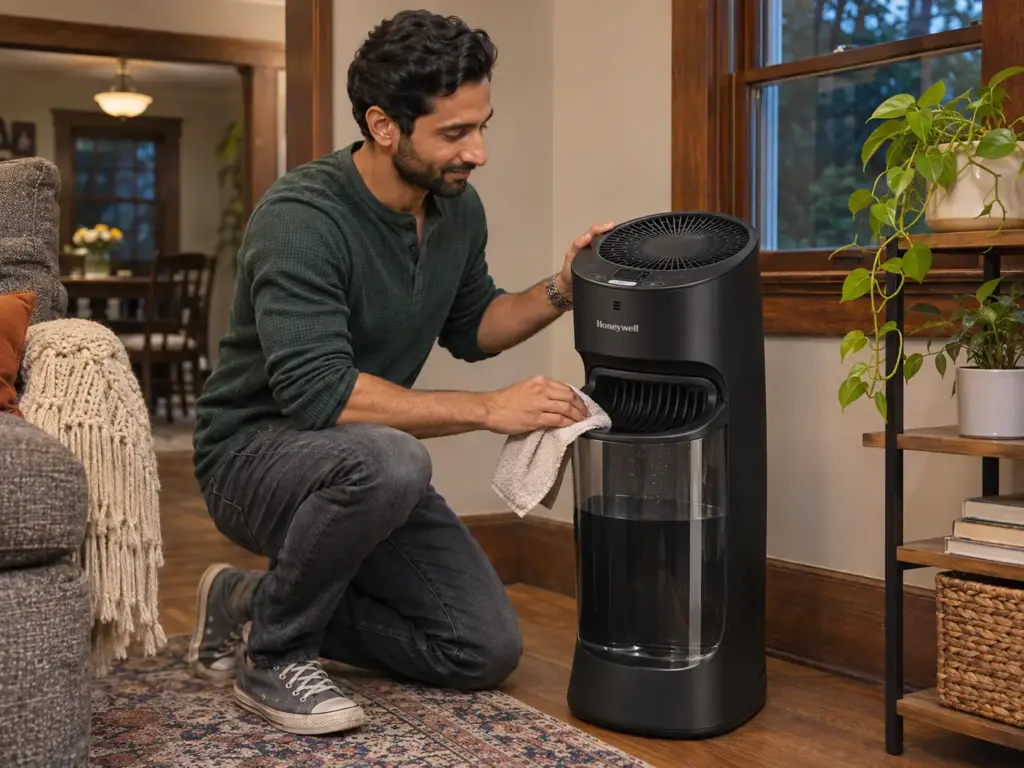
The EPA’s cleaning schedule is counted in days: empty the water tank, wipe it dry and refill daily, and clean the whole unit every third day by the method in the maker’s manual. A reservoir that is only topped up never gets empty and ends up holding stagnant water, and that is the one part of this problem the machine causes by itself. By week three the waterline carries a film that wipes off on a cloth.
Where the manual names no cleaning product, the EPA says to clean every surface that touches water with a 3 percent hydrogen peroxide solution, then rinse the tank through several changes of tap water so none of it is left to disperse.
A Wick Left Damp Between Runs
An evaporative unit pulls water up through a wick, which makes invisible vapor and leaves the minerals behind in the wick. The wick that stays damp between runs, and then goes stiff, is a culture and no longer a filter. The pads are short-lived and get replaced on the maker’s interval.
The Honeywell HEV620B is the evaporative pick here, a 1.5 gallon top-fill tower with a wicking filter, a digital humidistat and a 12-hour timer, rated up to 700 square feet. Some rooms never pass 48 percent with it, the wick filters wear out quickly and the auto shut-off cycles on and off.
Keep a jug of distilled water beside the unit and use it for the tank only. The watering can can stay on tap water, and the white dust stops arriving on the leaves.
Airflow, Placement and When One Shelf Needs No Machine
A room humidifier raises the whole room, not the pot, and for one shelf of plants the cheaper local answer often beats it. This section covers the last free move, the placement that keeps the mist off the leaves and the glass, and the honest case for running no machine at all.
Air Across the Shelf, Not at the Pots
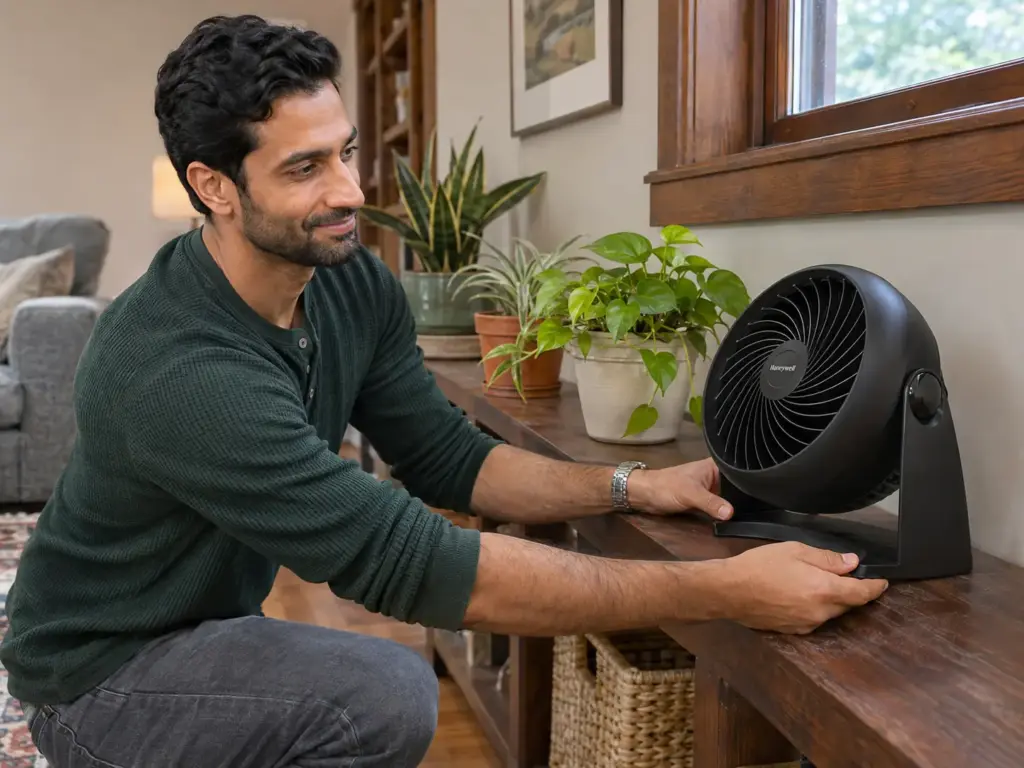
Air moving between the pots is what the extension service prescribes, and the smallest thing that does it is a tabletop fan on its lowest setting, aimed along the shelf. The Honeywell TurboForce HT-900 is a small tabletop room fan with three speeds and a 90 degree pivoting head, 2.6 lb. Fans die inside a year, so any fan the house already owns does the same job. A fan aimed at the pots blows the surface dry for a day and the film is back by the weekend.
Once the fan is running, the order to bring a high reading down, free fixes first takes over if the meter still reads above 50 percent. If it reads high with the unit switched off, the room needs a dehumidifier or an exhaust fan before it needs a different humidifier, and the plants are no longer the question.
Where the Unit Goes So the Mist Misses the Leaves and the Glass
Stand the unit a foot or more from walls and curtains, never inside a closed closet, away from the pane behind the shelf, with its output across the room and not onto the leaves. Wipe the condensation off nearby surfaces. A room unit cannot hold 60 percent at a shelf two feet from an open door in January without pushing the window behind it past the dew point.
The Shelf Where the Room Already Reads in the Band
A shelf two feet from a door that opens in January, in a room reading 40 percent, has plants that are fine and a machine that has been running for nothing. Whether the room reads low enough to need a humidifier at all is the question that comes before the purchase, and what to check when the meter reads dry covers the other direction.
For one or two plants, grouping them, spacing them so air moves between them and a pebble tray that is cleaned each week cost less and make less mess. When the room reads 40 percent that is the whole answer. The reading after the changes decides: if the room sits in the band and the pots dry between waterings, the machine is cleared.
Lift One Pot Out of Its Cachepot, Then Read the Leaves Two Days Later
The mist is vapor, and the growth needs a surface that stays wet. That surface is the pot more often than the room, so the watering can comes first: water when the top inch has dried, empty the saucer and the cachepot of what the pot drained, and keep air moving along the shelf.
The reading at the leaves says whether the room is the problem, with 50 percent the stricter ceiling to obey. The glass behind the shelf is where the room’s air does wet something, and the type of mist decides what lands on the leaf. The machine’s own mold is the tank and the wick, and the white crust is mineral.
Check the pots again after a few weeks of drying between waterings, and the tank and the wick on the EPA’s interval in days: empty and wipe the tank daily, clean the unit every third day, replace the wick when it goes stiff. A growth that settles to a dime-sized patch is a pot doing what it should.
Tomorrow’s first move is to lift one pot out of its cachepot and empty what it drained. Two days later, take the meter at the leaves. If the air reads fine and the soil is still fuzzy, the answer sits in the watering can. If the reading is high, the room’s own number and the plant-humidity guide come first.
Frequently Asked Questions
01Is the white stuff on my plant soil mold?
It can be a fungal film, algae or a mineral crust, and only the fuzzy white-gray or green layer is growth. A hard crystalline crust on the soil or the rim is mineral and fertilizer salt from the water.
02Should I stop running the humidifier if the soil is fuzzy?
Not before reading the room at leaf height and letting the pots dry out between waterings. If the reading sits at or under 50 percent, the humidifier is not the source of the film on the soil.
03Can a humidifier for plants cause mold on the walls and windows?
It can on the coldest surfaces when the room sits above about 50 percent. That is why the EPA says to move the unit or lower its humidistat when water condenses on windows, walls or pictures.
04Does humidifier mist make plant leaves get spots?
A leaf that stays wet is where leaf spots start, so keep the mist off the foliage and keep air moving between the pots. Water early in the day and space the plants so each leaf dries.
05Can I use tap water in a humidifier next to my plants?
With an ultrasonic unit, tap water leaves a white mineral dust on leaves and soil. The EPA names distilled water or a demineralization cartridge as the remedy, and scale in the tank is a surface microorganisms grow on.