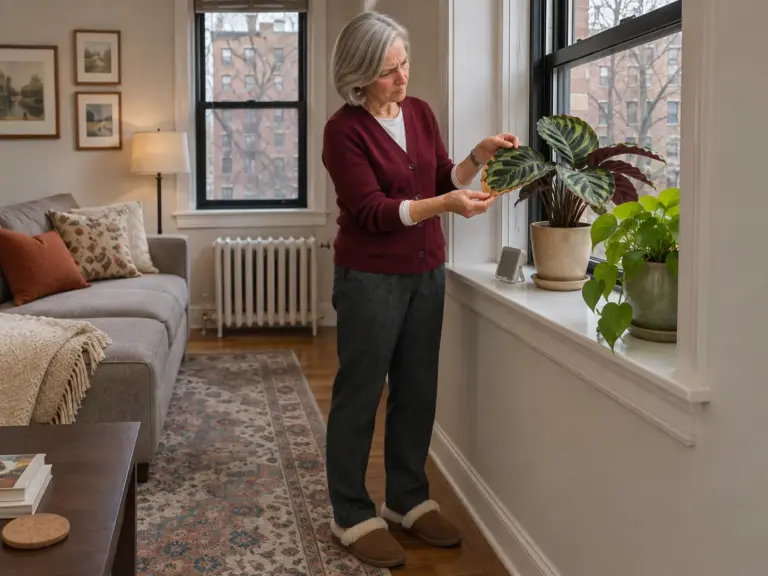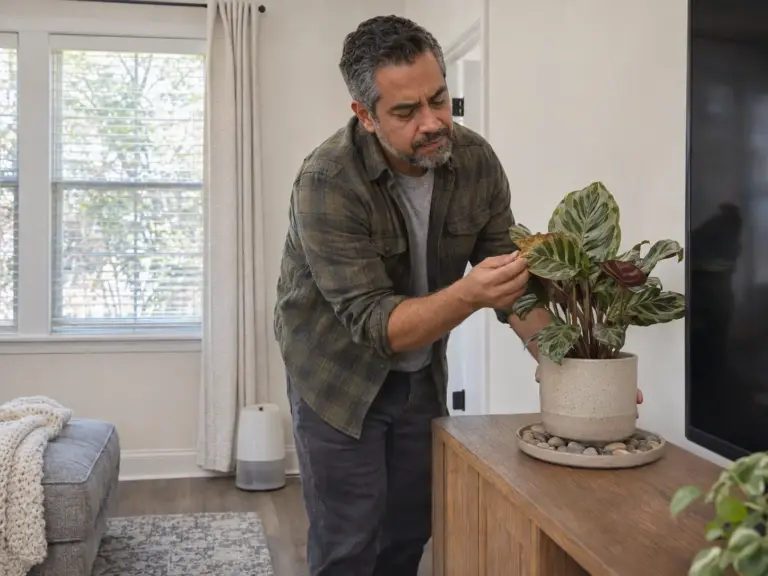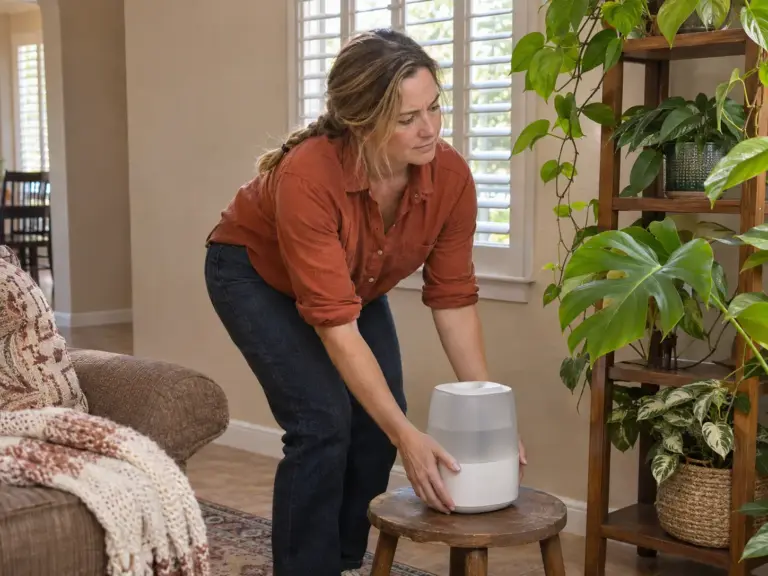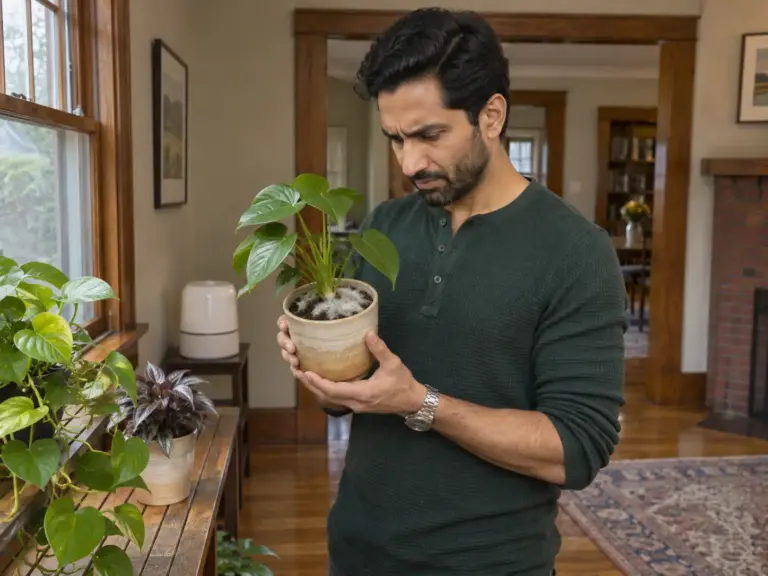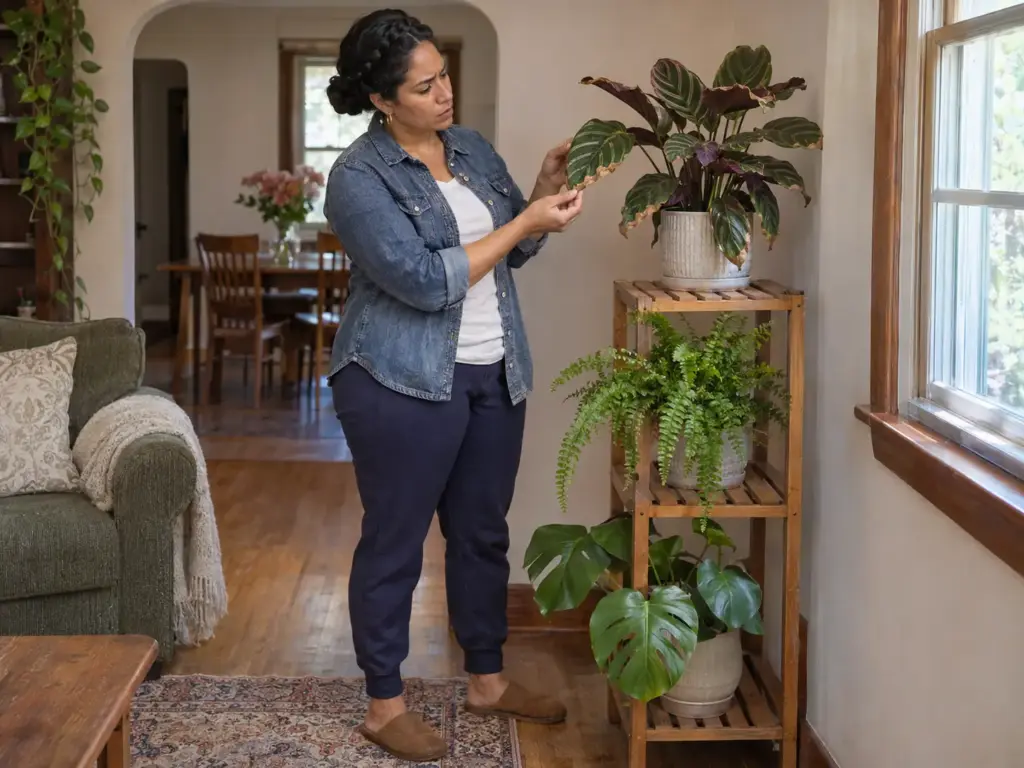
The label on a calathea says 70 to 80 percent humidity, the leaf edges have started to crisp in the first cold weeks, and the meter across the room reads a number the label never mentions. That is the moment somebody searches how much humidity for house plants, or how much humidity do houseplants need, and the answer arrives as two numbers that do not agree: most houseplants sit at 40 to 60 percent, tropical species ask for 70 to 80, and the house has a ceiling below 60. The stretch where the plant’s band and the house’s limit overlap is narrow, so a plant that wants more gets a pocket of air around it while the living room keeps its number. What follows sorts the bands by kind of plant, shows why a heated room falls under them, puts the plant’s number next to the house’s ceiling, and then reads the room at the pots, separates the brown tip from the air, and weighs what each trick and each humidifier does.
Quick Answer
Most houseplants want 40 to 60 percent relative humidity, tropical species 70 to 80, and cacti and succulents whatever the room reads. The house’s own limit is below 60 percent (EPA), so the stretch that fits both is about 40 to 50. Give a plant that wants more a pocket, not the room.
What Humidity House Plants Ask For, by Kind of Leaf
Houseplant humidity has two correct answers, because a shelf holds two kinds of plant. A pothos, a spider plant and a snake plant sit at a number that would crisp a calathea, so each pot needs sorting before any figure on a chart means anything.
The Band Most Houseplants Sit In
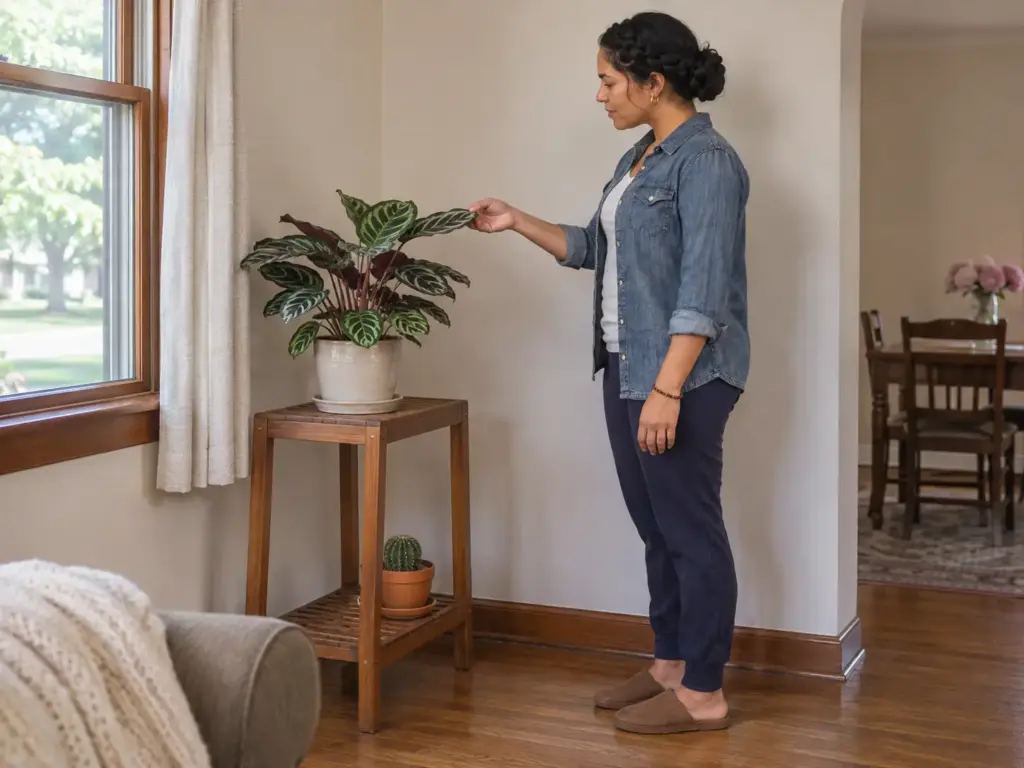
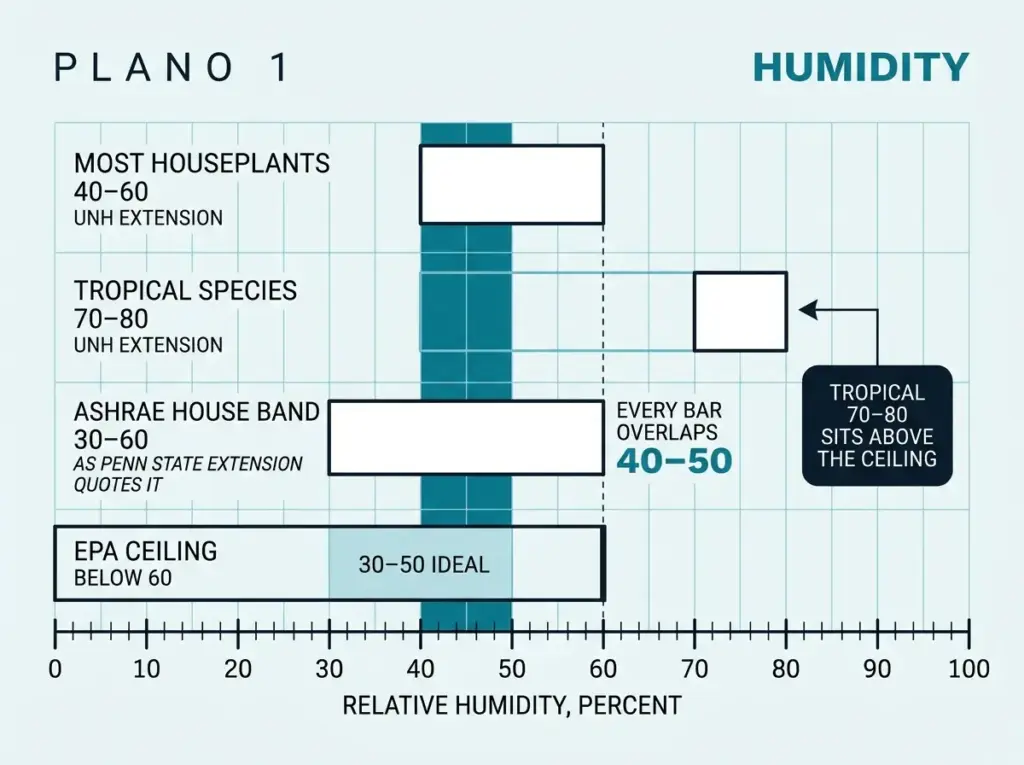
According to UNH Extension’s guide to raising humidity for houseplants, “Most houseplants (excluding cacti, succulents and a few others) prefer a relative humidity range of 40-60%.” It is an extension service’s range for plants and a plant-shop favorite, and it is no building standard, which matters in a few paragraphs when the house’s own numbers arrive.
The ordinary collection lives in this group, so the usual mistake is chasing the tropical figure for pots that never asked for it. Thin leaves lose water faster than thick, waxy leaves, which is the reason the edge of a fern crisps before the edge of a rubber plant. The mechanism behind all of these numbers is laid out in the guide on why dry air at the leaf makes a plant close its pores.
Sort the shelf into two piles before reading any chart: the pots that look the same in January as in June, and the ones whose edges crisp the week the heat comes on. Only the second pile is asking for the higher number.
Tropical Species Ask for More
The same page puts tropical species at 70 to 80 percent. That follows from where they grow: Colorado State Extension gives the native climate of most tropical houseplants as 70 to 90 percent, which makes the calathea and the fern the plants that speak first when a room dries out. The monstera, the peace lily, the anthurium, the orchid, the bromeliad and the fiddle leaf fig share that tropical origin, so they sit closer to this group than to the cactus. In one house, with the same water, a calathea can run a year with no special care while another is gone in a month, and the gap is the air around the leaf far more than the effort put in.
Cacti and Succulents Ask for Less
Cacti and succulents are the exception to all of this. Colorado State says they adapt well to the low humidity of homes, and Penn State names them as the exception to the rule that plants want more than a winter house gives. Neither source prints a band for them, so there is no figure to chase: they sit at the room’s own reading, and a humidifier bought for them solves nothing.
Why a Heated Room Falls Under the Plant’s Number by January
The plant did not change between June and January. The room’s number did, and heating is the cause, with the plant acting as the instrument that shows it.
Cold Air Carries Little Water, and the Furnace Adds None
Cold outdoor air holds little moisture to begin with, and central heating removes more of it.
Penn State Extension says indoor humidity can easily fall below 30 percent in the heating season, and Colorado State Extension’s note on houseplant temperature and humidity goes further: heating and cooling often create environments under 10 percent, against the 70 to 90 percent of the tropics. The under-10 figure is Colorado State’s outer case. The below-30 figure is the one a living room reaches easily during winter heating.
A furnace adds heat and no water. Colorado State adds that a plant in low humidity or in a draft loses more water through transpiration, so its roots need more water, and the plants beside a vent are the ones that develop leaf spots or brown tips. The whole-house side of that story, what pulls a house’s humidity down every winter, is covered on a separate page.
The Reading Moves With the Temperature of the Room
Temperature changes what the meter shows. Warm air holds more water, so a warm room reads lower at the same moisture and a cooler room reads higher.
University of Maryland Extension puts the best growing range for foliage plants at 70 to 80 °F (21 to 27 °C) by day and 60 to 68 °F (16 to 20 °C) at night, so a plant room that cools after dark gains reading without anyone adding a drop of water.
The wall across the room and the shelf two feet from the register are different air: the plant nearest the heat starts to crisp while the one at the far end of the same shelf looks fine. A reading under the plant’s number is a house fact before it is a plant problem, and what a reading under 30 percent means for the house itself carries a lesson: there is no floor rule worth chasing.
Where the Plant’s Number Meets the House’s Ceiling
The plant asks for one number and the house allows another, and a tropical’s 70 to 80 percent sits above the line a living room should stay under.
The House’s Number Stops Below 60
ASHRAE recommends 30 to 60 percent indoors, as Penn State Extension’s guide to humidity and houseplants quotes it.
The EPA is stricter at the top. According to the EPA’s guide to mold and moisture, “keep indoor humidity below 60 percent (ideally between 30 and 50 percent) relative humidity.” The ceiling belongs to the building: past 60, moisture settles on the coldest surface in the room before it does anything for a leaf. The full range a house should sit in, and why 60 is the line, has a page of its own.
The Stretch That Fits Both Is About 40 to 50
Lay the numbers out in a row. The plant bands are 40 to 60 and 70 to 80. The house bands are 30 to 60 and below 60, with 30 to 50 as the EPA’s ideal. The only stretch inside all of them is roughly 40 to 50 percent.
Most plants live at the room’s number and are fine there, and the tropical has to get something else.
A whole-house humidifier does not change the arithmetic. Penn State says it will not reach the ideal for plants, though it helps, and a system asked to hold a plant band is asked to cross the ceiling, with the duct and the glass where it shows. What a furnace humidifier does to the duct and the glass is worth reading before anyone turns one up for a calathea.
A Pocket for the Plant That Wants More
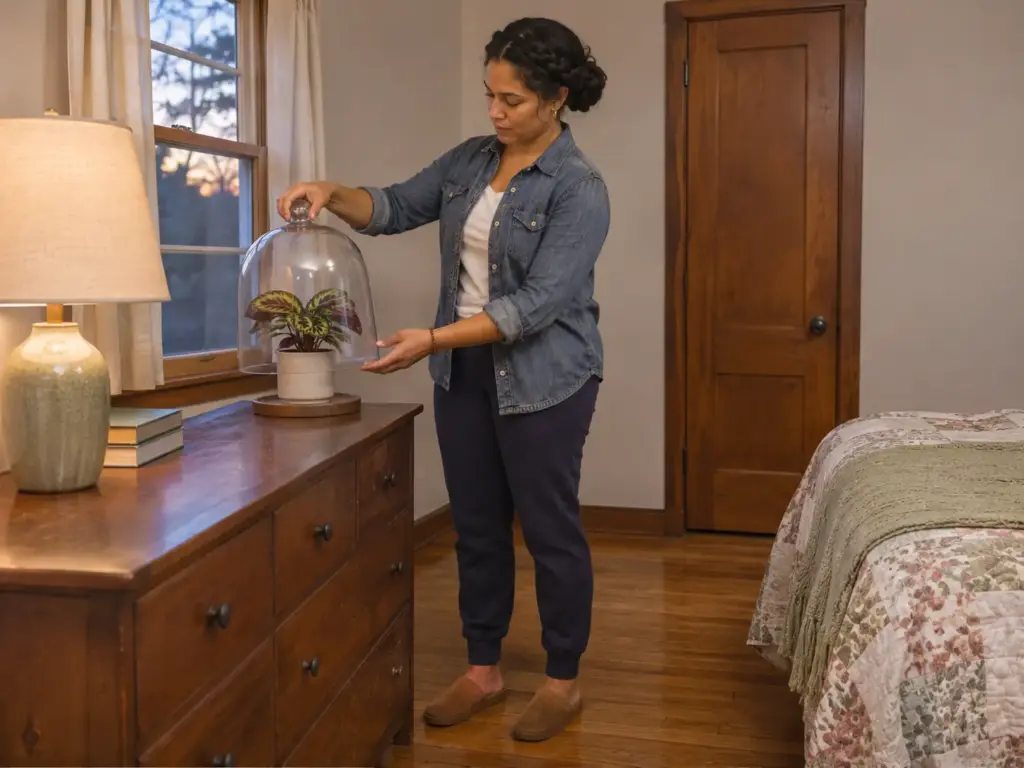
A pocket is the plant’s own water instead of the room’s: a glass dome, a cloche, a terrarium, a mini greenhouse, or a tight group in a small room with low airflow (Penn State, UNH). UNH adds that the lid is lifted now and then so moisture does not build up.
The reason to bother is the clock. The EPA says drying a wet area within 24 to 48 hours stops mold in most cases, and a room held at 70 percent for one plant spends that clock every day.
The window glass sweats first, and when the glass sweating is normal and when it means too much separates the two. The late sign sits in a corner: after a season of grouping and humidifying, fuzzy growth appears on the wall behind a couch or a bookcase and a faint smell of damp comes with it, while the middle of the room reads fine. A small circulator aimed at the ceiling and left running keeps the moisture from settling there.
Read the Number at the Pots Before You Change Anything
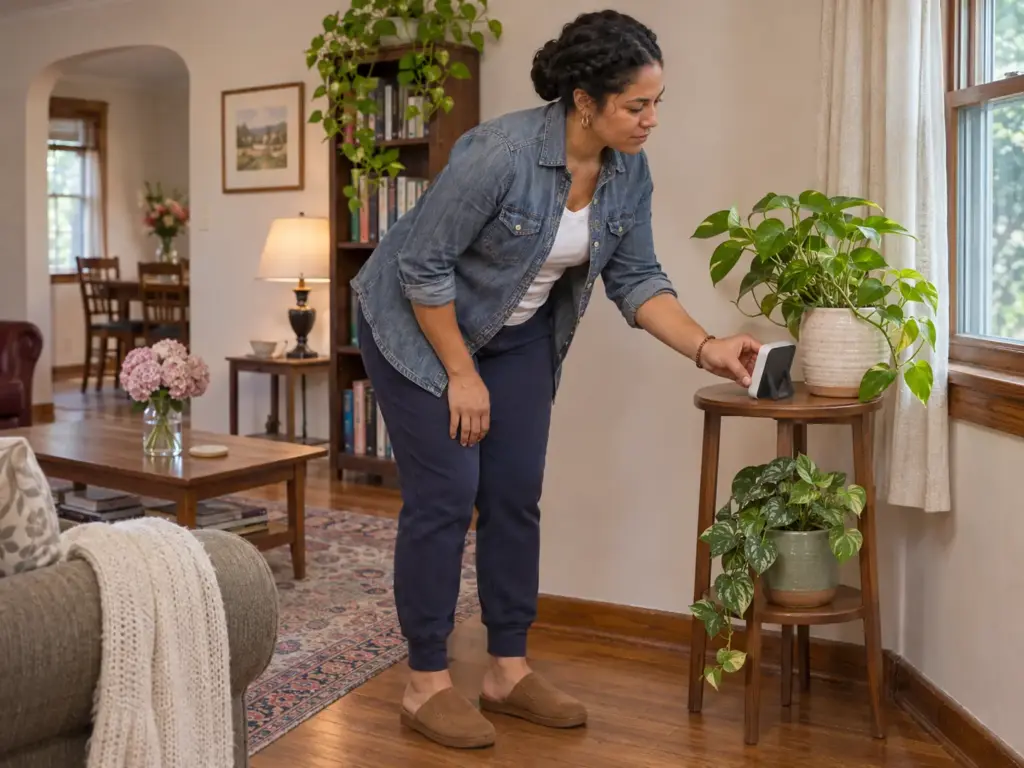
The collision only matters if the room is actually off, so the first move is a reading. A meter on the wall across the room and a plant on the shelf by the register live in different air.
Put the Meter Where the Leaves Are
Measure humidity at the pots: read relative humidity at the height of the leaves, in the spot where the plants stand, over a morning and an evening, and let the meter settle after every move. Where a meter goes in a room and how long it takes to settle is spelled out on a separate page. A meter carried from the shelf to the sill reads lower on a cold morning, and the difference closes by afternoon.
The humid room is a reading too. Penn State says bathroom humidity depends on how often the shower runs, and to measure it with a hygrometer before moving a plant there: a guest bath with two showers a week is a dry room.
Kitchen humidity is the same kind of question, since UNH names bathrooms or kitchens as the rooms that can be more humid, provided the light is enough. UNH says to pair a portable humidifier with a digital thermometer and hygrometer to see how much it helps. The meter sets the hours a unit runs, and a fixed schedule only guesses.
Read the pots twice a day, once at dawn and once late in the afternoon, and keep the 24-hour low. The dawn low is the air the plant has actually lived in, and it is the number a humidifier would have to lift.
The Two Cheap Meters, and What Each Gets Wrong
The Govee H5075 states ±3 percent RH (the maker’s claim), shows the 24-hour high and low on a 3-inch LCD, and reaches a phone over Bluetooth to about 164 feet with two years of data export. That night-to-dawn record is what a plant room needs.
The Bluetooth link is the mixed point, and some units quit inside six months. A record like that shows how far the room falls after the heat drops, which is the figure to compare with the plant’s band, and a digital hygrometer in a small plastic case is all a plant shelf needs.
The AcuRite 00613 is the cheaper meter: a stated 3 to 5 percent RH, the current reading plus the 24-hour high and low, and one AA battery. Its readings can disagree with each other, some units have died within days, and one hygrometer test measured a unit 7 percent low with no way to calibrate it. A cheap meter gives a direction more than a number, and two of them side by side show how far to trust either. Which inexpensive humidity checkers hold up and which drift is the subject of a separate guide.
When the Brown Edge Is the Soil, the Light or the Vent
A reading in hand, the plant gives a second opinion. The brown tip is the first place a low number shows and also the first place half a dozen other problems show, so the meter decides whether the air is in play at all.
What Low Humidity Looks Like on the Plant
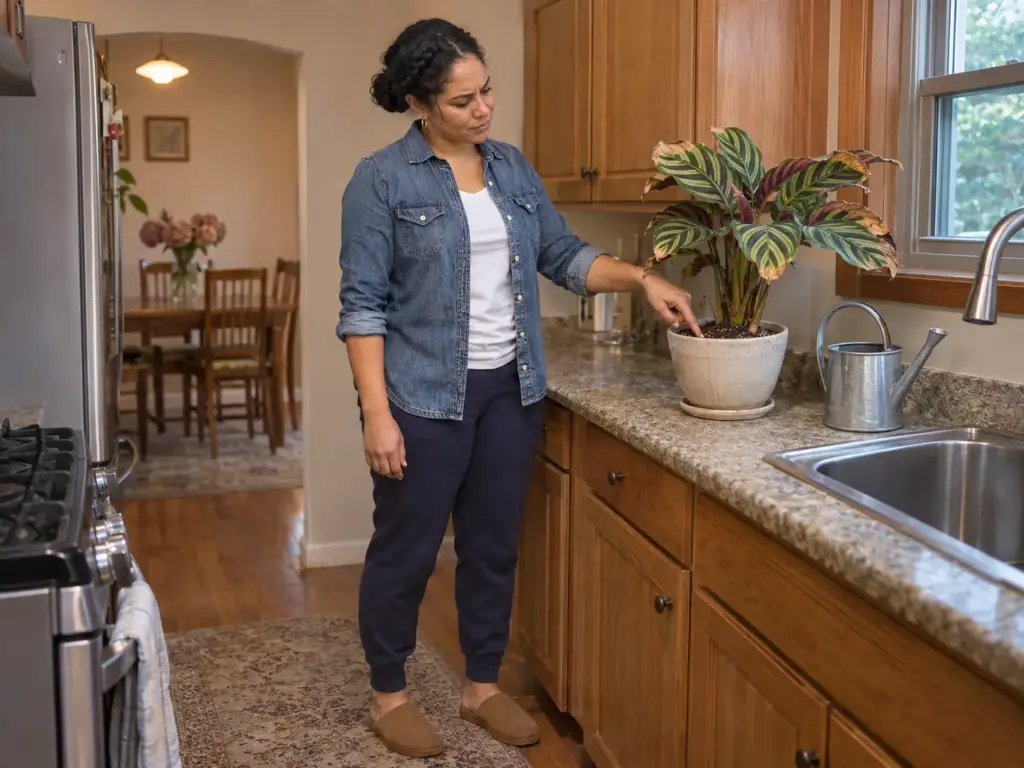
Brown, crispy leaf tips and brittle margins are the visible sign that a plant is short of humidity (UNH). The edge is where the number shows first, and it is also where heating vents and drafts leave their mark, which Colorado State ties to brown tips.
University of Maryland adds that temperature extremes can stop growth or damage foliage, so curling leaves, leaf scorch from a register’s hot air and stunted growth can have the vent as their cause as easily as the air. A calathea can lose a leaf at a time beside a humidifier that runs all day, and improve once the light changes. When the edge comes back brown on every new leaf whatever the meter reads, the cause sits in the soil or the light.
What Too Much Looks Like
Too much humidity looks different: mold on the leaves, mildew on soil, a fungus on potting soil, rot, yellowing with wet soil. Root rot gives yellowing, browning and dieback even in wet soil (UNH), so a brown edge on a plant whose pot never dries is a watering problem dressed as a humidity one. A humidifier bought for that problem changes nothing.
Move, Light, Water, Then Read the Meter
Run the free checks in order. Move the pot off the vent or the radiator, check the light, and check the watering, holding back before overwatering as UNH’s closing advice says. Then read the meter.
University of Maryland Extension’s note on temperature and humidity for indoor plants says plants are sensitive to drafts or heat from registers and should not sit near heat or air-conditioning sources. Penn State ends by saying light and watering are the things easier to control. A plant that sulks at the living-room window and does well by the bathroom window is a reading: measure both rooms before deciding which one it belongs in.
What Misting, Trays, Grouping and Domes Actually Do to the Reading
Every page lists the tricks as if they were equals. Each one moves a different number, and only some move the one on the meter.
Misting Buys Minutes
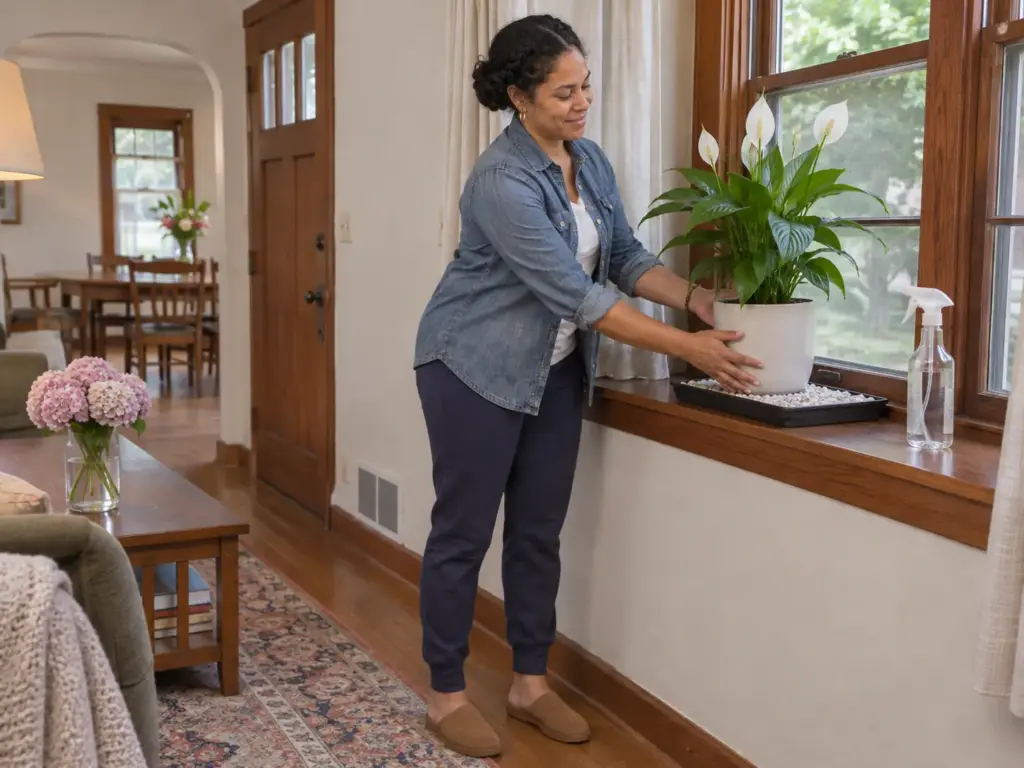
The rise from a spray lasts until the water evaporates, a matter of minutes, so even daily misting does nothing for the humidity around a plant (Penn State). A spray bottle on the sill is a habit that feels like a fix and leaves the reading where it was.
The Tray Catches Drips and Barely Moves the Room
UNH allows a small benefit, and only with several plants and low air circulation. What a tray does reliably is catch drips and keep the sill dry. The Brussel’s Bonsai humidity tray, 8 inch with decorative rocks, keeps the pot standing on the stones and out of the water; it runs smaller than expected and its sturdiness is mixed. The water in a tray goes green and warm within the first weeks, and the plant above it reads no different from the one beside it.
Grouping and a Glass Dome Work in the Pocket
Grouping plants makes a microclimate. Penn State says its effect depends on the number of plants and the size of the room, and UNH says it works best with several plants in a small room with low airflow. A big room’s reading stays put, and a tight group pushed against a wall is where damp settles.
A dome, a cloche or a terrarium recycles humidity in the plant’s immediate surroundings (Penn State), and it is the one local fix with no dispute. A mini greenhouse or a greenhouse cabinet is the same idea at furniture size, and the lid or the door gets opened now and then too.
A clear storage tote with its lid on works as a dome for a few small pots. Put the meter inside it for a day, and if the reading climbs past the plant’s band, leave the lid ajar for longer.
A Humid Room Only Works if the Shower Does
A bathroom is a plant room only when the shower runs often enough, and Penn State says to measure it with a hygrometer first. Bathrooms also tend to lack the right light for plants. Drying laundry indoors or boiling water adds moisture to the room, and the room judges it by the same ceiling, below 60 percent, whatever the plant wants. How much indoor laundry a room can take before it passes 60 percent is a matter of arithmetic.
A Humidifier Moves the Room’s Reading and Leaves Scale Behind
After the free fixes, the plant may still ask for more and the room may still read low. A humidifier is the only method that changes the room’s number, and the only one whose bill arrives later.
When a Humidifier Is the Answer, and Three That Fit
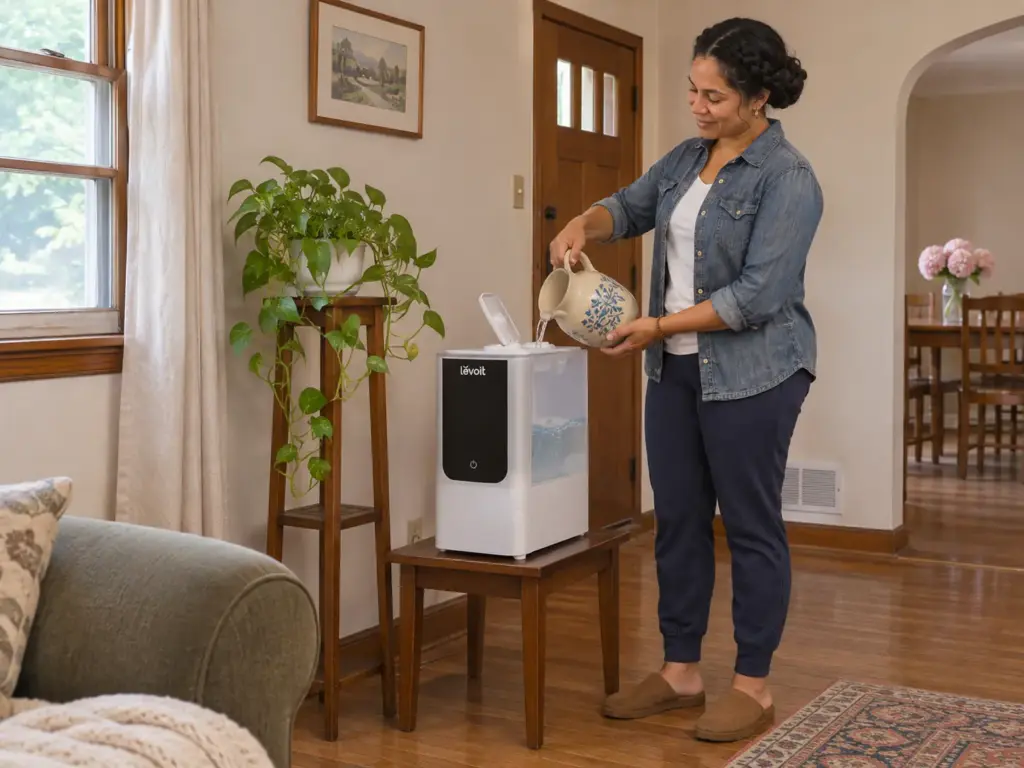
A portable humidifier close to the plants offers the most benefit, particularly in larger rooms, and likely has to run several hours a day (UNH). A tabletop humidifier is the small version of that, and a whole-house unit helps but will not reach the ideal for plants (Penn State). Three portable units fit three jobs.
The Levoit OasisMist 450S has a 4.5 L top-fill tank, runs up to 45 hours, makes warm and cool mist, and its Auto mode holds 40 to 60 percent, the maker’s figures and the same band this article prints. Cleaning is the mixed point: a full descale takes 30 to 40 minutes of soaking.
Size follows the room, and how to size a humidifier for a room in gallons a day, not tank size does that math. A small unit that has to be refilled twice a day to stay running is the real cost of holding a band in a dry room, and a slightly bigger one lasts a working day.
The Dreo HM713S holds 6 L, runs up to 60 hours, covers 550 square feet, makes warm and cool mist at 500 mL/h, and states ±5 percent control. That suits a tropical collection and a plant room more than a single shelf. Durability is its weak side: some units stop after about a month, give little or no mist, or leak.
At the budget end, the cool mist humidifier Dreo HM311S takes 4 L through a top-fill tank, runs up to 36 hours at 28 dB, makes cool mist only and serves one room. Some units break inside two months, and the value for the money is uneven.
Mineral Dust, Scale and the Tank That Needs Cleaning
A humidifier leaves things behind. An ultrasonic unit on tap water leaves mineral dust, a fine white film on the dresser and the lower leaves after a few weeks of running, while the number on the meter looks right.
Scale builds in the tank, and a tank left wet grows mildew, so it gets emptied and dried between fills. The choice between cool and warm mist for tap water and a plant room is worked out in a guide on which mist suits tap water and a plant room. The mist never points at a leaf.
Set the unit to chase 45 to 50 percent on the meter at the pots, never the 70 on the plant’s label. Wipe the tank dry when it is empty, and the mildew has nothing to start on.
The Small Room With the Door Shut
In an apartment, a small bedroom with the door shut reads higher through the night, and a humidifier asked to hold 70 percent for one calathea pushes the glass and the wall past the line before the plant is satisfied. The humidity a bedroom should sit at with the door shut is 30 to 50 percent. Past 60, the EPA’s 24 to 48 hour drying clock keeps running against the wall, and what a room kept at 70 percent costs the wall is more than a plant is worth. The setting follows the meter, never a schedule.
Is It Worth It for the Plants You Have
A collection that sits in the 40 to 60 band needs no humidifier, and a room that already reads 45 percent is finished. A unit earns its place when a tropical collection sits in a room that stays under its band after the free fixes, and then the size and the mist type are the next decision.
Read the Pots First, Run the Free Fixes, and Give the Thirsty Plant a Pocket
Most houseplants sit at 40 to 60 percent and the tropical ones ask for 70 to 80. A heated room often falls under 30, and the house’s own line is below 60, so the overlap is narrow and the tropical gets a pocket instead of the room. The meter at the pots decides whether the air is in play, the brown edge often has other owners, misting buys minutes and the tray barely moves the room, and a humidifier is the one tool that moves the number, with scale and a ceiling attached.
Tomorrow’s first move costs nothing: put a meter at the pots and read it before touching anything, then move the pot off the vent and read it again. Check back after the first cold fortnight and again in the second month of a humidifier: the white dust on the dresser and the lower leaves, the smell from the tank, the dawn low with the door shut, and any film on the lower pane all say whether the setting needs to come down. If the plants still ask for more after that, whether a room humidifier is worth it for them, and of what size, is the next decision.
Frequently Asked Questions
01Is 70% humidity too high for house plants?
For a tropical plant, 70 to 80 percent is its band according to UNH Extension, but for a room it is past the EPA’s below-60-percent line. Give that plant a pocket, such as a glass dome, instead of the whole room.
02How much humidity do cacti and succulents need?
Cacti and succulents need less humidity than other houseplants and are the exception to the usual rule, sitting at the room’s own reading. Colorado State Extension says they adapt well to the low humidity of homes, so they need no humidifier.
03What humidity should house plants have in winter?
The band stays the same in winter: 40 to 60 percent for most houseplants and 70 to 80 for tropical species. A heated room can fall under 30 percent (Penn State Extension), so the reading at the pots matters most then.
04Does misting raise humidity for house plants?
Misting barely raises humidity for house plants, because the rise lasts only until the water evaporates, a matter of minutes. Even daily misting does nothing for the humidity around a plant (Penn State Extension).
05Should I run a humidifier all day for house plants?
Let the meter decide how long a humidifier runs. A portable unit near the plants may need to run several hours a day (UNH Extension), but past 60 percent the room pays for it.