
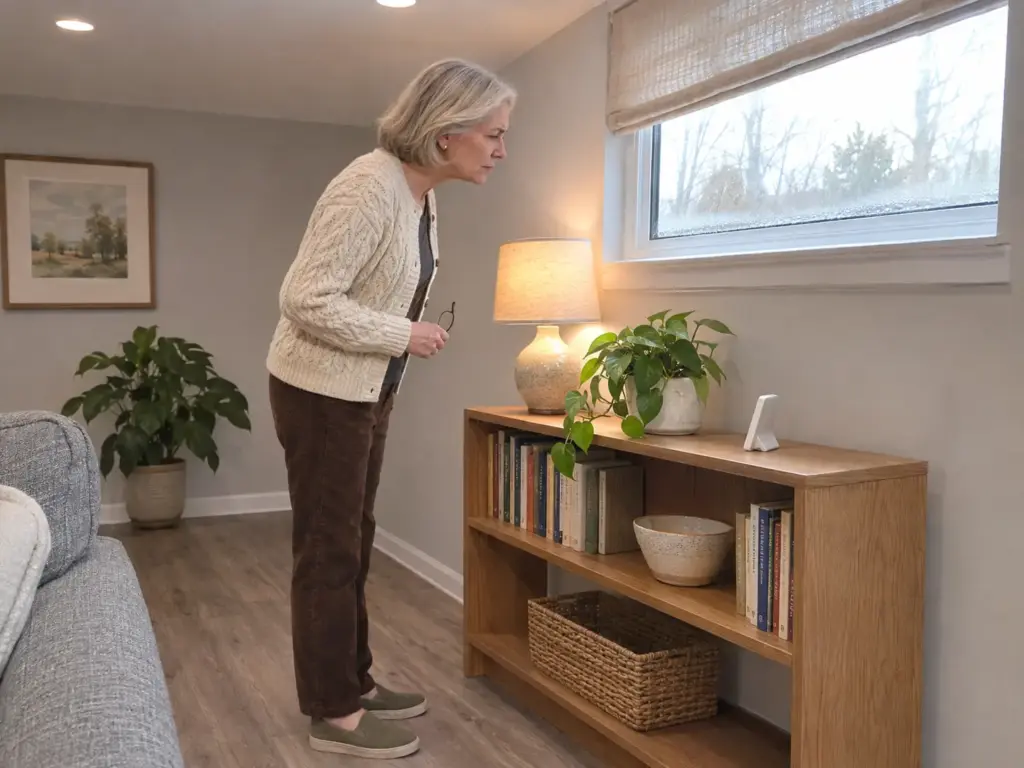
On the first hard-cold morning of the heating season, the bottom inch of the bedroom window is beaded with water, and the humidifier on the furnace has been running all week the way it always does. You wipe the glass, and the question that comes with it is the one people type into a search bar: does a whole house humidifier cause mold? The unit only adds water to the house. Mold needs that water to land on a surface that stays damp, and there are three of them: the unit’s own wet parts, the cold duct run, and the cold corners and glass of the rooms.
Whether mold affects anyone’s health is a question for a doctor; this page stays with the house and reads its numbers. The sections follow the order you would check them in: the humidity band, the pad and the months the furnace sits idle, the duct, the setting against the cold outside, and the point where it stops being a setting problem.
Quick Answer
No, not by itself. The unit adds water, and mold starts only where that water lands on a surface that stays damp: a pad the furnace never dries, a cold duct in an attic or crawl space, or a room held above 60 percent humidity. Check the room first, then the pad, then the duct.
Where the Water Lands When the House Is Past 60 Percent
A humidifier is only half of this story. The other half is the first surface its water reaches, and in winter that surface is the coldest one in the house, so the room gets read before the box gets opened.
The band the EPA publishes, and the shortcut people use instead
Moisture control starts with a number, and the number comes from the agency that writes the guidance on mold. According to the EPA’s mold course on indoor humidity, “Indoor relative humidity (RH) should be kept below 60 percent — ideally between 30 percent and 50 percent, if possible.” That makes 60 the ceiling and 30 to 50 the band to aim for. Fifty percent gets repeated as if it were the limit, but it is a comfortable place to sit, not the ceiling, and why 60 percent is the ceiling and 50 is not takes the difference apart in full.
What the ceiling leaves out is that the surfaces of a house are not all at the room’s temperature. That gap is where mold starts.
Why the glass sweats before the wall does
Warm, humid air that touches a cold surface leaves water on it, and how cold “cold” has to be is the dew point, which climbs with the humidity. At 70°F (21°C), air at 50 percent humidity starts condensing on anything below roughly 50°F (10°C); at 60 percent, the dew point climbs to about 55°F (13°C). On a hard-freeze morning the inner face of a window pane and the inside of an outside corner can sit near or under those temperatures. The glass goes first because it is the thinnest and coldest thing in the room, and the wall is what the glass was warning about.
The EPA names the inside of ductwork and the surface of walls behind furniture as places where condensation forms and mold can hide. So the beaded window is the one you can see, and the corner behind the dresser is the one you cannot. A damp, musty smell there tends to show before any visible growth does.
Glass that fogs on the coldest mornings and clears by afternoon is behaving normally. A corner that is still damp at noon is the one to follow. And wet glass alone is no verdict either way: when the wet glass does mean mold, and when it does not is its own question, with its own test.
One reading in the room that decides everything after it
Before touching the humidifier’s dial, put a humidity meter (a hygrometer) on the wall of the coldest room, near the height of the window glass, and read it at the same hour for a few mornings. The Govee H5075 (see it on Amazon) is accurate to about 3 points of humidity by its spec sheet, which is enough to tell 30 from 50 and not enough to chase a one-point change. Its Bluetooth link drops on some units and long-term reliability is mixed, and since it only reads (there is no humidistat in it), it controls nothing; a two-pack of basic digital hygrometers does the same reading in two places, one mid-room and one at the cold corner, with the same reliability caveat.
A reading under 60 with a wet corner points at the building. A reading well above 60 points at the dial. Either way you now know which direction the house is off, and that decides what to look at next.
Take the three readings at breakfast, before the shower or the kettle adds a spike. If the number swings ten points between Monday and Wednesday, the room is following the weather outside, and that tells you more than any single reading would.
The Pad Holds Water After the Furnace Shuts Off
Of everything in a forced-air system, the humidifier is the one part that handles liquid water. A pad that stays damp while the furnace is idle is a surface in its own right, and the question is how many months of the year it sits that way.
Why a wet pad is the first surface to check
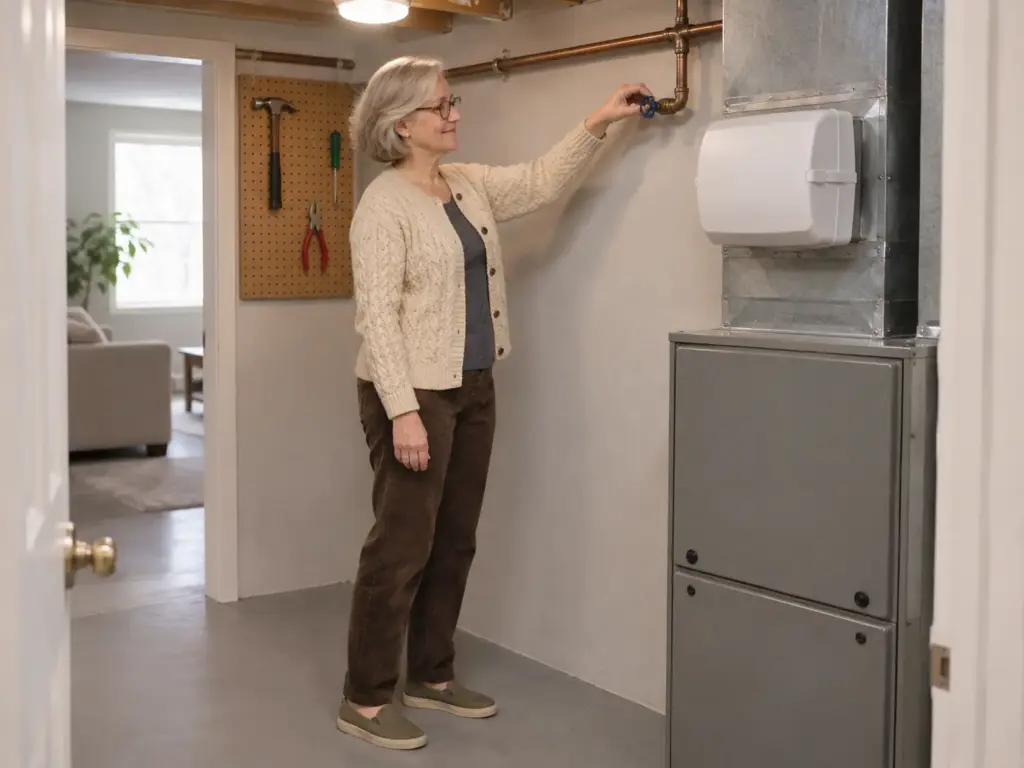
On a bypass or flow-through unit, water runs over a pad (the water panel) and the furnace’s air picks up the moisture as it passes. The pad is a consumable, and it only dries when warm air keeps moving through it. In the shoulder months, when the heat calls for a few minutes a day, a pad that is still being fed from the supply line can stay wet for most of the day. A pad like that, or a tray holding standing water, is a surface worth checking before the duct.
Hard water adds a second thing to look at: white mineral deposits that build up on the pad, in the blower and in the return over a season. The deposits mean the pad has been working. It is a different problem from mold, and its upkeep belongs to a different page.
The months the furnace is off and the water is on
Picture the furnace closet in April. The heat has been off for a week, the water valve has been open since February, and there is a faint damp smell at the return. Nothing in the dial or the thermostat says the humidifier is still wet. That stretch, the weeks when the water is on and the blower is idle, is the stretch that rarely gets counted, and it is where a pad goes from a working part to a damp surface.
The EPA’s guidance on any in-duct humidifier is to operate and maintain it strictly to the manufacturer’s recommendations, so the maker’s own schedule is the first place to look. The free check takes a minute: open the cabinet on a day the furnace has not run for hours. A pad that is wet or smells musty has been sitting in idle water, and the free repair is to close the valve. Only then does the pad need replacing.
What the maker’s manual says for the Model 400
Aprilaire’s own manual for the Model 400 asks for the water panel to be replaced twice a season on that model, where other Aprilaire models change it annually. The summer shutdown is two steps. First close the bypass damper, which is part of the unit, with its small handle; then shut off the water supply by closing the saddle valve. The humidifier control needs no adjustment for summer, in either automatic or manual mode.
Closing a valve is a homeowner’s job; moving the valve or opening the water line is install work, and which parts of the install a homeowner can do and which to leave to a pro draws that line.
When the pad does need replacing, match the model number printed on the old one before ordering. The Alocs 35 water panel two-pack (Alocs 35 on Amazon) is a replacement for the Aprilaire 350, 360, 560, 568, 600, 700 and 760 series; the compatibility list leaves out the 400, so a Model 400 owner matches the pad that came out of their own unit. A two-pack is normal for a part changed every season. The fit is good; the material quality is mixed.
A pad that is still stiff and wet in the first warm week of spring is one that was never dried. Check that week, not the following autumn.
Close the water valve on the day the heating season ends, and tie a tag to the handle with that date on it. The tag is what a year-old memory of “I think I shut it off” cannot be.
The Duct Run in the Attic Is the Cold Surface Nobody Sees
The duct is the longest cold surface in the system, and it is out of sight. What condenses on or in it depends on the space it runs through far more than on the humidifier’s make.
Why a duct in the attic or crawl space sweats
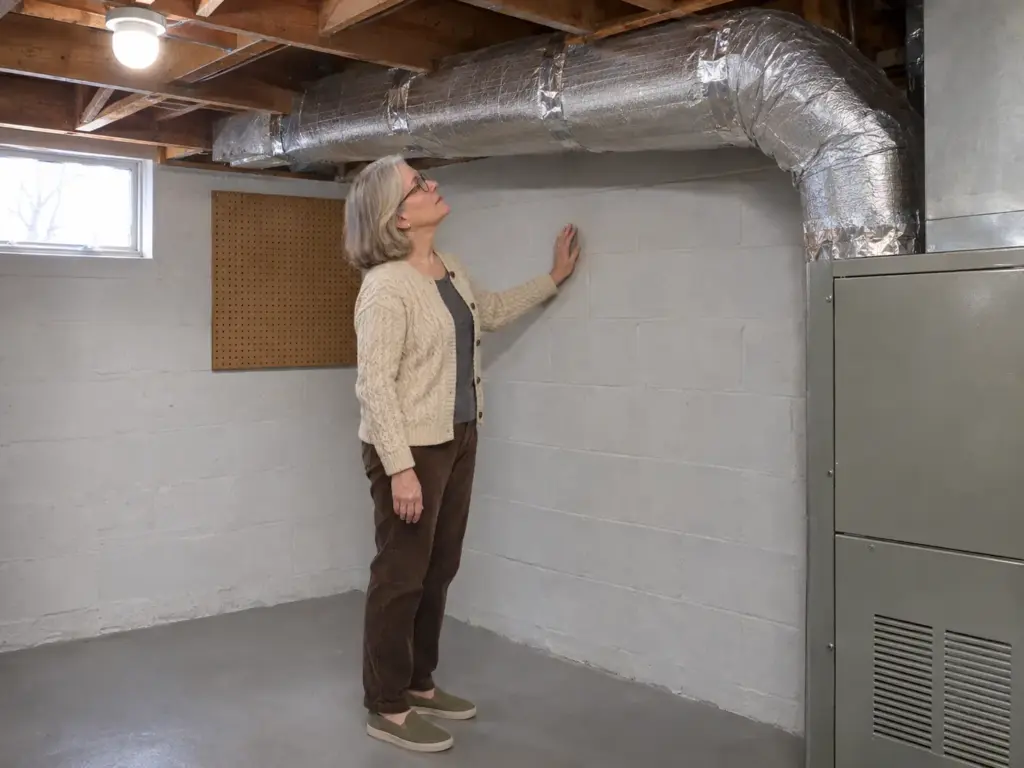
A humidifier sends moisture-laden air through the same ductwork that crosses an attic at winter temperatures. If that duct is bare, the inside surface is the coldest thing the humid air touches, which makes it the first place water lands. The damp tends to show up first at the plenum and the return, often with the white deposits a season of hard water leaves behind.
Nothing about this is specific to one humidifier brand; any moist air pushed through an uninsulated run in an unconditioned space does it. The furnace side has a second cause worth ruling out too: the furnace filter and the pan behind a wet window explains how a loaded filter and a pan problem can mimic this.
What the EPA says to do about it
The agency’s repair is plain: ducts in spaces that are not air-conditioned have to be sealed and insulated so condensation does not form on them or enter the system. The EPA’s guidance on insulating cold ducts puts the duct insulation on the outside of the duct, and the product that matches the job is a foil-faced wrap.
The Reflective FRK foil-faced fiberglass duct wrap (FRK duct wrap on Amazon) is 2 inches thick, rated R-6 to R-8 by the maker’s statement, and sold as a roll 4 feet by 25 feet with a foil vapor retarder. It is rated for 35 to 250°F (about 2 to 121°C). It stops water from forming on the outside of a duct, and it does nothing for mold already growing inside one. The seams have to be sealed for it to hold, the work happens in a tight attic, and this is the splurge of the three products on this page.
The free first move needs no roll at all. From the attic access point, without climbing in, look at the duct run. Is it wrapped, and is the wrap intact? That look is the check; the insulation is the repair.
When the job is not a weekend job
Insulating a long duct in an attic or crawl space is a professional’s job when access is tight. The homeowner’s part is to look, to feel whether the duct is cold to the touch on a cold day, and to ask a contractor about it with the EPA’s wording in hand.
On a cold day, lay a bare hand on the first stretch of duct you can reach from the access point. If it is cold to the touch and unwrapped, that run is the surface to deal with before anything else in the attic.
Set It by the Outdoor Cold, and Seal Before You Add Moisture
The band is not one number all winter. The setting that is fine in October can sweat the glass in January, and a leaky house sends the extra moisture into the wall.
Why the setting follows the weather outside
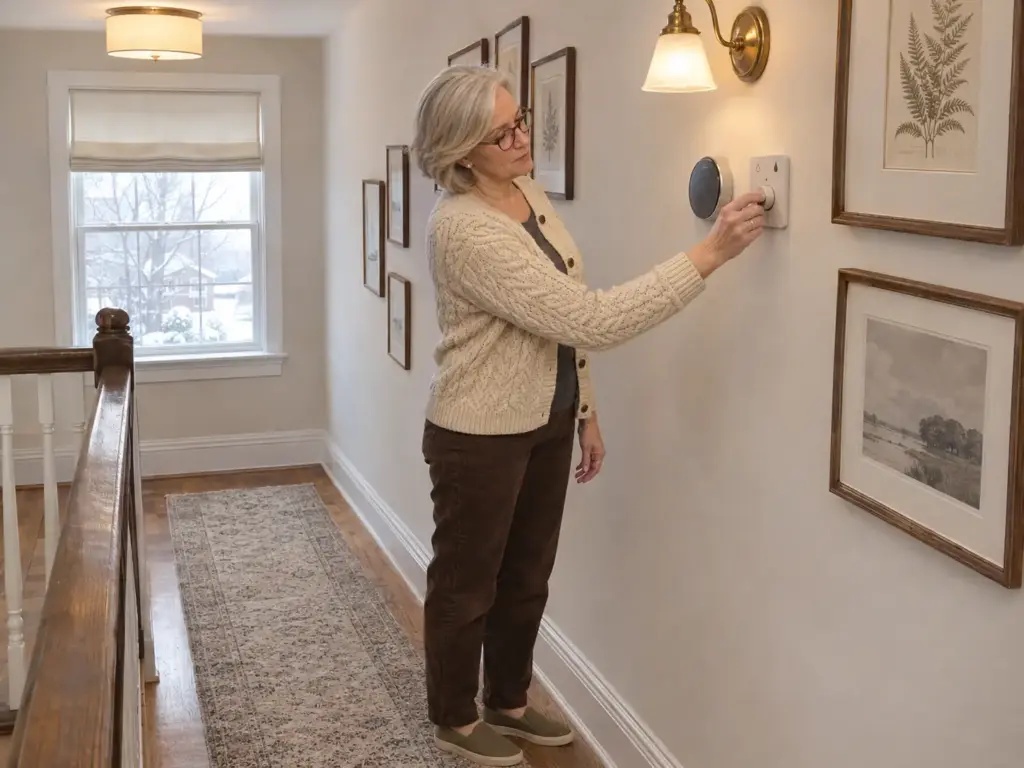
The colder it gets outside, the colder the inside face of the glass and of the outer walls, so the same indoor humidity reaches a surface cold enough to condense on sooner. The dial has to come down as the cold deepens, or the unit’s outdoor sensor has to do it for you. A house with a sensor still deserves a check of the glass, since a sensor drifts and a dial left at an October setting is the most common version of this problem. What the indoor number should be at each outdoor temperature has the numbers for each step.
Glass that stays dry through November and sweats in the first hard freeze, with the dial untouched, is the weather doing exactly this.
A house without a sensor needs nothing extra to start: the dial and the wall meter do it by hand. Lower the dial one step, read the meter and the glass on the next three mornings, and only then decide whether a second step is needed. Two steps at once hide which one worked.
The house that leaks loses the water to the wall
Air leaks change where the moisture goes. Gaps around windows and the wall behind outlets let humid air move into the wall cavity, where the sheathing is far colder than the room, so adding water to a leaky house feeds the wall rather than the air in the room. Air sealing costs less than holding a lower setting all winter, and it comes before raising the number. When the reading already sits above the band, the free ways to bring a room’s humidity down come before any equipment.
Make a pencil tick on the cabinet at the dial’s current position before each change. When the glass sweats in a hard freeze, you can see exactly where you were and step back to it.
When It Stops Being a Setting Problem
The first four sections are the homeowner’s checks. This one is where they end, because mold in the duct or the plenum, or a patch larger than a door, changes who does the work.

The EPA’s rule for a moldy system
The sharpest line in the agency’s guidance is about running the system. In the EPA’s guide to mold, moisture and your home: “Do not run the HVAC system if you know or suspect that it is contaminated with mold – it could spread mold throughout the building.” The agency’s remediation course adds that a system found contaminated stays off until it has been remediated, and that the work is for professionals experienced in HVAC; the EPA’s mold remediation course, on HVAC is where that rule is set out.
A smell at the register that does not clear when the unit’s water is off belongs in that category. Mold near the return or the intake is another sign that moves the job to a professional.
The patch larger than ten square feet
For a patch smaller than about 10 square feet (roughly 3 feet by 3 feet), the EPA’s guide says most people can handle the cleanup themselves; a larger area, or a lot of water damage, goes to a professional. How a patch under ten square feet is handled covers the small case. Past that size, the cleanup is not the job anymore, and finding where the water came from is.
What to ask the professional to look at
The question to bring to an HVAC professional is short: which surface is wet, since when, and is the duct run insulated? The professional’s answer decides what happens to the duct. Yours decides the setting.
And some of what looks like a humidifier problem is the building: a leaking drain pan, a roof leak, an attic duct that sweats because nobody insulated it when the house was built. None of those is fixed by a lower dial.
If the answer is to replace the unit or drop it, the next question is whether a furnace unit fits the house at all, and that deserves a measured answer of its own. A cold, still wall is the third surface in this chain, and why mold grows on a cold, still wall goes into it.
If the smell is at the register, shut the unit’s water off, then stop running the system until a professional has looked at it. A running blower carries the smell through every room in the house.
The Reading to Take Tonight, and the Pad to Check in April
A humidifier causes mold only when its water meets a surface that stays damp, so the work is finding which of three surfaces that is. Read the room before the box, close the valve when the heat is off, wrap the duct on the outside, let the dial follow the cold, and stop running the system when the smell is at the register.
The check for later is built around the pad and the season. In the first warm week of spring, open the cabinet on a day the furnace has not run, and look at the pad. Put the meter back on the coldest wall at the first hard freeze of next winter, because that is when a setting left alone shows its hand.
For tomorrow: set the meter on the coldest wall tonight and read it at breakfast for three mornings. Those three numbers decide which surface to look at first.
Frequently Asked Questions
01Is there a mold risk with a whole house humidifier?
Only where the water stays on a damp surface: the pad when the furnace is idle, a cold uninsulated duct, or a cold wall in a house held above 60 percent humidity. Read the room first.
02Is it common to have mold in HVAC?
It turns up where moisture sits, such as a drain pan, a cold duct or a wet pad. If mold is known or suspected in the system, the EPA says not to run it.
03How do you know if a humidifier is causing mold?
Check three places: the pad on a day the furnace has not run, the duct run for wrapping, and the coldest wall and glass with a meter. A musty smell at the register means stop and call a professional.
04Should I leave a whole house humidifier on in summer?
No. Aprilaire’s manual for the Model 400 says to close the bypass damper and shut off the water at the saddle valve. On other models, follow that model’s manual.
05Are whole home humidifiers a good idea?
In a ducted house that holds a low setting through the cold months, yes; in a leaky house they send water into the wall. The guide to room unit or furnace unit helps you choose between them.