Two tabs are open on your screen, one humidifier that boils its water and one that never gets warm, and the bedroom they are meant for has never been measured. The cool mist vs warm mist humidifier question feels like a choice between two ways of raising humidity, but both put the same water into the same room, and the relative humidity climbs the same way either way. What separates them is what happens to the minerals in the tank, how many watts the boiling costs across a night, where a hot unit can safely sit, and how much scraping each one asks for by the eighth week. This page starts with the room’s own reading, follows the water through each type, counts the kilowatt-hours, and ends where the dry room turns out to be the building and not the machine.
The table sorts the seven units by what each one leaves behind and where it falls short, since the humidity they raise is the same.
| Unit | Mist type | What it leaves behind | Its main flaw |
|---|---|---|---|
| Vicks Warm Mist Humidifier V745 | Warm, boiling element | Scale on the element | Noise and durability vary from unit to unit; leaks come up |
| Vicks Warm Steam Vaporizer V150RY | Warm, electrode vaporizer | Scale where the current meets the water | Steam output splits between plenty and none; one fixed setting |
| Dreo HM713S 6 L | Warm and cool in one tank | Scale when run warm; check the cool side for dust | Durability is uneven; the tank is too tall for a shallow faucet |
| Levoit OasisMist 450S 4.5 L | Warm and cool in one tank | Scale when run warm; check the cool side for dust | Cleaning ranges from easy to a long job |
| Levoit Classic 300S | Cool, ultrasonic disc | White mineral dust in a hard-water house | Output is mixed; the shut-off can cut out; many crevices to clean |
| Pure Enrichment MistAire XL | Cool, ultrasonic disc | White mineral dust in a hard-water house | The shape gets harder to clean the longer it runs |
| BLUEAIR InvisibleMist H35i | Cool, evaporative wick | A wick that stiffens; no visible mist, no dust | The most expensive here; run time falls short of the box |
A Bedroom Already at 45 Percent Needs Neither Mist
Before either unit goes in a cart, the bedroom needs a number, because every answer below depends on it. A room already holding the right reading has no use for a boiling unit or a vibrating disc, and the band it gets judged against is public.

The Band the EPA Gives, and the Meter That Reads It
According to the EPA’s guide to caring for the air in a home, “Keep indoor humidity between 30 and 50 percent.” The agency says to read it with a gauge from a hardware store, and its mold guidance puts the ceiling at 60 percent. A bedroom that already reads 45 to 50 percent relative humidity needs neither mist, so the money belongs in a hygrometer and a lower thermostat setting. Below the band is where a unit starts to earn its place, and what a reading that is too low actually means is worth a read before the cart is.
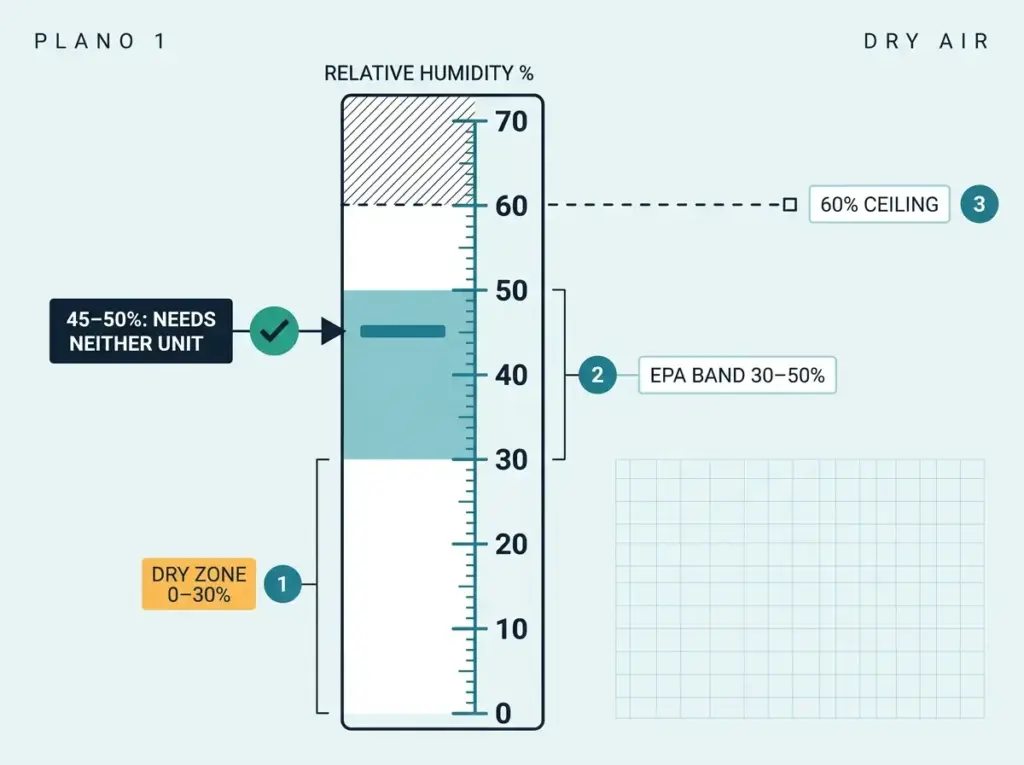
Thirty is a floor and 50 a ceiling for a reason: a humidifier is the one device that can push the room it fixes across the line. A bedroom sitting at 48 percent is already near the top of the band, and a unit added to it has nowhere to go but over.
Bedtime and Dawn Are Two Different Readings
The CDC asks for no more than 50 percent all day and for more than one reading a day, and the CDC’s mold page on keeping a home dry is the place to see it. A bedroom shows why. With the door shut the room collects moisture and nothing leaves, so the dawn reading runs a few points above the bedtime one (the mechanism is laid out in why the dawn reading differs from the bedtime one). The dawn number is the one to plan around.
One boundary belongs here, early. If the reason for wanting a unit is how a person feels, a cough, a cold, a child’s room, that is a question for a doctor, and this page stays with the room, the water and the machine.
The Changes That Cost Nothing, in Order
Static at the lamp switch is the other sign of the same dry reading (the static at the lamp switch that goes with the same reading is the same room seen from that side), and a number settles it better than a feeling does. When the meter does say dry, the order matters, with a reading after each step:
- Lower the thermostat by a degree or two Fahrenheit (about 1 °C); cooler air reads higher on the same moisture. Check the meter an hour later.
- Leave the bedroom door open for an hour in the evening so the moisture of the rest of the house reaches the room. Check at bedtime.
- Move the meter off a radiator or away from a vent, both of which skew it dry. Check again before trusting any earlier number.
Only then does a unit enter, and the order of the free fixes before any device is the page to keep open beside it. Once a unit is running, the glass becomes the receipt: if water beads on the window, the EPA’s rule is to move the unit, turn its humidistat down or run it less.
Put the meter at bed height on the far side of the room from where the unit will stand. A sensor beside the mist reads wetter than the room does, and it will tell you the job is done while the pillow end is still dry.
What Happens to the Water Inside Each Type
With the room reading dry, the next question is not the brand but what the machine does to the water on its way into the air. It can boil it, shake it into droplets or pull it off a wet wick, and that choice decides what leaves the unit with the vapor, what stays behind inside it, and whether a hot surface sits in the bedroom.

Heat: The Boiling Element and the Electrode Vaporizer
Both mists put the same water into the same air, so the humidity a room reaches follows the unit’s output and the room’s size and leakiness, never the temperature of the mist.
A boiling-element unit brings the water to its boiling point at a heating element until it steams, and the hot water in the tank is what makes it a burn risk for children and pets. An electrode vaporizer passes current through the water itself, which means the minerals in the tap water take part in how it boils. The Vicks Warm Steam Vaporizer V150RY, a 1.5-gallon electrode unit with a single setting, shows what that fixed setting means in a bedroom: when the meter reaches the band, the only control is the plug. Steam output is also where it splits, since some units put out plenty and others little or none, a few have died within days and others after a couple of months, and heat, noise and cleaning all vary from one to the next.
A Vibrating Disc, a Spinning Impeller and a Wet Wick
The EPA separates the types by what they do with the minerals, and the EPA’s own use-and-care guidance for home humidifiers says it plainly: an ultrasonic humidifier (a vibrating disc) and an impeller humidifier (a spinning disc), the cool-mist kind, disperse minerals and microorganisms from the tank into the air, while steam vaporizers and evaporative humidifier units are not expected to disperse substantial amounts. A wick-and-fan unit pulls water off a wet wicking filter and makes invisible mist, nothing you can see. The invisible kind is not the weaker kind, and the same guidance is why the hot types are a placement decision before they are a cleaning one (that part waits for the watts, further down).
Why the Mist You Can See Proves Nothing
A cloud rolling across the dresser tells you the unit is putting out droplets, and little else. It does not say how much water the room gained, and for a disc it is the very plume that carries whatever was dissolved in the tank. Only the meter in the room says what the output did, so a wick unit that shows nothing at all can raise the reading exactly as far as one that fogs the window.
A sound gives the unit away sooner than a cloud does. A warm-mist unit with scale building in the works gurgles louder than it did on its first night, and that noise comes before the failure, not after. A different question sits above all this, whether one portable unit or a furnace-fed system is the right size of fix, and whether a furnace-fed unit is the better size of fix for the house belongs to the page that settles room against house.
The White Dust Is the Tap Water, Not the Mist
The pale film on every surface gets blamed on cool mist as a type. It is a property of the water in the tank, which is why the same hard water sends a different bill to each of the three kinds of unit.

Why a Disc Throws Minerals and a Boiling Element Keeps Them
A disc breaks the tank water into droplets and sends them up, so whatever was dissolved in the water leaves with them and settles on the furniture as a fine white dust. A boiling element does the opposite: the water leaves as vapor and the minerals stay behind as scale. The EPA’s line on this is that a white dust film on surfaces means the minerals are not being removed, and the Levoit Classic 300S is the clearest case: a 6 L ultrasonic tank drawing 26 W, cheap to run and quiet, with the film as the price of both. Its humidity output is mixed, with some units not raising the room at all, the automatic shut-off can cut out when it should not, leaks and durability come up, and the base has so many crevices that cleaning it is tedious.
Picture a pale ring on the dark top of a television two weeks after a disc unit goes in, and no sign of where it came from. The width of that band matches where the plume falls, so the film is a map of the mist’s path, and moving the unit off the wall moves the film with it.
Distilled Water, a Cartridge or a Wick
The EPA calls distilled water the most effective way to stop the dust, and says demineralization cartridges vary widely and need watching for the dust coming back.
In a hard-water house the fine dust also works into the vents of anything standing near the unit, so a television or a router beside a disc unit is where it settles first. The budget answer is a grocery-aisle gallon of distilled water and never a different machine. The Pure Enrichment MistAire XL shows the plain arithmetic of a cheap cool-mist night: a one-gallon tank and 25 W. Its shape makes it harder to clean the longer it is used, so the saving on the unit is paid back in scrubbing.
Run one tank of distilled water, then lay a dark cloth on the nearest dark surface for a few days. If no pale film forms, the water was the whole story and the machine was fine.
One Hard Water, Three Different Bills
The evaporative type is the answer for a hard-water house that will not buy water by the case. The BLUEAIR InvisibleMist H35i holds 3.5 L, claims 500 square feet on the box and carries a wick rated for six months, and the EPA does not expect that type to disperse substantial minerals. It is the most expensive unit in the table by a wide margin, independent testing found its run time well short of the 48 hours printed on the box, and getting the tank out means taking several pieces apart, most of them hand-washed.
Count the bills for one tank of hard water. The disc pays in dust on the furniture. The boiling element pays in scale that has to be scraped. The wick pays by stiffening until it stops pulling water, and the fix for each is different, so the type that looks cheapest on the shelf is not always the cheapest in the closet.
A Boiling Element Draws 248 Watts All Night
A warm-mist unit is not dear to run because it wastes anything. It pays the whole bill for boiling the water, where a cool-mist unit lets the room’s own air do that part for free. That arithmetic, and the placement a hot unit needs, separate the two types long after the first night.

248 Watts Against 26, Counted in Kilowatt-Hours
A boiling-element unit rated at 248 W and running an eight-hour night draws about 2 kilowatt-hours. The ultrasonic discs on the listings, 26 W and 25 W, draw about a fifth of one. That is a factor of ten, and it is the entire difference in running cost: multiply the kilowatt-hours by the rate on your own bill and the ratio holds even when the rate moves. The physics sits underneath it, since turning one gallon of water into steam takes about 2.7 kilowatt-hours of heat, so a 248 W element running flat out all night boils off a bit under a gallon.
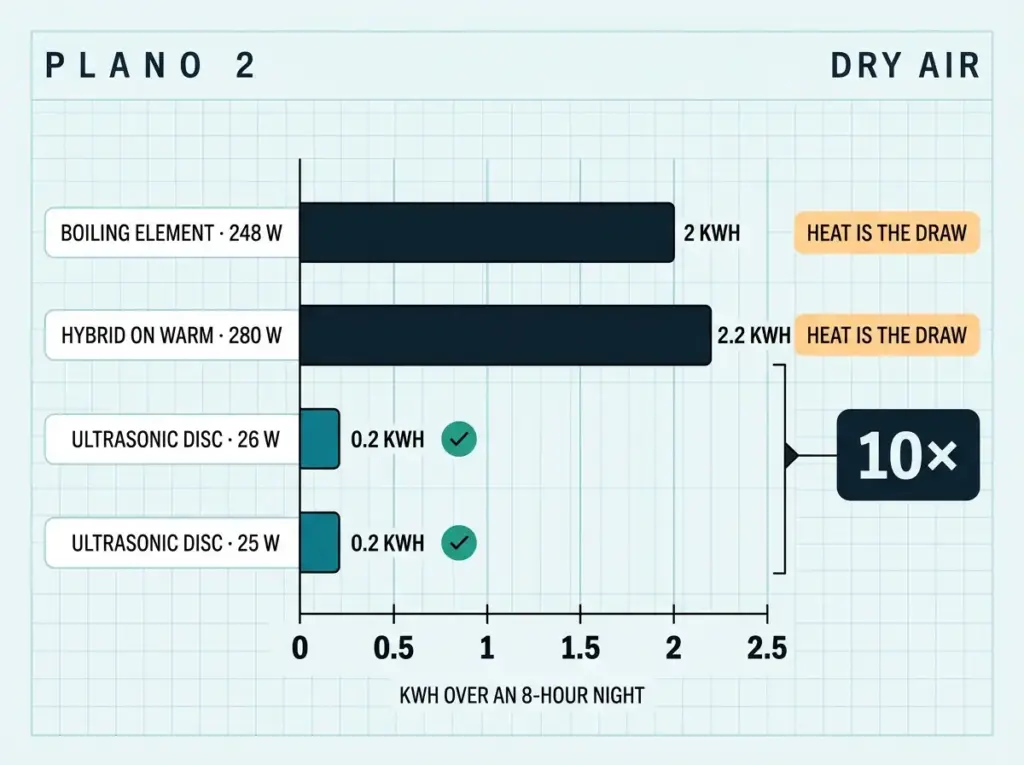
A hybrid listed at 280 W on warm puts a similar draw on the heat, and the cool setting on the same tank is the cheap one. And a cool-mist night costs a fraction of either: the disc turns the electricity into vibration and leaves the evaporating to the room.
Where a Hot Unit Belongs in the Room
The EPA says to keep steam vaporizer humidifiers out of the reach of children, because steam and boiling water may cause burns, and the way to follow that in a house is placement. Put the unit on a sturdy, level surface at a height and in a spot where a person or a pet cannot knock it over. Keep the cord short and off the walkway, and never beside the edge of the bed. A hot unit is a placement decision before it is a cleaning one.
Route the cord to the wall behind the unit and walk the path in the dark before the first night. The spot that looked safe in daylight is often the one a bare foot finds at night.
The Warm-Mist Pick and What Is Wrong With It
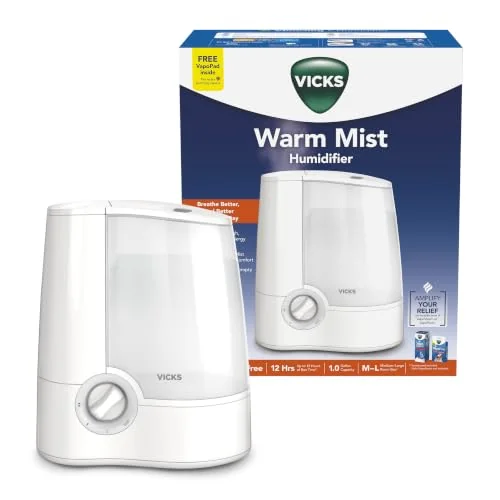
The Vicks Warm Mist Humidifier V745 is the cheapest way into warm mist, and the one whose listing prints its wattage, so the night’s cost can be worked out instead of guessed. It holds one gallon, has no filter and shuts itself off, at 248 W. Noise is split, with some units near silent in use and others loud, durability is split too, with units breaking inside a month, and leakage keeps coming up.
A cheap warm-mist unit at the bottom of the range is in practice a disposable one: a low-priced appliance that dies in a season costs less than a dear one that dies in two. The element, meanwhile, rings itself with scale and wants descaling every few months, and left alone it gurgles louder and puts out less. When it comes out, the heater wears a hard white collar that has to be scraped off with a tool.
One Unit, Two Mists, and the Noise on the Pillow Side
A unit that makes both kinds of mist settles the argument by letting one household try each in the same room. The next number that matters in a bedroom is then not the mist at all but how loud the lowest setting is.

Warm and Cool in One Tank, and What That Costs
The Dreo HM713S 6 L Smart Humidifier puts warm and cool mist on one top-fill tank, rated at 500 mL/h and 280 W on warm, with a humidity sensor and an auto mode that runs from 30 to 90 percent. That lets a household use the cool setting most nights and the warm one on the nights the arithmetic says it is worth it: one unit, two bills, and the meter says which one the room needed. Durability is the note that repeats, with units breaking inside a month, some giving little or no mist and some leaking. The tank is too tall to fit under a shallow faucet, and the inner parts stay hot to the touch after a run.
The Hum of a Fan, the Silence of a Disc and a Boil
Each type sounds different, and the decibels on the box are the only way to compare them. A fan on an evaporative unit hums, a disc is close to silent, and a boiling element is quiet apart from the gurgle that signals scale. A unit that whistles a little is giving the early warning: the noise is scale in the works, and it comes before the failure. A unit that was almost silent in its first week and begins to whistle around week eight does not have a new fault, it has the old one arriving.
The Lowest Setting Is the One You Sleep On
The Levoit OasisMist 450S 4.5 L is the hybrid with the lowest stated noise: 26 dB on its lowest setting (the maker’s figure), a 4.5 L top-fill tank, 430 square feet on the box and an auto mode that holds 40 to 60 percent. The lowest setting is the only one a shut bedroom lives with, and the coverage on the box belongs to the highest. Cleaning splits opinion on this one, easy for some and a long job for others, and in one independent comparison it held onto more bacteria than the other models tested.
Trust the sensor on any of these units only as far as the meter agrees with it, since a unit’s own display can read several points off. The setting to match is the one in the humidistat setting and why the glass overrules the dial: when the window beads, the dial loses.
What Each One Looks Like in the Second Month
The first week flatters every unit. By the second month the differences are on the parts: a collar on the element, a stiff wick, a tank that smells when the unit is switched back on after a few days of standing.

Two Clocks: Fresh Water Daily, a Scrub Every Third Day
The EPA sets two clocks for a portable unit: empty and refill the tank daily, and clean it every third day by scrubbing off scale and film and wiping it dry. The cleaning solution and the steps belong to the maker’s manual, which decides what is safe for each part. A tank left standing is where a film grows, and it smells the moment the unit comes back on.
The Collar, the Dust and the Stiff Wick
By about the eighth week each type has worn in a different place. The boiling element wears a hard white collar that has to be scraped. The ultrasonic unit builds up film (biofilm and mineral crust) on the base and the disc.
The wick goes stiff, brown and dry in the middle and has stopped pulling water, so the unit is now a fan, and the wick is rated for months, not for the year. Filter replacement on a wick is the cheapest of the three chores, because the wick is a replaceable part. The element and the tank are not.
Date the wick with a pencil mark on the housing the day it goes in. A stiff, brown wick stops pulling water long before the unit looks broken, and the mark tells you which morning to check it.
The Tank That Smells After a Few Days Dry
A tank that smells when the unit is switched on again was standing wet while it sat unused. Empty it, dry it and refill only on the day it runs. Whether a vinegar solution or a new wick is the better move is for the manual to say, because it knows which part tolerates the acid. By month two the tank is where the habit shows.
A unit that keeps running past what the room can hold is how mold and mildew get a start, first on the coldest surface near it and later on the ceiling above, even in a room whose windows open every day. The glass gives the earlier warning, and what the water on the window is telling you about the unit covers how to read it.
Size, Placement and When the Dry Room Is the Building
Once the type is chosen, the last questions are how much unit and where, and the first sensible answer is that a box’s coverage is a lab ceiling. The other answer is that sometimes the machine was never the problem.

The Square Feet on the Box Are a Ceiling
Most of the units here claim between roughly 430 and 550 square feet, and a shut bedroom gets a fraction of that ceiling. The tank, not the square footage, decides whether you are refilling at 2 a.m. For the sizing decision itself, which unit suits a bedroom with the door shut is the page that carries it.
Away From the Wall, Off the Nightstand
Move the unit off the nightstand and away from the wall so the mist has room to spread instead of landing on one surface. A unit parked against a cold outer wall wets that wall first, and the corner behind it is where a damp line appears. Run it only while the room reads below the band, and switch it off when the reading is back inside.
When the Window or the Furnace Is the Reason
A dry room with a window that leaks, or a furnace that over-runs, is a building problem, and a portable humidifier fixes neither.
When the whole house reads dry, a whole house humidifier (a bypass unit on the furnace, not a console on the floor) is the larger fix, and the portable one stays a bedroom tool. Read the reading, change one thing, read it again. The 60 percent line is the one a unit can push a room across, and the same 60 percent line and what it means for mold applies to a portable unit as it does to a duct. And when the room is already over the band, the fix is a lower reading and not a different mist: what to do when the room is already over the band starts there.
Hold a hand near a window frame on a cold night. A moving trickle of air there means the room is losing its moisture faster than any unit can add it, and sealing the gap changes the reading more than a bigger tank would.
Read Bedtime and Dawn First, Then Let the Water Pick the Type
The number comes from the room, read at bedtime and again at dawn. Both mists raise it the same way, so the water decides: dust from a disc, scale on an element, a stiff wick. The boiling element draws about ten times the current of a disc, a hot unit goes on a sturdy surface out of reach and away from the edge, and a hybrid lets one household try both. Every unit carries its flaw, written beside it, and a dry room is sometimes the window or the furnace and not the machine.
Check back on the parts that drift: the collar on the element after the first few weeks, the film in the tank after a few days of standing, the wick at the six-month mark the maker quotes, and the dawn reading against the bedtime one as the weather turns, which is the story in why the safe setting falls as the weather gets colder.
Tonight, put the meter in the bedroom and read it at bedtime. Read it again at dawn. Tomorrow decide whether a unit is needed at all and, if so, which water the house can put in it, starting with the free fixes for a dry house between 30 and 50 percent.
Frequently Asked Questions
01Which is better, a cool mist or a warm mist humidifier?
Neither raises humidity better, because both add the same water to the same room. The difference is what stays behind: mineral dust from a cool-mist disc, scale on a warm-mist element, plus watts, noise and cleaning.
02What are the downsides of a cool mist humidifier?
An ultrasonic unit throws the tank’s minerals into the room as white dust on hard water, and its tank needs fresh water daily and a scrub every third day. A wick unit avoids the dust, but its wick stiffens and needs replacing.
03Does a warm mist humidifier use more electricity?
Yes, about ten times more. A boiling-element unit rated at 248 W uses roughly 2 kilowatt-hours over an eight-hour night, against about 0.2 for an ultrasonic disc rated at 26 W.
04Can a humidifier run all night in a bedroom?
Only while the room reads below the band, since the EPA says not to humidify above 50 percent. Water beading on the window at dawn means the setting is too high or the unit is too big for the room.
05How often should you clean a portable humidifier?
The EPA says to empty and refill the tank daily and to scrub off scale and film every third day, then wipe it dry. A tank left standing smells when the unit is switched back on.