
The dial on the wall says 45. The small meter on the shelf says 30, the windows are clear and dry, the furnace has been cycling all evening, and you finally typed why is my whole house humidifier not working into a search box. A unit that is on is not the same as a unit that is adding water: this kind only humidifies while the furnace blower is moving air and the humidistat is asking for more, and each of those two conditions can fail separately. The free checks come first (the hours the unit really runs, one flap, the dial against the weather, the water at the pad), then the two small parts, then the house itself, and a bigger unit comes last.
Quick Answer
Most of the time the unit is not broken. It is not running (no heat call, so no blower and no water) or only half running: a crusted pad, a drip at the drain, or an airflow flap left on summer. Check those against the outdoor temperature before buying a part.
A Dial at 45% and a House at 30%
The unit’s own dial says one thing and the house says another, and every fix below is a way of closing that distance. So the first job is to find out which of the two numbers is telling the truth, with a reading taken in the room you actually live in.
What the dial is promising
The automatic control that ships with units like the Aprilaire 600 sets a target anywhere from 10 to 45% relative humidity, with an accuracy of about three points either way. That makes 45 the ceiling of the control, and it says nothing about what a house can hold. It is a target the unit tries to reach whenever conditions allow, and a target makes no promise about delivery.
The control also reads the air at its own address, on the return duct or on a wall near it. The living room, the hall and a bedroom at the far end of the duct run can all read differently from that spot, so a number on the dial is a statement about one place in the house.
A second reading in the room you use
Put a hygrometer on a shelf in the room that matters, away from the kitchen and the bathroom, and leave it there for a day. The AcuRite 00613 (the 00613B listing) is a small thermometer and hygrometer, about 3 in by 2.5 in, that keeps the day’s high and low so you can see how the number moves instead of catching one moment. Its accuracy is middling and its durability uneven: some units run for years and others quit within days, so a surprising reading deserves a second meter or a second room before you act on it.
It is the cheapest purchase in this whole article and it changes every decision after it. The method for three readings from one meter takes a few minutes and settles whether the house reads 30 or the dial is reporting for a different room.
A reading at 30 with a clear pane is the house telling the truth. The dial and the room disagree more often than any part fails, and that is worth knowing before a wrench comes out.
Where the EPA’s band stops
The number you are judging all of this against comes from the EPA.
According to the EPA’s humidity range for a home, “If possible, keep indoor humidity below 60 percent (ideally between 30 and 50 percent) relative humidity.” A dial parked at 45 already sits in the upper half of that band, so the unit is not being asked for something unreasonable.
What the band cannot say is whether a particular house, in a particular week, will let a bypass unit deliver it. The long version of the band a home is measured against explains each reading in turn. Everything from here on is about the distance between 30 and the number you asked for, and what is eating it.
The Unit Only Works While the Furnace Fires
With a reading in hand, the first free check is not on the unit at all. A bypass or fan-powered humidifier (the evaporator pad does the work in both) adds water only while the blower is moving air, so the question is how many hours a day it was actually given a chance.

Why a mild week shuts the unit out
The air-conditioning, heating and refrigeration trade association, AHRI, describes a bypass or fan-powered evaporative unit as adding moisture only when the humidistat is calling for humidity and the furnace blower is running. Both conditions have to be true at once. A unit that is watered, wired and set to 45 still adds nothing in an hour when the burner never fires.
Aprilaire’s own capacity table makes the same point in its footnote: the printed gallons assume the blower runs all the time, a plenum at 120°F (49°C) and cold incoming water. A house whose burner fires twenty minutes an hour never sees that number. The rated 17 gallons a day belongs to a heating season at full blast, and a thermostat set to 64°F (18°C) in a mild week gives the unit a fraction of the hours it was rated for. It is the same unit with fewer heat calls, so a unit that seems fine in a cold week goes silent in a mild one.
Fan on, not auto
The cheapest hours to buy are the blower’s. Moving the thermostat fan from AUTO to ON (the continuous fan, or a circulation mode) keeps air moving across the pad between heat calls. The cost is arithmetic you can run with the furnace’s nameplate: blower watts times hours, divided by 1,000, gives kilowatt-hours. A blower drawing 400 watts all day is 9.6 kWh, or about 290 kWh over thirty days, and a modern variable-speed motor draws a good deal less.
Check the manual first, because the fan setting does not help every installation. A unit wired to the furnace’s humidifier terminal (HUM on the furnace control board) opens its water valve only during a heat call, and on that unit the fan setting changes nothing while a slightly higher heat call is the lever. And the manufacturer rules on what continuous fan is allowed to do to a given furnace. Read the meter after one evening on the new setting, and only then move anything else.
Write the meter’s reading at the same hour on a cold day and on a mild one, with the dial untouched. If the cold day reads several points higher, the lever is hours, and no part has anything to do with it.
One room opened up
Humidified air has to travel somewhere to register on a meter. A bedroom with the door shut and the supply vent closed gets almost none of it, and its reading stays low while the hall’s climbs. Open that door and that vent for an evening, then read the room again. If the number moves, the air was never reaching the room, and the unit was doing its job elsewhere.
The Airflow Flap a Fall Cleaning Leaves on Summer
If the furnace is firing and the blower is moving, the next free thing is a lever, and it is one the unit’s own upkeep can break. The cleaning that was meant to help is the one that can leave the humidifier running and useless all winter.
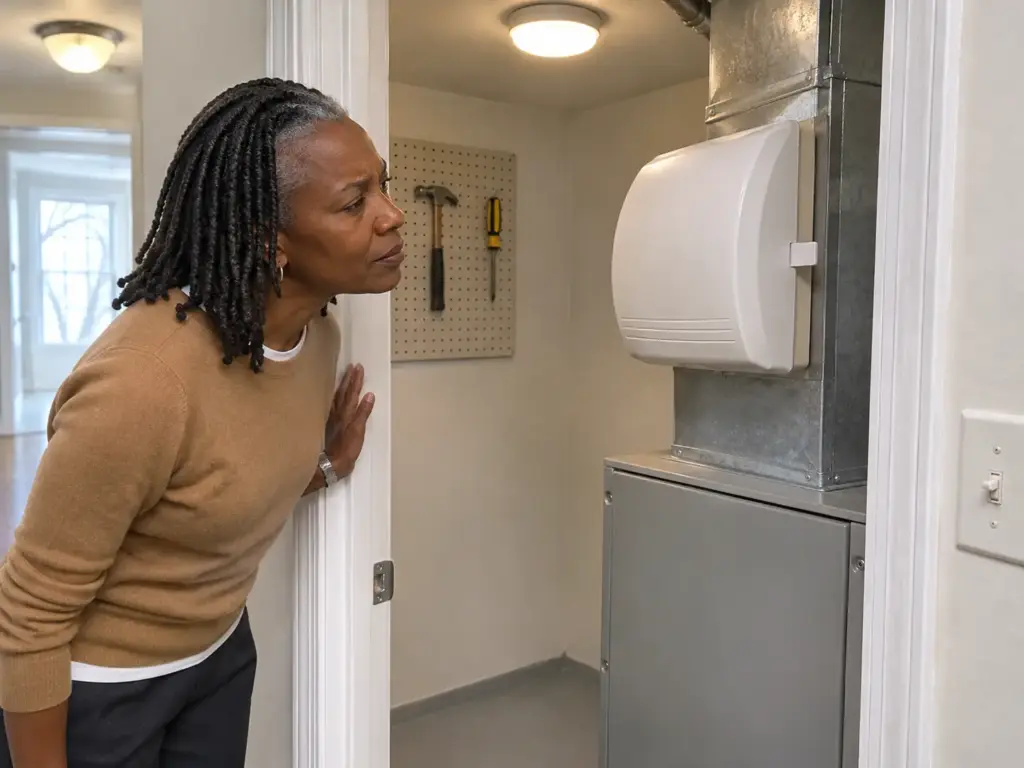
The cover that only fits one way
On a bypass unit the airflow flap (the bypass damper) has a summer position and a winter position. The cover goes back on only with the flap in its summer position, so a tray cleaning in the fall can end with the flap shut: the unit waters the pad all winter and humidifies nothing. The unit is working perfectly, in the sense that water flows and the pad gets wet. The air simply has no path through the pad.
It is a trap for the careful owner, the one who did the fall chores in the right order and still has a dry house in December. Swapping the pad and cleaning the tray is a perfectly good job to do. The only addition is a look at the lever afterward, which is labeled, moves freely and takes a second. A fan-powered unit has no damper at all, so this check belongs to bypass units: if there is a round duct running from the humidifier to the return plenum, yours is a bypass.
Take a photo of the flap’s label before the cover comes off, and look at it again once the cover is back on. The manual shows where the lever can still be reached and which position means winter.
Both controls have to say yes
A flap is rarely the only thing wrong. In the cases that resolve, there are two faults at once: the flap on summer and a loose wire connection at the valve, never one cause alone. So when one fix leaves the reading where it was, the sensible move is to look for the second.
The unit also needs two controls to agree before the valve is a suspect, which is the whole winter-mode logic of a bypass humidifier. The humidistat has to be calling for humidity, and the airflow sensor or proving switch in the duct has to confirm that the blower is moving air. A valve with 24 volts and no airflow signal still adds nothing, which makes it a bad idea to condemn it before both controls have been proven.
A 45% Dial in a 20°F Week
The lever costs nothing and so does the next check, which needs no tools at all: the number the dial was asked for may never have been reachable that week. What the outdoor temperature allows is a limit the unit cannot argue with.

Colder outside, lower on the dial
The safe setting falls as the outdoor temperature falls. A windowpane is the coldest surface in the room, and a setting that is fine in a mild week fogs that pane in a hard freeze, because the glass sits below the dew point of the room’s air. The full ladder lives in the linked chart of targets by outdoor temperature, and here only the direction matters: colder outside, lower on the dial. As a rule of thumb, near 20°F (-7°C) the setting belongs in the mid-30s, and the number is a guide, not a promise.
The mistake is to leave the dial at its October number through the first cold snap and then blame the unit for a figure the weather had already ruled out. Turning the dial up in that week does not fix the reading. It fogs the glass.
The glass as the real ceiling
The glass outranks the dial.
The EPA says on its advice on how far to turn a humidifier that “If water condenses on windows, walls, or pictures, relocate the humidifier, lower its humidistat setting, or reduce its use.” The same page says not to humidify past 50 percent at all. Fog on the pane means the setting is too high for that outdoor temperature. It does not mean the unit is working well.
The lower corner of the window beads first, and it is the earliest warning you get. A wet corner with a meter that still reads 30 in the middle of the room tells you the room is losing moisture to the glass and the weather, so the unit is not failing. What a fogged pane is telling you covers how to read the pattern, and the curve of the dial across a winter is in which setting to use for winter when the dial lies.
A Drip at the Drain Instead of a Steady Stream
With the hours, the flap and the dial ruled out, what is left is water, and water can be measured with a glance at the drain line. A unit can be wired, blowing and set right and still be starved at the pad.

Watching the drain line
The manufacturer’s instruction for drain-type units is specific: the correct water flow is set by an orifice fitted to each unit, and while the unit runs there is a small, steady stream to the drain that flushes out the minerals. A steady drip is the diagnosis (a clogged orifice is the usual reason). A stream means water is arriving at the pad.
Wait for a heat call, then watch the drain outlet with a flashlight for a full minute. A thread of water that never breaks into drops passes. Drops that fall singly are the answer, and no part needs to be bought to learn it.
The orifice and the strainer that clog over summer
The metering orifice and the valve’s small inlet strainer are what clog while the unit sits idle through the warm months. The flow drops to a drip, the pad dries out, and the unit that worked in October is dry in December with nothing broken at all. Pulling and cleaning that strainer is the repair that brings the stream back, and it can be done the same evening. Shut the water supply valve at its shutoff before anything is taken apart, and let the manual rule on the rest of the disassembly.
The saddle valve is open or shut
A saddle valve is not a flow regulator. It is designed to be completely open or completely closed, and the orifice does the regulating. A piercing valve that clogs every season is the budget fix to remove: a proper 1/4 inch shutoff in its place keeps the supply from silting up the same way. If the stream is still a drip with a clean strainer and a shutoff that opens fully, the job moves to a technician.
A Crusted Pad Sends the Water Straight Down the Drain
If water is arriving and the house is still dry, the water is probably not evaporating. The part that makes it evaporate wears out by design, and it is the cheapest thing in the unit to replace.

Scale, rust and the pad that stops soaking
The pad (the water panel) is a consumable. Aprilaire’s interval is one panel per heating season, and two on hard water.
A pad coated in mineral scale stops soaking up the water, so it runs straight to the drain instead of evaporating into the airstream. From the front it can look fine. A pad that rings stiff and gray along its lower edge is already finished, whatever the calendar says.
Right way up, seated level
A pad installed backwards or off level passes water through. It has a top and a bottom, and it must sit level in its tray so water spreads across it instead of running down one edge. A new pad also sheds gunk into the drain line and the duct for the first days. That is the pad settling in and has nothing to do with the water heater.
The second month
The first week after a swap is the easy part. On hard water a pad crusts again inside the same season, so the output you measured in October is not the output of February. The right size matters for the swap: the Model 35 measures 10 in wide by 13 in high by 1.75 in deep, and it is the pad that fits the 600 and 700 family and the 560 and 568.
The AprilAire 35 water panel in a pack of 2 covers a season and the spare. Its only weakness is that it is a consumable: one per season, two on hard water, and always the first part to swap before anything involving a wire. The schedule for how often the pad needs to go depends on how hard the local water is.
Twenty-Four Volts at the Valve, or None
If the pad is fresh and water still is not coming through, the last small part is the valve that lets it in, and a good test of it takes two numbers.

Two numbers that decide it
The valve is rated 24 volts AC at 0.5 amp (24 VAC on the label). Set a multimeter to AC volts and read across the valve’s terminals while the humidistat is truly asking, which means the dial turned up above the room’s reading. In a healthy unit the humidistat leg passed a trace of about 0.1 volt with the dial low and about 23 volts with it high. If the humidistat never passes more than a trace, the valve was never the problem: the call for water never reached it.
Resistance tells the other half. One documented pair of coil readings is 22.4 ohms for a new coil and 30.3 ohms for the 2009 original it replaced, which is how a tired coil shows itself. A valve with 24 volts present and no water coming through is the one to replace. The part that fails is the valve, and replacing it takes a wrench and a screwdriver and about fifteen minutes, with the water shut off and the power switch at the furnace off.
Read the voltage at the valve itself and leave the furnace’s own terminals alone. A reading taken at the valve with the control calling is the only one that proves the signal arrives where the water is.
The AprilAire 4040 is the replacement for the 400, 500, 600, 700 and 760 series (the 4040 solenoid valve), and it ships with the in-line strainer, a compression sleeve and a nut. It can leak past the seat, its durability is uneven, and the box carries no parts list, so photograph the old assembly before taking it apart. An aftermarket copy exists at a fraction of the cost, and that is a comparison point only: start with the genuine part.
The loose connection at the valve
A loose wire nut at the valve was the second fault in the cases that resolved, with the valve itself fine. Look at it before buying the part. A connection that has worked loose looks identical to a dead coil from the far side of the duct.
What goes to a technician
The valve is an owner’s job. The control board, the transformer, the wiring and anything touching the gas side of the furnace belong to a technician, and that is the end of the owner’s list. Which jobs on a unit like this are yours and which are a technician’s draws the line more fully.
A 17-Gallon Unit in a House That Leaks
If the hours, the flap, the water and the parts all check out and the reading will not climb, the reason is no longer a part. It is arithmetic between what the unit can add and what the house loses.

The same rating, three houses
Aprilaire prints 17 gallons per day (0.7 gallon an hour) for the AprilAire 600, for tightly constructed homes up to 5,000 square feet. The sizing table behind that figure rates the same 16.7 gallons a day for 5,000 square feet in a tight house, 2,500 square feet in an average one and 1,500 square feet in a loose one. The same machine is a 5,000-square-foot humidifier or a 1,500-square-foot one, depending on the house, and a working 600 can lose to a leaky older house.
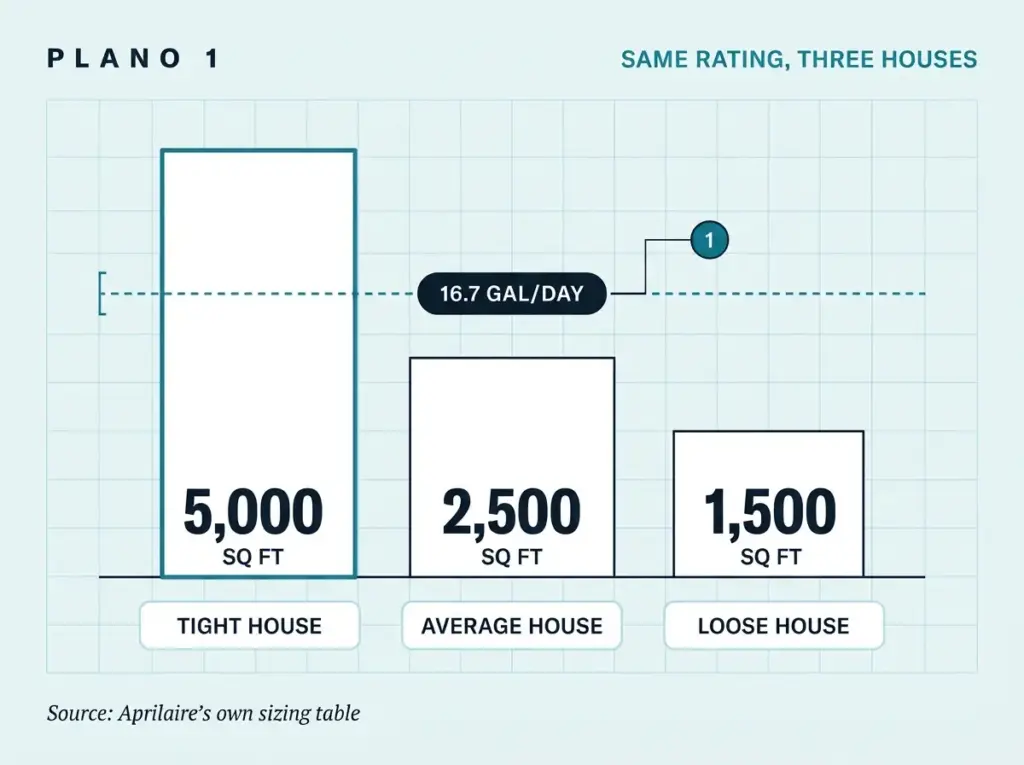
The 600 is a bypass unit with an automatic control, and two things about it are uneven: the control can be fussy to set up, and the hardware in the box can come up short. That rating is also a laboratory condition. It assumes the blower runs all the time, as the footnote says. A bypass unit tops out well below a steam unit, and no repair changes that.
Where a house loses its moisture
The house doesn’t hold humidity is a contractor’s exit line, and it is true only when it comes with a list. The usual suspects are recessed lights, the attic hatch, a skylight, ducts through unconditioned space (the duct leakage nobody sees from the living room) and the air leakage around every one of them. Each one lets the moisture the unit adds walk out as fast as it goes in. The reasons behind why a house reads so low in the first place are worth a pass with that list in hand.
The hours column is the nail in the argument. In a house that fires its burner for twenty minutes an hour, the same unit is a different machine from the one that was rated.
How to prove it before spending
Take the reading with the unit running and every door shut, then take it again at a different outdoor temperature.
If the number tracks the weather closely and barely moves with the dial, the house is the limit. A blower door test is the professional’s answer when the list of leaks is long, and it measures the building rather than the unit. And be honest about the flaw of any upgrade: a bigger unit in a leaky house still loses. For the opposite error, a humidifier asked to do too much, see what a reading that stays low is really saying.
Repair First, Step Up Second, Humidify the Bedroom Alone
Once the ceiling is proven, the question stops being what is broken and becomes the cheapest way to move the reading, and the answer comes in a fixed order.

When to stop repairing
The repairable list is a pad and a valve, both small and both doable. The unrepairable list is the control board, the transformer and the heat-exchanger side, which a technician handles, and the ceiling case is no part at all. It is gallons per day against the house.
A pad costs a fraction of a valve, a valve costs a fraction of a unit, and a new unit in a leaky house still loses to a meter in the right room. When the pad and valve are fresh and the stream is steady, stop spending on parts. Room unit against whole-house unit, measured first lays out how to decide which kind of device the house actually needs.
The cheapest added capacity
The cheapest way to add capacity without touching the duct layout is a budget bypass in the same footprint, the Honeywell Home HE200A1000. It is a drop-in for an older Honeywell of the same size, with a built-in humidistat at 24 volts and a rating of roughly 12 gallons a day for up to about 2,000 square feet, so read the box for the figure that applies. Its control is accurate to about five points either way, and the solenoid is the part that tends to fail after a few years.
A heat pump house, or a house with no room for a bypass duct, takes the fan-powered sibling, the AprilAire 700M. Above that sits the AprilAire 800 steam unit, whose price of admission is a 220-volt circuit and a professional install. The models that fit the house you have compares them, and what the step up costs once it is installed covers the money.
The room the duct never reaches
For one bedroom the duct does not serve, a single-room unit beats re-piping the house.
The Levoit Superior 6000S is an evaporative console with a 23-liter tank, a stated 1,500 mL an hour and a stated reach of up to 3,000 square feet. It runs on tap water without throwing white dust onto the furniture. It costs more than a one-room job strictly needs, and it is one zone, which makes it a bedroom answer only. Close the door and read that room’s meter.
Tonight: the Meter, the Fan Setting and a Look at the Drain
A unit that is on is a unit that has to be given heat hours, water at the pad and air across it, and the dial is a target the weather can rule out. The stream at the drain and the clear pane are the two checks that cost nothing, the pad and the valve are the only small parts worth buying, and a house that leaks outruns any bypass unit.
Look at the drain line again once the first cold weeks have passed, because the strainer that clogged over the summer is the part most likely to slow down again. On hard water, press the pad’s lower edge in the middle of the season: stiffness there means the season’s panel is done.
For tomorrow, put the meter on the shelf in the room that matters, set the fan to ON for one cold evening if the manual allows it, and read the number again in the morning. The order of the fixes once the unit itself is fine picks up from there.
Frequently Asked Questions
01What are the common reasons a whole house humidifier isn’t working?
Most often the unit gets too few heat hours, the airflow flap is still on summer, or water arrives as a drip. After those come a crusted pad, a valve with no 24 volts, and a house that outruns the rated gallons. Check them free-first, in that order.
02Should a whole house humidifier run all the time?
No. It runs only while the humidistat asks for humidity and the furnace blower moves air, so it cycles. Keep the setting honest for the season, with a fogged window as the stop sign. See what an idle pad and a cold duct run can do.
03Why isn’t my Aprilaire humidifier raising the humidity?
Run the same order as this article: the heat call, the airflow flap, the stream at the drain, the pad, then the valve. If all of those pass, compare the rated gallons per day against how leaky the house is.
04Why is my air still dry even though a humidifier is running?
A unit that is on is not necessarily humidifying. The hours it runs, the outdoor temperature and the leaks in the house decide how much water stays in the air. A meter in the room tells you which one it is.
05Why does my whole house humidifier drain water all the time?
Drain-type units send a small steady stream to the drain on purpose, to flush the minerals. A heavy stream with no change in the reading points to a crusted pad or the orifice. The manual rules on the rest.