
You opened the cover of the furnace humidifier that came with the house and found a gray panel wearing a white film, the same film on the plastic door, and no manual anywhere in sight. So how do you clean a whole house humidifier like that? Water runs down the panel, the furnace’s air picks the water up as it passes, and the minerals stay behind, so the film builds up in the one part meant to wear out. This guide to whole-house humidifier cleaning takes the job in the order the water travels: water and power off, a check that water arrives, the tray, the panel, the clocks, and then the humidistat setting.
Quick Answer
On a furnace-mounted unit, the order of the work matters more than the scrubbing.
- Shut off the water supply and disconnect power.
- Flush the strainer and clear the drain line.
- Scrape the mineral crust you can reach off the tray.
- Replace the water panel once each heating season instead of scrubbing it again.
- Hand a steam unit to an HVAC technician.
Find the Unit Type and the Model Number Before You Touch It
What you clean depends on which of three machines is behind that cover, and the label that tells you is the first thing to find. Whether anyone in the house feels better or worse around a humidifier is a question for a doctor, and no cleaning schedule can answer it; this page stays with the machine, the water and the house.
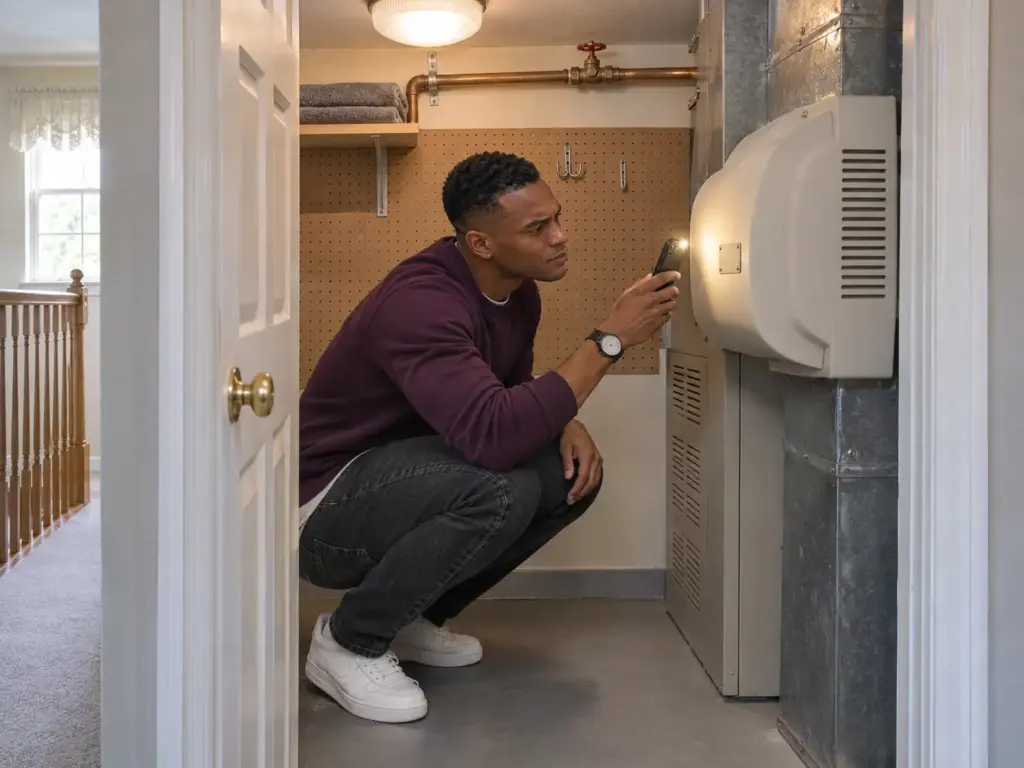
Three machines wear the same cover
A bypass humidifier (also called flow-through or drip) sends water down a panel while a duct carries furnace air across it. A fan-powered humidifier does the same job with a built-in blower pushing air through the panel. A steam humidifier has no panel at all: it boils water in a canister and sends the steam out through a dispersion tube. So the water panel belongs to the first two machines, and the canister to the third.
That panel gets called the insert, the humidifier pad, the evaporator pad, even the filter. Here it is the water panel, because a rated filter it is not: water runs down it and the air takes the water as it passes, which makes it a surface that wears out instead of a screen that traps. If the unit on the furnace was never the right machine for the house, whether a whole-house unit or a room humidifier fits the house comes down to a humidity reading, and it is worth settling first.
Where the model number hides
The model number is rarely on the cover. Look for a plate on the housing or on the duct side of the unit. A house that has gone years without service usually shows the same two things: a white film on the panel and the door, and a plate nowhere near where anyone looks.
The number matters because the maker’s directions are the clock for a furnace unit. For console and central (furnace-mounted) units, the EPA’s guidance on using and caring for a home humidifier sends the reader to the manufacturer’s directions on cleaning and maintenance, and the model number is how those directions get found.
Photograph the panel in its seat, then the plate, before a clip or a screw comes out. The first picture shows how the panel sits against the tray and which way it faces. The second is the part number for every later decision.
A steam unit is the professional’s job
If the plate says steam, the job changes size. Trane’s directions call for replacing the canister once a year, and sooner when the unit’s service light asks for it, depending on whether the water is hard or soft. The plumbing, the drain and the steam hose belong to a technician’s yearly visit, and Trane puts that professional maintenance at about every 500 hours of service. For the other two machines, a technician can fold the same checks into a furnace tune-up, and the remaining sections cover those, the ones with a panel.
Shut Off Water and Power, Then Check That Water Reaches the Panel
The scrub comes last. Before it come two switches and one reading, whether water reaches the panel and whether the drain runs, because a blocked line leaves a freshly cleaned unit doing nothing for the room. A unit that sat idle for three years or more deserves this check in its first heating season, before anyone decides the machine itself is the problem.
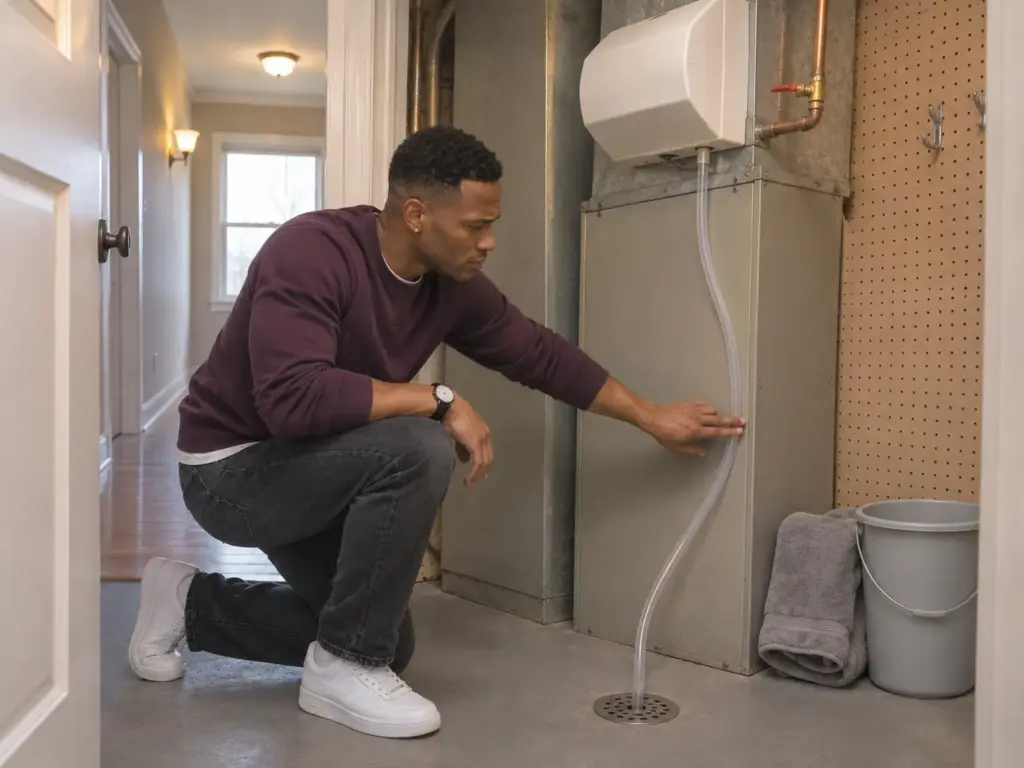
Water supply off, power disconnected
Trane puts two instructions ahead of any cleaning: turn the water supply off and disconnect the unit from power. The water valve is usually a small saddle valve on the supply line, the same one that gets closed for summer. Nothing in the next steps needs either one live.
Flush the strainer and clear the drain line
Trane’s sequence moves on to the in-line strainer and the drain hose: flush the strainer, clear the hose, and make sure the water supply orifice is not plugged. This is the step that decides whether the rest of the cleaning matters. A clogged strainer or a saddle valve that is only partly open starves the panel, and a starved panel stays dry where it should be wet no matter how well the tray is scraped.
The reading that proves it comes once everything is back together. With the supply open, power restored and the humidistat asking for humidity, water should reach the top of the panel. A panel that is wet low and dry high points to the strainer or the supply before it points to scale. That is also why a unit that has been off for years gets this check before it gets any judgment.
After the supply is back on, give the water several minutes to reach the top of the panel before you call it dry. A look taken too early reads the same as a blocked line.
Look at the inlet tube and the slope of the drain
Cracks or leaks in the water inlet tube go to an HVAC pro, because a leak is a repair and rinsing fixes nothing. For which parts of the water line and drain are a weekend job and which are not, the install guide goes through the line piece by piece.
The drain line slope matters: it needs a constant downward run and no kinks. A flat or pinched line keeps water sitting in the tray, and that is where the minerals settle. The furnace has a drain pan too, and the furnace’s own drain pan is a different wet part with a different problem, so trace which line is which before assuming the humidifier’s drain is clear.
Scrape the Tray and Housing Where You Can Reach
With the flow proven and the water off again, the tray and the housing are next, and the goal is smaller than most people fear. The scale within reach comes off; the rest waits for the panel.

Trane’s directions are modest: remove the mineral deposits from the distribution tray where you can get at them, and wipe the outside of the unit as needed. Rinsing does not remove the white film, which is mineral buildup. The water moves it around, and a scraper takes it off. The door carries the same film, and wiping it clean changes nothing about how much moisture reaches the house.
Whatever touches the tray gets rinsed thoroughly, because the EPA asks that any cleaning agent be rinsed out so none goes into the air. That is also why a store-bought descaler is not the first reach. The vinegar solution is the cleaner the maker names for the panel, and if the manual for your model names something else, the manual decides.
One reading is worth keeping from this step. The scale on the tray is a measure of the water, and it says nothing about how well the tray was cleaned. If the crust is thick again next month, the water is the variable, and a harder scrub will not move it.
Replace the Water Panel Instead of Scrubbing It Again
The panel is the part that wears, and the maker treats it that way: it gets cleaned once in a while or it gets replaced, and it never gets restored. This section puts those two choices in order and then matches the panel to the unit.
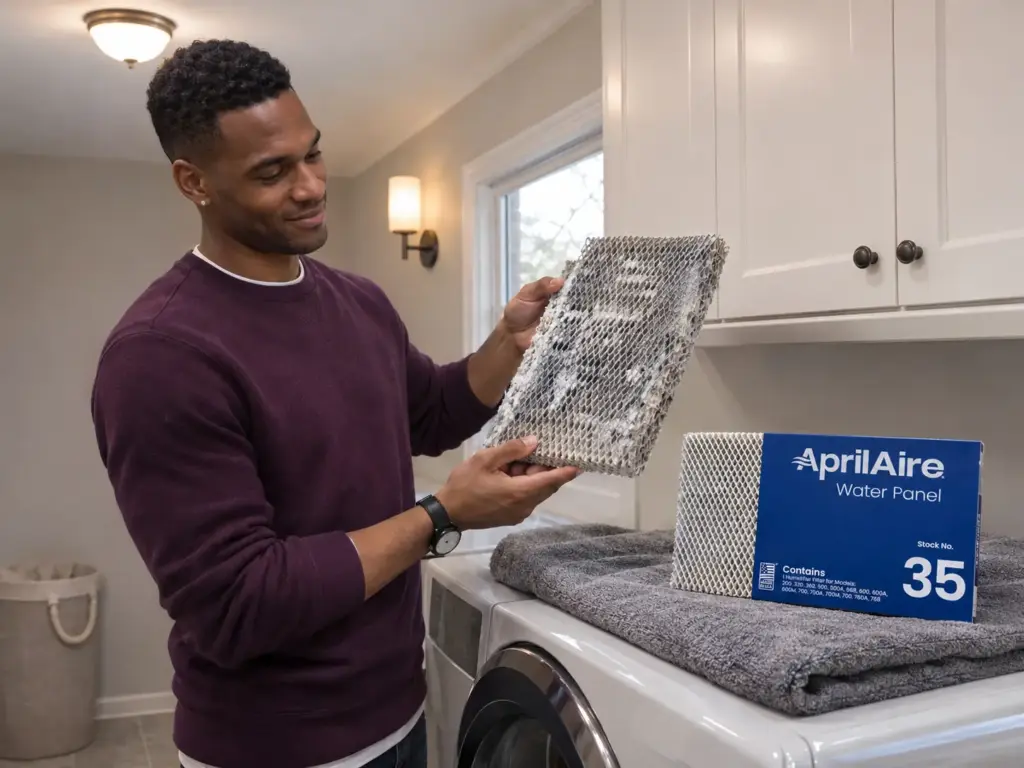
The free step first: Trane’s vinegar solution
Trane names two options for the water panel, clean it with a 1:3 solution of water to vinegar or replace it, and the free one comes first. Wash the panel in the solution, rinse it thoroughly, and look at it again. Vinegar does well on a light film.
What it cannot do is reach a white crust that has built up deep in the panel’s media, which is where the scale lives. The water runs down the panel, the air takes the water, and every mineral in that water stays. A panel that has carried that load for a season is a finished part, and no soak makes it a new one.
When the crust stays, the panel goes
Trane says a furnace unit generally needs a new panel about once a year, and annual pad replacement is the maker’s floor. Neither the EPA nor Trane puts a number of months against water hardness, so the water decides how much sooner, and the monthly look tells you when.
Two signs say the panel has run its course: it stays crusted after the vinegar, or the same white film is back in the same places within weeks of a wash. At month three, a panel that wears a fresh film in the same spots is showing the water, and another scrub is wasted effort.
A new panel can look pale or crusty straight out of the package because of its coating. The film that returns after a few weeks, in the same places, is the reading; the look on day one is not.
Match the panel to the model on the plate
The plate decides, and it is the only check that counts. For an AprilAire in the 300 to 768 series, the panel is the AprilAire 35 Water Panel Replacement (Pack of 2), an aluminum mesh with a ceramic-type coating that measures 13 by 10 by 1.75 inches. AprilAire calls for a new one once a season, so a pack of 2 covers this winter and next.
The coating is the thing to know: a new panel can pass for scale or mold, and that white coating should be left alone instead of scrubbed off to clean it. The second panel stays on the shelf until the next heating season.
Trane’s two part numbers split by unit size, and both are sold as compatible panels from other makers instead of Trane originals, so the number on the plate has to match. The small unit (EHUMD200, HUMD200, THUMD200) takes BAYPAD01A1010A, and the Trane BAYPAD01A1010A Compatible Water Panel, 1 Pack (HIFROM) is that part at about 10 by 9.5 by 1.5 inches, one panel per season for one unit. Because it is a compatible part, hold the old panel next to the new one for size before the cover goes back.
The larger Trane units (HUMD300A, HUMD500A, THUMD300ABA00B, THUMD500APA00B) take BAYPAD02A1310A. The Trane BAYPAD02A1310A Compatible Water Panel, 2 Pack (Bibolic) is aluminum and diatomaceous earth, with the second panel set aside for next season. It is another compatible part, and the listing names the compatible models without giving a size, so the plate and the part number are the whole check. It sits at the high end of the three.
For units beyond these families, which panel each popular whole-house unit takes is listed with the upkeep interval for each.
Write the month and year, and the model number from the plate, on a strip of tape on the furnace casing near the unit the day the new panel goes in. The film reading needs a starting date, and so does next season’s swap.
Which Cleaning Clock Belongs to a Furnace Unit
Every third day and daily are clocks written for portable tanks. A furnace unit runs on three slower ones, and this section says which clock is yours.

The portable tank’s clock is not yours
The EPA’s clock for portable humidifiers is cleaning every third day, and the Consumer Product Safety Commission’s cleaning routine for humidifiers asks for daily cleaning of portable units under five gallons. Both clocks belong to a tank that holds standing water for days. For console and central, furnace-mounted units the EPA says to follow the manufacturer’s directions, and the CPSC adds a line that applies here too: “Some units may require special maintenance steps so carefully follow the manufacturer’s cleaning directions.”
A furnace unit is built to run water over the panel and out the drain, so there is no tank of standing water to empty on a schedule. Cleaning it every third day means opening a unit that mostly needs a monthly look.
The monthly look, the yearly panel, the steam canister
A furnace unit’s three clocks are slower, and each belongs to a different part. The unit gets a monthly look during the heating season: remove the scale you can reach and wipe the outside as needed. The panel is replaced at least once a year. On a steam unit the canister is replaced annually, or sooner when the service light calls for it, depending on whether the water is hard or soft.
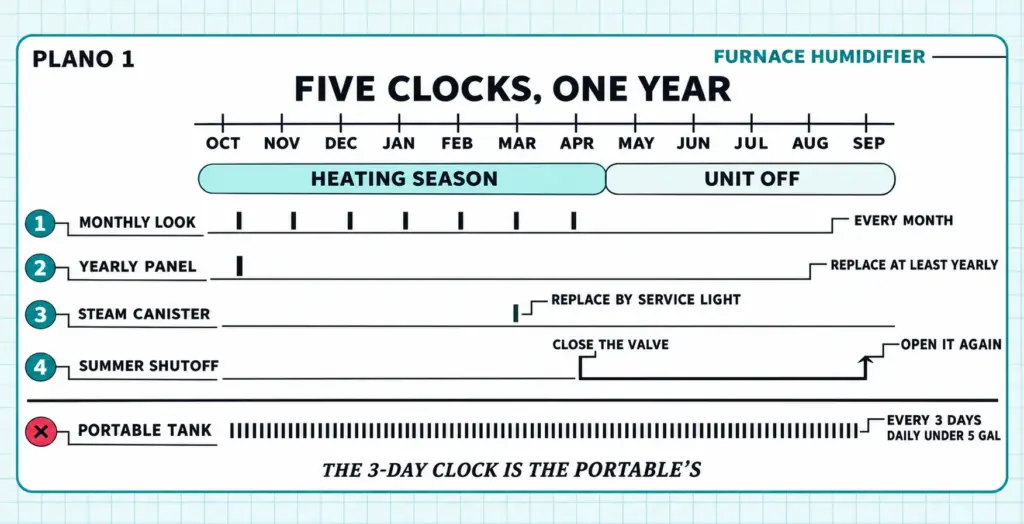
Those are the maker’s floors. Hard water moves the panel’s date earlier, and the steam canister’s too, and the monthly look is how you find out by how much. The panel is also a recurring cost, and what the yearly panel adds to the running cost is worked out as arithmetic on the cost page, which matters more as hard water pulls the swap earlier.
The summer shutoff and the October reopening
In summer, Trane closes the saddle valve on the water supply line and, on some models, the bypass damper, then reopens both when heating starts. The shutoff stops the water for the season; it cleans nothing. Many units have one, and the reader who closed it in spring gets asked in October to open it again.
A unit left idle with the valve open and the panel damp is the case covered by what a damp panel does to the duct while the unit sits idle. Closing the valve is what closes that door.
Set the reminder for the first cold week on the day the valve gets closed in spring. A valve reopened late means the first cold snap meets a dry panel and a humidistat with nothing to work with.
Reset the Humidistat Once the Unit Is Clean
A clean unit still humidifies to whatever the humidistat says, and the number that decides is the one the glass shows. The cleaning comes first and the setting second.

Under the EPA’s 50 percent ceiling, the instruction is plain: “Do not humidify to indoor relative humidity levels exceeding 50 percent.” Retail copy that suggests a 40 to 60 percent band runs past that ceiling, and the ceiling is the number to use. When water condenses on windows, walls or pictures, the EPA’s remedy is to lower the humidistat setting, relocate the humidifier or use it less. Beading on the glass is the signal to turn the setting down, and no amount of scrubbing answers it.
The window reads the setting before any meter does. Window condensation, beads along the lower corners, means the setting is above what the coldest pane allows that day.
The humidistat is a setting, and a hygrometer in the room gives the reading that confirms it. Trane’s table of recommended indoor humidity allows 45 percent at 40°F (4°C) and falls to 15 percent at -20°F (-29°C), so the number you set in November will not hold in January. The setting by outdoor temperature lays the whole table out against the outside temperature.
Find the Plate Tomorrow, Then Read the Glass
The order exists for a reason: water and power off, then the flow, then the tray, then the panel, because a blocked line or a worn panel makes a spotless tray irrelevant. On a bypass or fan-powered unit the water panel is the consumable, and the vinegar wash is the free step before the replacement the maker expects once a year. Your clocks are the monthly look, the yearly panel and the summer shutoff. The every-third-day clock belongs to portable tanks, and a steam unit goes to a technician.
A few weeks into the heating season, look at the tray and at the window glass during the first cold snap. Scale shows on the tray first, and beads at the lower corners of the glass mean the humidistat is set too high for that day’s outdoor temperature.
For tomorrow, before anything is ordered, find the plate and photograph it. Then, once the unit has run for a few days, read the room with a hygrometer and set it beside the humidistat setting.
Frequently Asked Questions
01Do you need to clean a whole house humidifier?
Yes, on the maker’s clock: a monthly look in the heating season, a new water panel at least once a year, and a water shutoff for summer. The every-third-day clock belongs to portable tanks. Hard water pulls the panel date earlier.
02Can I run vinegar through a whole house humidifier?
Trane’s directions give vinegar one job: a 1:3 solution of water to vinegar for cleaning the water panel, followed by a thorough rinse. For any other part of a furnace unit, the manual for your model decides.
03How long can water sit in a humidifier before it goes bad?
For portable humidifiers the EPA’s cleaning clock is every third day, so standing water in a tank gets a short leash. A furnace unit is built to run water through and drain, so the check there is whether the drain runs.
04How do I find the right replacement water panel for my model?
Read the model number on the unit’s plate, match it to the panel’s part number, and compare the old panel’s size with the new one before ordering. Compatible panels exist for several Trane and AprilAire models, so the number on the plate is the check.
05Can I clean a steam whole house humidifier myself?
A steam unit is a technician’s job: the canister is replaced annually or when its service light calls for it, and the plumbing, drain and steam hose get inspected. Hard or soft water changes how soon the canister is due.