You hang a wet load on the rack at ten at night, shut the bedroom door to hold the heat, and the room is what greets you the next morning: a musty smell with a sour edge that sits on the jeans and the hoodie while the thin shirts are fine. It is easy to decide that an indoor clothes drying rack smells bad and start sniffing the bars. The wood, the metal and the fabric straps hold no smell of their own, though.
What you are smelling is water that stayed in the cloth too long, and a shut room with no way out for the air is where water stays. The smell has three possible sources, and each has a check that costs nothing, starting with the one number the rack is standing in.
Quick Answer
The rack rarely makes the smell. The cloth does, when a load stays damp past the first night, and a shut bedroom is where that happens. Get the drying room under 60% relative humidity with air leaving it, and the load finishes before the smell starts. Check the rack’s bars and the washer next.
Why a Damp Load Starts to Smell Overnight
The smell follows a clock. Cloth that stays wet long enough grows what you smell, and the room’s air sets how long that takes; the full method for keeping humidity under 60% while clothes dry indoors is built on that fact. Before any fix, it helps to know what is growing and when it starts.
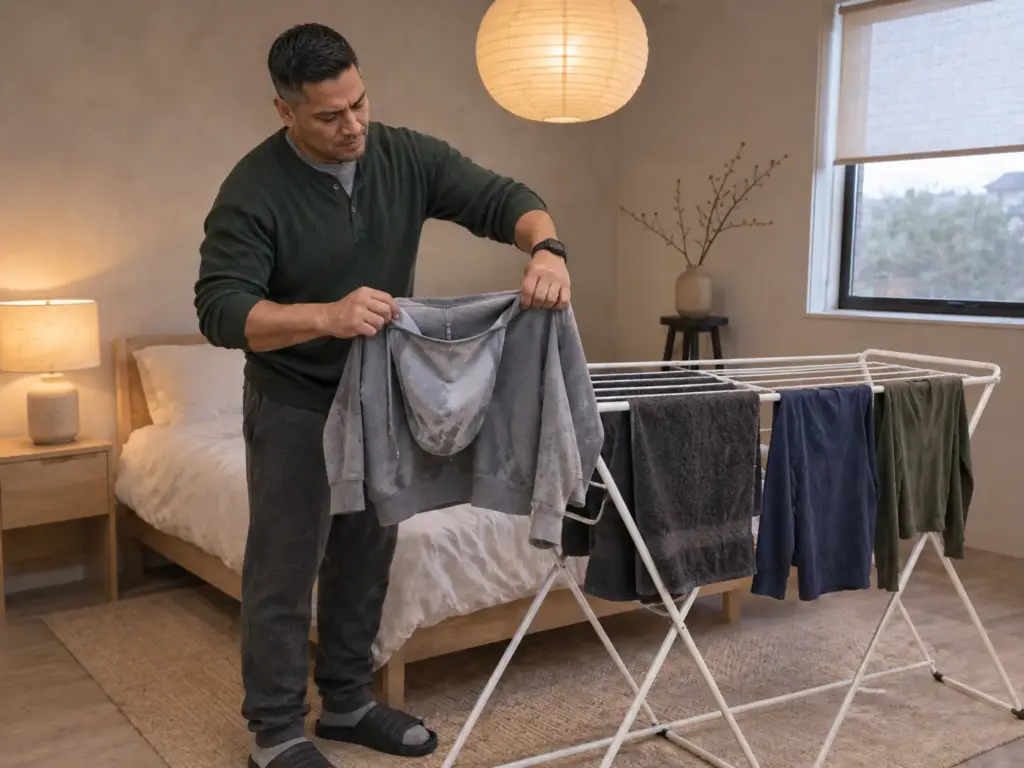
What Grows in Cloth That Stays Wet
Bacteria and mildew multiply wherever moisture sits, and a rack in a shut room with nothing moving the air leaves trapped moisture in the damp fabric for hours, and that gives the cloth a mildew smell. Air at room temperature gives water up slowly, and a pair of wet jeans has a lot of it to give. That is the mechanism behind every cause in this guide; everything after it is detail about where the water hides.
A dryer changes the picture. Its heat takes most of what survives a wash out of the cloth, and a rack’s room-temperature air does not. So a load that left the washer smelling fine and comes off the rack musty is showing the signature of slow drying, not of a dirty rack.
Why the Thick Pieces Smell First
Hoods, pockets, cuffs, waistbands, jeans, towels and heavy cotton hold water longest. They are the pieces that come off the rack with a damp smell while the thin shirts beside them are fine, because a thin piece finishes inside the window, while a thick seam keeps its moisture (moisture retention is highest there) and is still wet at its center when the thin one has been dry for hours. Polyester is the other repeat offender: it holds a smell and gives it up slowly, so a synthetic that smelled once tends to smell again the moment it warms up.
And that is the pattern worth watching for. The smell is strongest when the garment is folded into a drawer or hung in the wardrobe, or when it warms up, because the water left in a thick seam wakes up then. A piece can pass the sniff test at the rack and fail it an hour later. Drying time by fabric, thin against heavy, is laid out in how long each fabric takes to dry in winter.
The Clock a Room Runs On
The EPA’s guidance for damp building materials is to dry them within 24 to 48 hours to keep mold growth from starting. That is a building number, and cloth starts to smell much sooner than a wall starts to grow anything. No standard prints an hour count for the smell itself; the working line is that a load still damp the next morning is already on the wrong side of the room’s clock.
It also matters when the load goes up. A load hung late in the evening gets its first hours in the part of the day when a room reads wettest, the reason behind why a room reads wetter at night, and a shut door keeps that water in the room with the rack.
Read the Room Before You Blame the Rack
A rack cannot tell you what the room is doing, and the room’s number decides everything after this: a fan, a machine, or nothing at all. Reading it takes one cheap meter and a few minutes.
The Band the EPA Gives for a Room
According to the EPA’s guide to mold, moisture and your home, “If possible, keep indoor humidity below 60 percent (ideally between 30 and 50 percent) relative humidity.” That is the same band the humidity range a home should sit in all year, and a rack in a closed bedroom pushes the room toward the ceiling and past it, because the load is the water source.
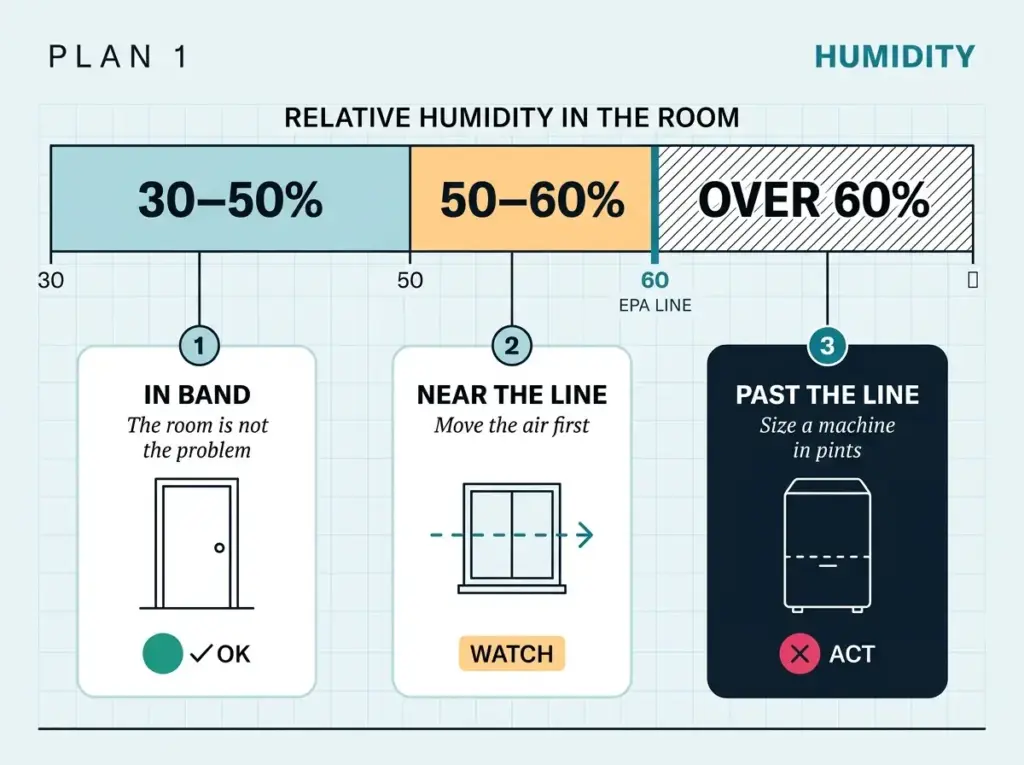
The direction the reading points decides the change. Under 50%, the room is fine and the smell came from the washer or the rack. Between 50 and 60%, the room is inside the line but slow, so the air moves first. Over 60%, the room cannot dry a load by itself, and the machine question opens.
Condensation gives the answer before the meter does: the EPA lists fog on windows, walls or pipes as a sign of high indoor humidity, and a wet pane beside the rack is that sign.
The 60% line of the EPA humidity band is a ceiling, and it depends on the glass. A window pane at the outside temperature reaches its dew point sooner than the room does, so a pane that fogs at 52% is the number to respect for that room, whatever the meter says about the rest of it.
Where to Read It, and When
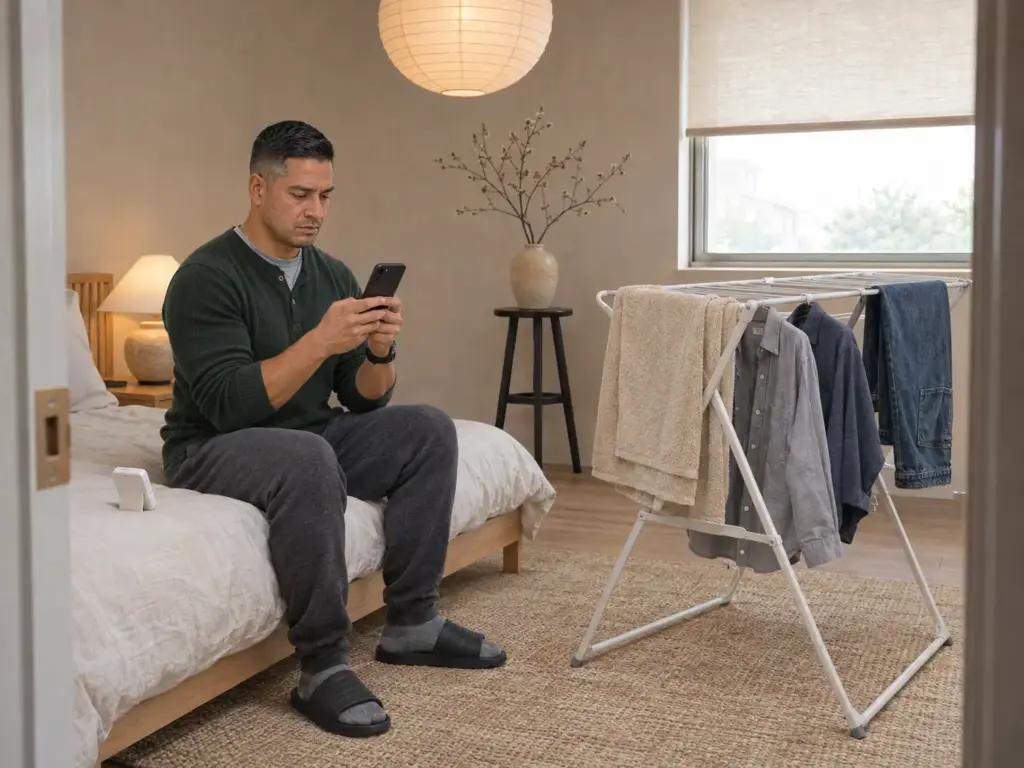
Put the meter at sitting height, away from the rack and away from the window, and read it after the load has hung a few hours. A reading taken beside the wet cloth reads the cloth, and a reading on the windowsill reads the cold glass; taking the reading at the right place and height matters more than which meter makes it.
The number moves most in the first hours after the load goes up. If the air has a way out, it settles lower by morning. If it climbs all night, the room is the source of the problem, and the free fixes in the next part come before any purchase.
Take three readings: before the load goes up, after it has hung a few hours, and the next morning. The first two show what the load adds to the room, and a third close to the first means the air had a way out.
Which room matters as much as where in it. The bathroom with its exhaust fan running sounds like the obvious drying room, and it fails in the flat that needs it most: the fan often stops short of the outside, and the room already sits near saturation after every shower, so a load dried there picks up the bathroom’s own smell. Dry in the driest room the household has; that drying space needs its doors to the kitchen and the bathroom shut.
Two Meters, and What Each One Gets Wrong
The Govee Indoor Hygrometer Thermometer H5075 is a Bluetooth meter with a 3-inch LCD, ±3% RH accuracy and two years of stored readings, and it answers the one question that matters before spending anything else. Its Bluetooth link to the phone is the weak spot: the connection drops, and some units stop working inside six months.
Any cheap sensor can read off by a few points, so a second meter placed beside the first is the check; how far a cheap humidity meter can be trusted goes through the drift and the two-unit test.
The Govee Smart WiFi Thermometer Hygrometer H5051 adds Wi-Fi to the Bluetooth and an app that keeps the room’s curve and sends an alert when the reading passes the band you set, which suits a room you would rather not walk into to check. It swaps the Bluetooth dropouts for Wi-Fi ones, its accuracy and value are rated mixed, and the battery in some units lasts about a month. For a room you read twice a week, the H5075 does the same job without the app.
Give the Air Somewhere to Go
Once the number says the room is too damp or holds stale air, the cheapest fix is not a device. It is a way out for the air, and this is the free half of the fix, in the order to do it.
A Shut Door and a Cracked Window Is Not Ventilation
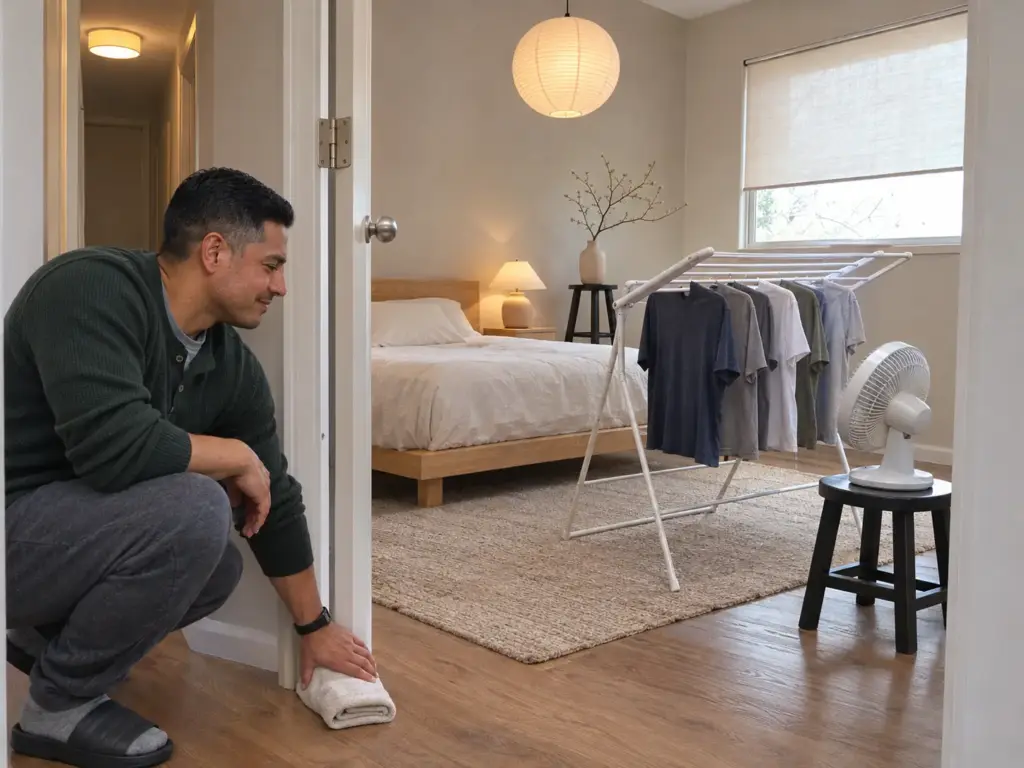
Ventilation means air leaving the room, and air stirred inside a room does not count. The EPA’s mold course chapter on moisture problems puts it plainly: “Without adequate ventilation, moisture may build up indoors and mold may grow.” A bedroom with the door shut and one window open for five minutes does not meet that, and neither does a window kept shut because the room is chilly. That last habit is poor ventilation by choice, and it is the whole problem for many rooms: three days on the rack with no way out for the air.
The free fixes go in this order, with a reading of the meter between each, so you know which move did the work and which one overshot:
- Move the rack to the driest room, with the bathroom and kitchen doors shut. The reading should stop climbing past where it started.
- Open the door or a window so air actually leaves, ideally at opposite ends of the room. The reading should flatten and then fall within the hour.
- Add a fan across the load (the next section). The reading should fall faster, and the thick pieces should feel drier first.
- Give the garments room and turn the thick ones. The load should be dry to the touch hours sooner.
- Read the meter again. If the number still sits over 60%, the room cannot clear the load by itself.
The overshoot is a room that goes too cold or too dry, and in a chilly bedroom the cure for the window that stays shut is the heat turned up a few degrees, 3 to 4°F (about 2°C), which lowers the relative humidity without a purchase. The longer list of free ways to bring a room’s humidity down before buying anything is worth keeping nearby.
Open the door and the window at opposite ends of the room. Two openings side by side move air between themselves, and two at opposite ends pull it across the rack on its way out.
Where the Fan Points and How Fast
Airflow across the load matters more than wind speed, and air circulation inside the room does most of it. An oscillating fan on low, aimed up through the garments, moves more water out of the cloth than a hard blast at one corner, because a thin film of still, wet air sits on every garment and the job is to keep sweeping it away. A borrowed box fan does the same job as a new one.
A fan stirs the air; it does not make it leave the room. That is why it comes after the open window and not before it, and why a fan pointed at a rack in a sealed room leaves the humidity where it was.
The Honeywell TurboForce Air Circulator HT-900 is the version for a reader who has no box fan or standing fan to borrow. It has 3 speeds, a head that pivots 90 degrees, and it sits on a table or mounts on a wall. Durability is rated mixed, with many units dying inside a year, so treat a fan at the rack as a part that wears out, not a purchase for life.
Spacing, Turning and the Order Things Go On
An overcrowded rack, with cloth overlapping, traps moisture and slows the whole load. Spacing between garments is the cheapest fix: shake each piece out before it goes on a bar, leave about a hand’s width (2 inches or more) between pieces, and turn the thick pieces as they dry. Put the heavy items where the air is moving most, and the thin ones in the corners of the rack.
Where the rack stands matters. Pick a drying area with air moving through it, pull the rack away from the cold outside wall and out of a corner, because still air collects there. If the floor has no room for that, where a wall-mounted rack hangs so the room’s air reaches the load is the version of the same problem with its own rules.
The Rack Holds a Film of Its Own
So far the cloth and the room were the suspects, and the rack itself is the one piece in the room nobody washes. It can carry a smell even when it looks spotless.
Bars, Dowels, Canvas Shelves and Padding
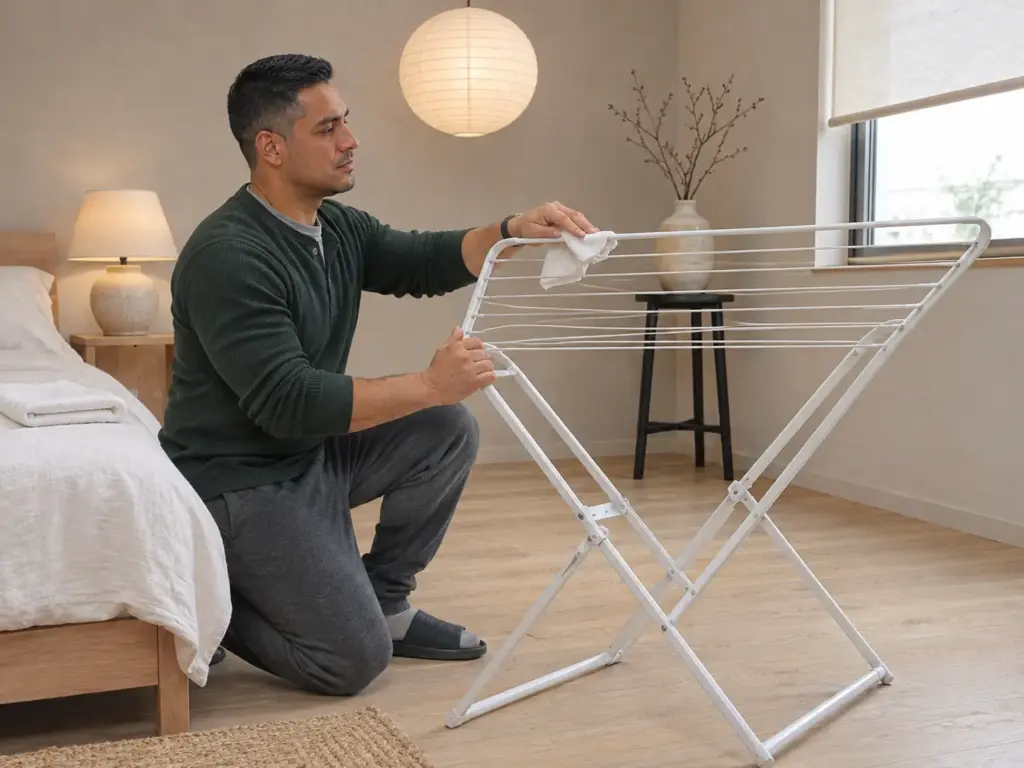
Bars, wooden dowels, canvas or mesh shelves, foam padding on the hooks and plastic joints hold a film of detergent, skin oil and dust, and that film stays damp between loads. A rack folded wet seeds the next load: the water left in a hinge or a fold is the same water that grows the smell in cloth. What each material does over time, and which one wears out first, is in what wears out first on each type of rack.
A tiered rack, a gullwing rack or a ceiling airer grows the same film, with more joints to hold it. Covered racks, drying pods and hanging nets deserve a warning of their own. A closed cover is a drying room with no air in it, and it traps the moisture it was sold to move. Materials that cannot be wiped and dried fully, such as untreated canvas and foam wraps, hold the film longest.
The Sniff Test That Separates the Rack From the Load
Hang one freshly washed, dry, odor-free cotton piece on the bare rack, in a ventilated room, for an hour. If it picks up the smell, the rack is the source. If it does not, the load or the washer is. The test costs nothing, and it is a method rather than a standard: the hour is a practical stretch, and a longer wait tells you more.
The timing is the clue. The smell appears on the first load after the rack has been stored, not on the load that dirtied it, because the rack sat damp in the closet and the film grew while nobody looked.
Drying and Storing the Rack
Wipe the bars and the canvas with a damp cotton cloth and plain water. Let the rack stand fully dry, open, before it is folded, and store it dry. If a cleaning product is wanted, follow the maker’s care instructions for that rack, since the maker is the authority on what the finish and the fabric can take. The routine is a minute of work, and it ends the rack as a suspect.
When the Smell Was in the Washer First
If the rack checks out and the room reads fine, the smell was in the cloth before it ever reached the bars. The cheapest place to find out is the washer’s door.
How to Tell a Washer Smell From a Drying Smell
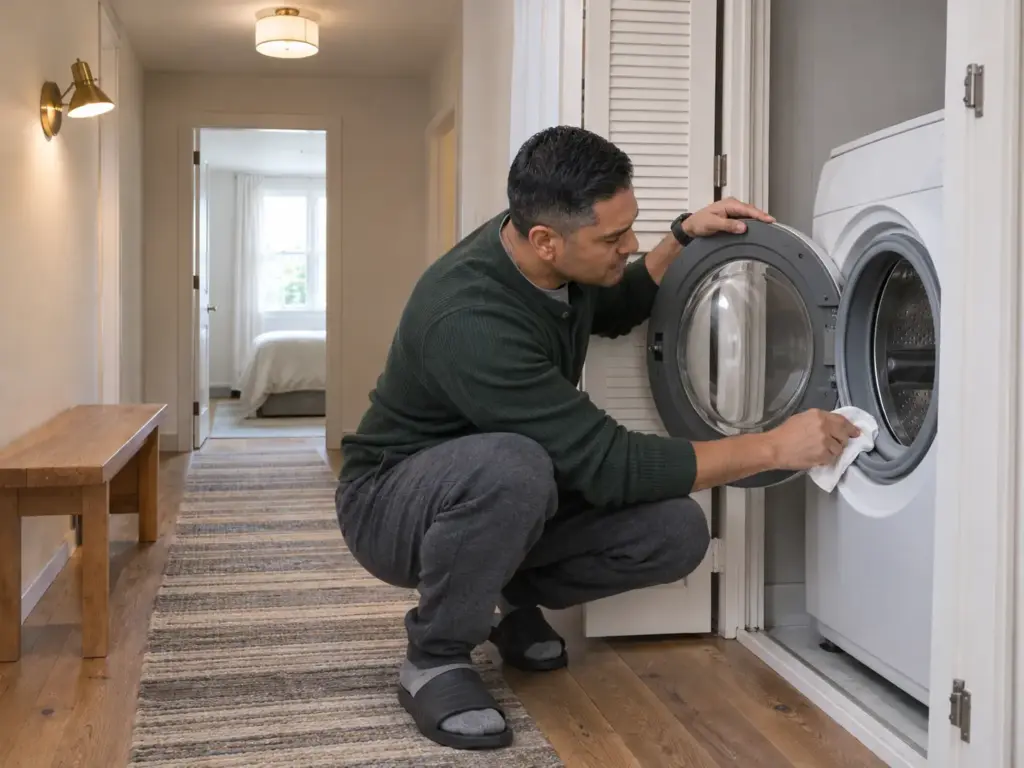
Smell the load straight out of the washer, wet. If it already has a sour smell or a musty one, the washer is the source, and no rack or fan will fix it. If it smells fine wet and sour dry, the drying is the source, and the room’s reading from the earlier section is where to go back.
Run the wet sniff on the heaviest piece in the load, the hoodie or the jeans, not on a T-shirt. The thick piece gives the washer’s smell away first, and a thin one can pass the test and hide it.
Detergent and Softener Film
Fabric softener builds a film on the cloth and in the dispenser, and so does too much detergent, especially in cold water that does not dissolve it all. The fabric softener residue and the detergent residue stay damp and hold smell. The free fix is to cut the softener, use less detergent, and run an extra rinse and an extra spin cycle.
For a load that already smells, wash it again on the warmest cycle the care label allows, a hot wash where the fabric takes it. A cold rewash does not move the smell, and it comes back the moment the cloth is damp again.
The Gasket, the Drawer and the Drum
The rubber seal (the gasket) and the detergent drawer of a front-load washer hold water and residue between loads, and the washing machine drum keeps the smell of whatever sat in it. Leave the door and the drawer open between washes so they dry, and run the washing machine cleaning cycle on an empty drum, as the manual says. The washer’s smell is worst in the first load after a few days of a shut door.
The two causes stay separate, and so do their fixes: a spotless drum does not fix a slow-drying room, and a dry room does not fix a load that left the washer smelling.
When the Room Needs a Machine, Size It in Pints
If the meter stays above 60% after the air has a way out and the cloth and the washer are sorted, the room cannot clear the load by itself, and only then does a dehumidifier make sense. A big unit is rarely the size a bedroom needs, so this starts with the rating.
What a Pint Rating Measures
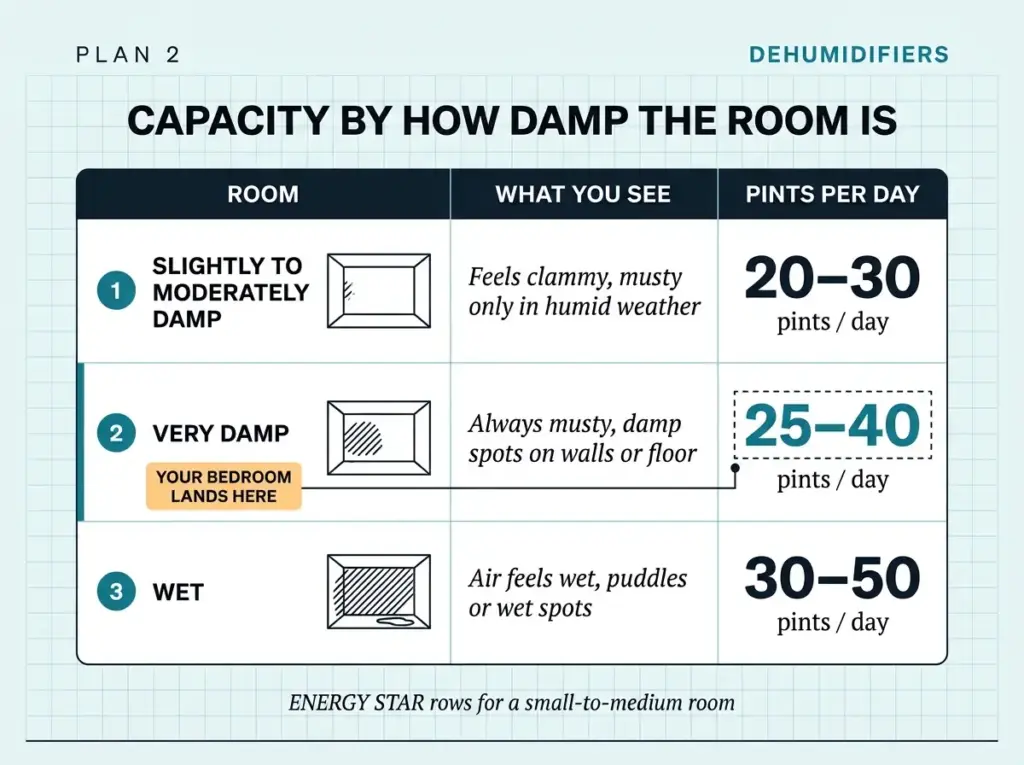
Dehumidifier capacity is measured in pints removed per 24 hours, and the capacity needed depends on the size of the space and the conditions in it. ENERGY STAR’s dehumidifier capacity chart gives, for a small-to-medium room under 2,000 square feet: 20 to 30 pints for a slightly to moderately damp room, 25 to 40 pints for a very damp room, and 30 to 50 pints for a wet room. The wet row is defined by walls or floor that sweat, by seepage, and by high-load conditions such as laundry drying.
The arithmetic at the wall comes next. After the spin cycle, an average load still holds a couple of liters of water, a ballpark of 3 to 5 pints for a full load, and that water has to pass into the room’s air before the cloth is dry. Against a 25-pint unit, one load is roughly a sixth of a day’s capacity. A bedroom with a full rack and a shut door is closer to the wet row than its floor area suggests.
A Ten-by-Twelve Bedroom Is Not a Basement
A ten-by-twelve bedroom is 120 square feet. It sits in the 20 to 30 row unless the walls sweat, and the 50-pint basement machine is built for a bigger, wetter space than that. Oversizing costs a heavier unit and a bigger bucket to carry.
The bucket is the real running cost. Electricity is the smaller part of a unit bought for the drying room; the daily chore is emptying the tank, and it fills every morning at first, then less often once the air has a way out. When it fills less, that is the unit telling you the free fixes are working. For a small room in the lower damp row, a 20-pint unit covers the job.
Where the Unit Goes and What It Gives Up
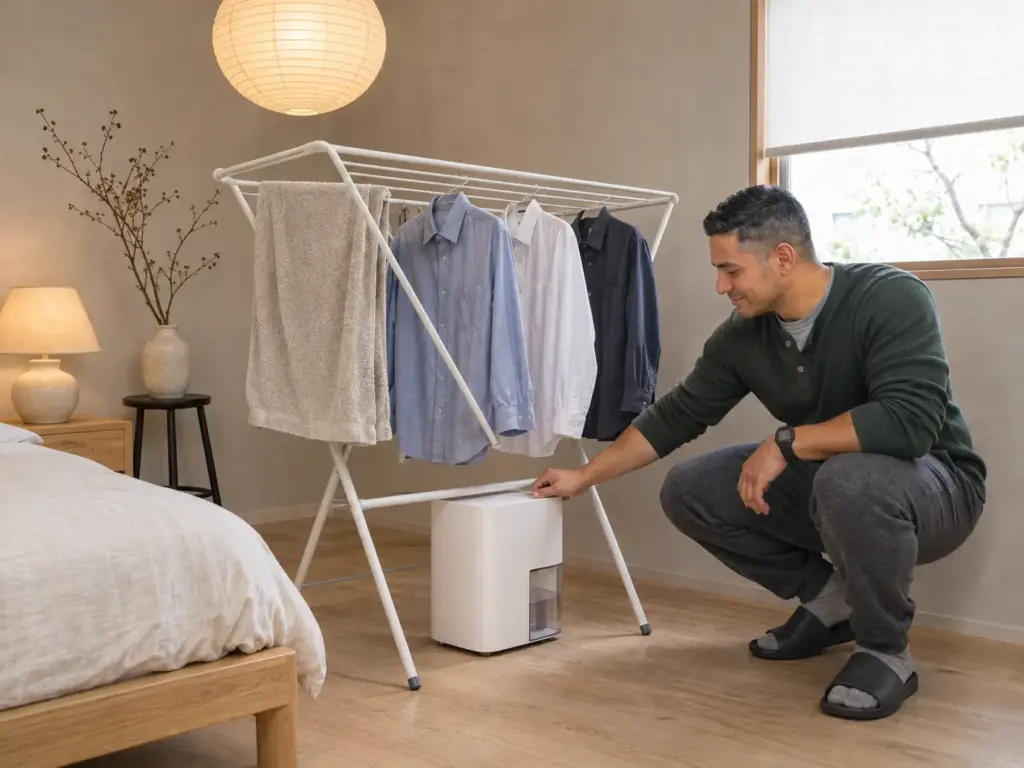
Run the unit before the load goes up, so its first hours go to the room’s air and not to the cloth. Keep the doors to the bathroom and kitchen shut so it is not pulling water out of the rest of the house, and stand it under or beside the rack, not across the room. The setting that ends the smell without over-drying the room matters once the unit is running.
The Midea Cube 50 Pint Dehumidifier is the large option: 50 pints a day, rated for 4,500 square feet, a humidistat from 35 to 85%, a gravity drain hose and a bucket that lifts and twists out. For a room that reads over 60% even with air moving, it has capacity to spare. Its low fan runs almost as loud as the high one in sound testing (52.4 dB against 53.6 dB at 10 feet), and at 41.5 lb it is not a unit you carry between rooms.
A smaller room still needs a smaller answer, and the bucket shapes daily life with either unit.
The Levoit Dehumidifier DOE 25 Pint/Day fits the bedroom row: 25 pints a day at 65°F (18°C) and 60% RH, an ENERGY STAR Most Efficient 2025 rating, a removable pump, a MERV 11 filter, and 50.2 dB at turbo. That decibel figure matters because the unit runs all night beside the rack. The panel has no laundry mode, so it runs on turbo for a rack, and the pump moves no water until the bucket is full.
If the unit has a drain option, run the hose to a tub or a sink. The bucket stops being a daily chore, and the full-bucket stop that cuts the unit off mid-night no longer happens.
For the device decision in full, the full comparison of bedroom dehumidifiers by pints, decibels and bucket size goes further than this sizing rule.
When the Smell Is Really the Wall
Sometimes the cloth, the rack and the washer are all fine and the smell is the room itself. The water the load puts into the air has landed somewhere cold and stayed.
The Cold Wall and the Glass
Condensation on windows, walls or pipes is a sign of high humidity, and the water lands first on the coldest surface. A rack stood against a cold outside wall feeds that wall with the load’s water night after night. Where the load’s water lands when the room cannot get rid of it is the window and the wall, in that order.
A Wall That Does Not Dry Back
The EPA’s 24-to-48-hour clock for damp materials applies to the wall as well. A wall surface that stays wet or darkens past that point is no longer a drying problem, and the fix is the moisture, not a spray. The CDC’s page on mold in the home says the same: if mold is growing in a home, it needs cleaning up and the moisture problem needs fixing. How fast a damp bedroom wall turns shows the building-side clock.
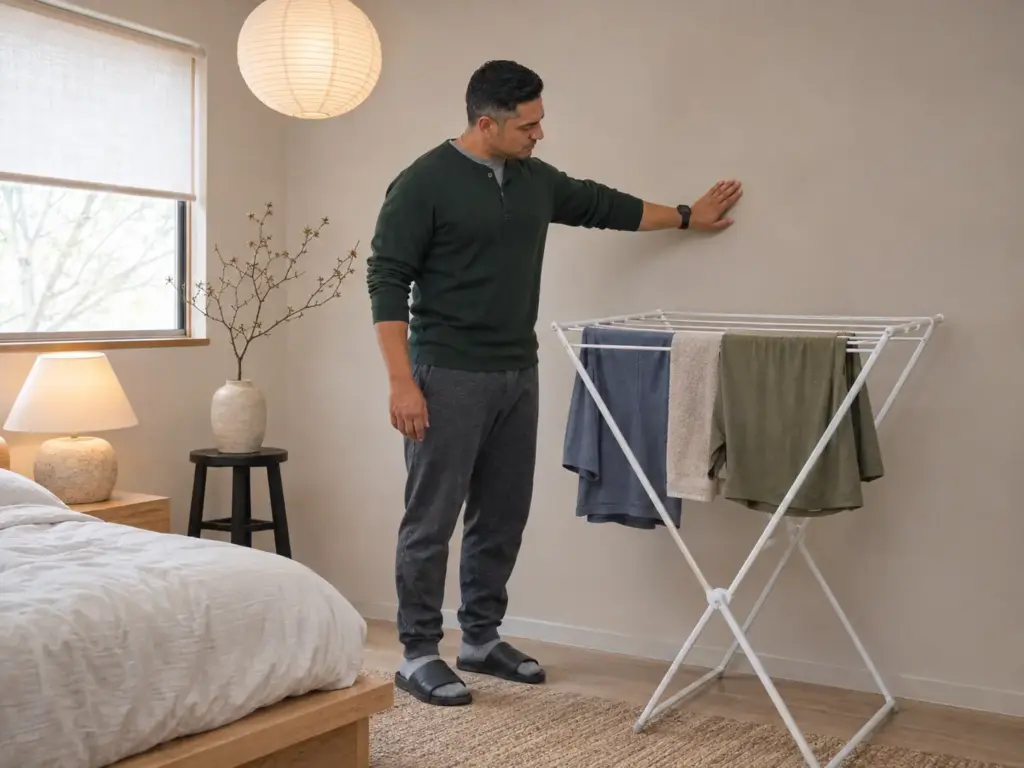
Pull the rack six inches off the outside wall and put a hand on the wall behind it. If the surface is cold and damp, the wall is where the load’s water goes. It is a free check, and it takes ten seconds.
A professional is the answer in three cases, and this is a matter of the building: a wall that darkens and stays damp through a dry week, a smell that does not leave when the rack leaves, or a stain that spreads.
Other Water the Same Room Is Fed
The rack is rarely the only moisture source in the room. A dryer that vents indoors, a bathroom fan that does not reach outside, and the washer’s drain all add water, and the EPA’s advice is to vent moisture-making appliances to the outside where possible. A stain behind the rack shows up weeks after the habit started, not in the first week, so a dry wall today says little about the wall in a month.
What the Fix Looks Like at Month Three
The fixes work in week one, and the setup either holds or quietly drifts back. This section is what to look at again and what each part does as it ages.
What Slips First
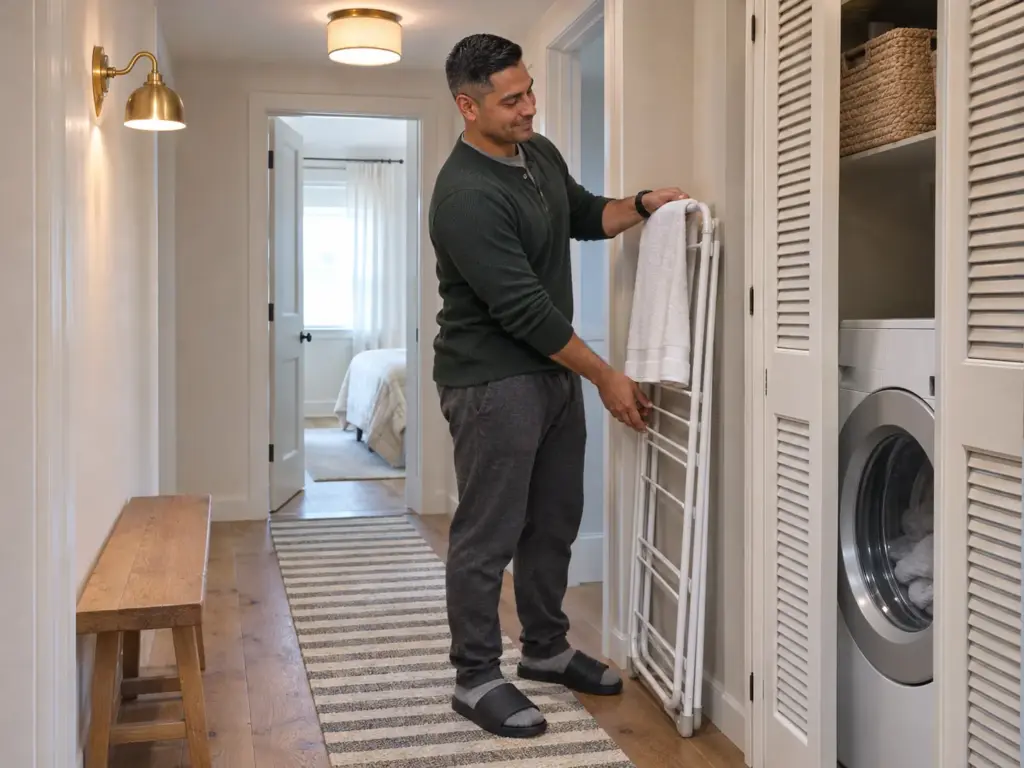
The softener comes back. The load gets crowded again, and the laundry routine slides. The rack is folded away with the last pieces still damp, and the door stays shut. The smell is not new when it returns; it is the old cause coming back, and the habit that was working in November has quietly changed by January.
The Check Worth Doing Again
The setup’s parts age at different speeds. The meter gets read less often than it should. The fan is the part most likely to die inside a year. The bucket is emptied every morning until it is not.
Read the room’s number again a few weeks after the setup settles, and again when the season changes, because it is the room’s reading that moved, not the rack.
When Air and a Machine Are Not Enough
When the room still cannot clear a load a day, a heated drying rack is the next move, and it has costs worth reading before it is bought. A bar airer draws roughly 230 to 300 W; run for 8 hours, that is 1.8 to 2.4 kWh per load, which you multiply by your own electric rate. Pod-style racks draw 600 to 2,000 W, which is 4.8 to 16 kWh over the same 8 hours.
A heated rack warms the cloth and still leaves the water in the room if no window opens. Heated racks for an apartment that cannot clear a load by morning covers when that trade pays off.
Open the Door Before the Load Goes Up, Then Read the Meter
The rack is the last suspect and not the first. A load that is still damp the next morning is the cause, and the room’s reading against 60% decides between a fan, a machine and nothing. The rack’s bars and the washer’s gasket are the two quick checks, and the wall is the one case where nothing in the laundry will help.
Come back to the setup after a few weeks and again when the heating season starts: read the meter, look at the bucket if there is one, and sniff the rack after it has been stored. A reading that crept up is the old habit returning.
Tomorrow, open the door or the window before the load goes on the rack. Set the meter at sitting height, away from the rack, and read it a few hours after the load has gone up.
Frequently Asked Questions
01How to stop clothes from smelling when drying indoors?
Get the drying room under 60% relative humidity with air leaving it, and space the garments so the load finishes drying the same night. Read a meter at sitting height to know where the room stands.
02Why shouldn’t you dry your clothes indoors?
A load puts a few pints of water into the room, and without a way out for the air the humidity climbs past 60%. The water then settles on the coldest wall and the glass.
03Why do my clothes smell if they haven’t been dried properly?
Bacteria and mildew multiply in cloth that stays damp. Thick pieces such as hoods, pockets and jeans hold water longest, so they smell first while the thin ones are fine.
04How to fix smelly clothes after drying?
Rewash on the warmest cycle the care label allows, with less detergent and no softener, then dry the load in a room with air moving. A cold rewash does not move the smell.
05Why does an indoor clothes drying rack smell bad even when the clothes are dry?
The rack’s bars, dowels, canvas and padding hold a film that stays damp between loads, especially when the rack is folded away wet. Wipe it with a damp cotton cloth and let it dry open.