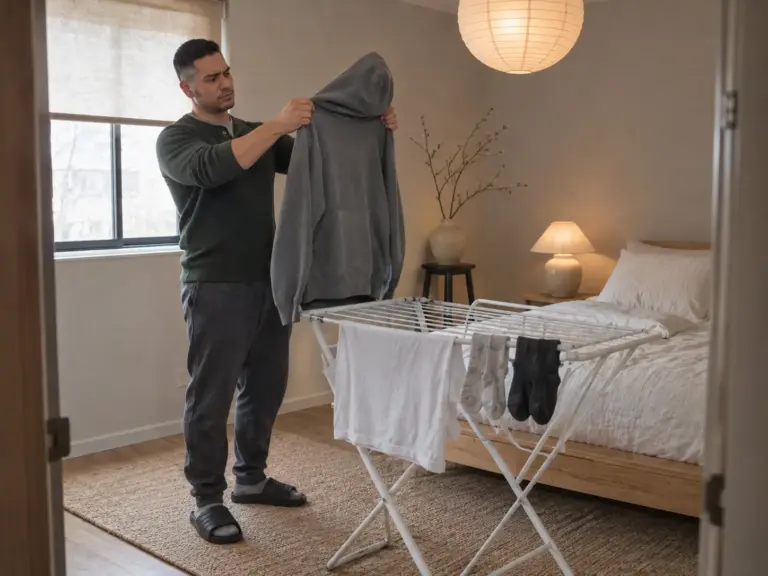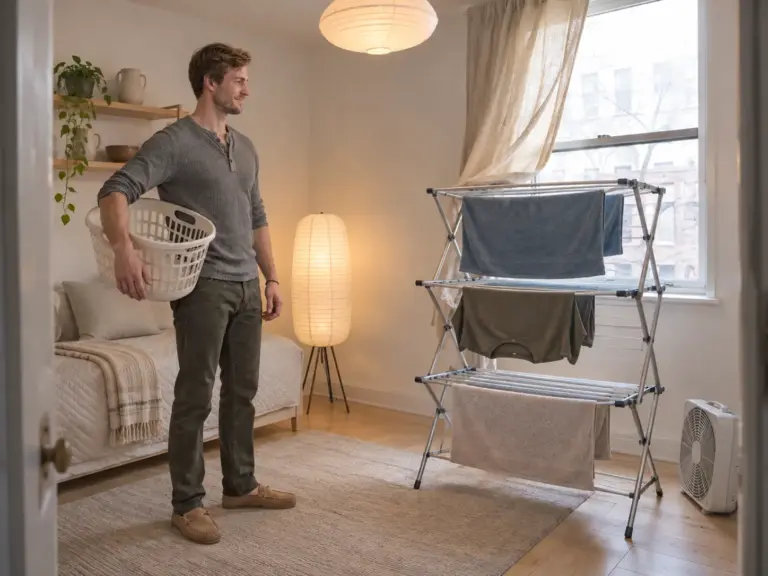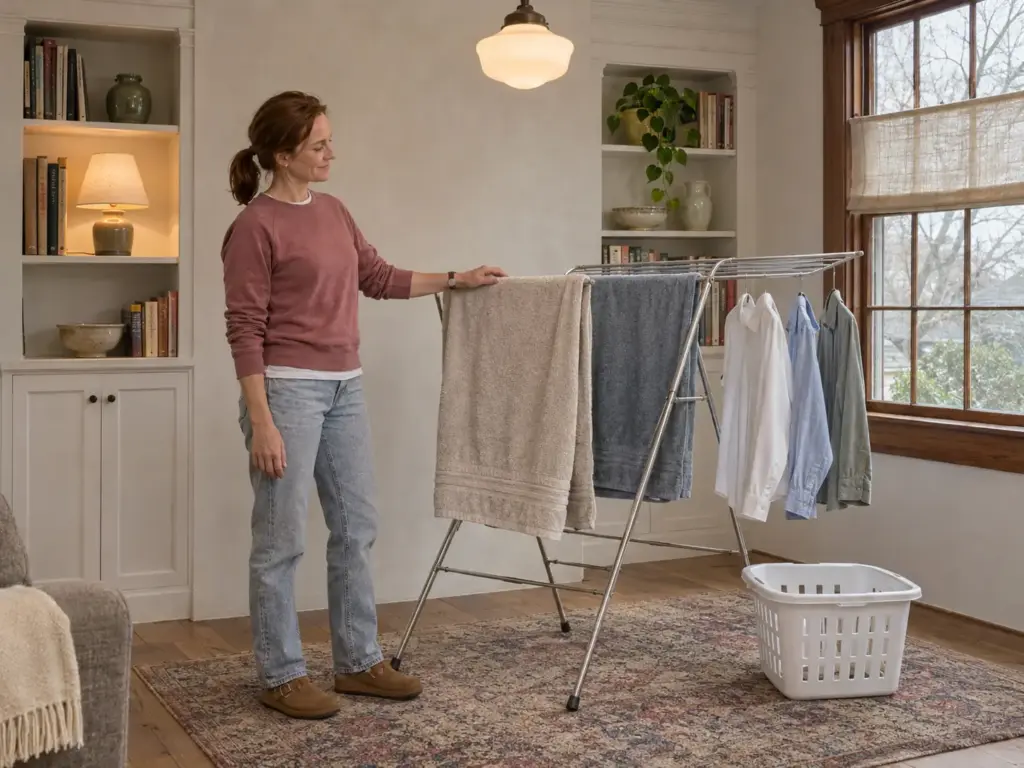
You loaded the rack in the one room with a door that shuts, the wash looked done by evening, and by morning the window glass is wet on the room side while the shirts in the middle of the rack are still cold in the seams. The rack got the blame, but the room was the problem. A clothes drying rack review that starts with the rail count answers the wrong question, because a rack only holds the fabric apart so air circulation can get between it, and the water leaves with that air or lands on the glass, the paint and the wall behind the rack.
A load off the spin cycle still carries several pounds of water, and that is the number every rack here is up against. In an apartment or a townhouse, indoor drying makes that water the room’s problem. Below: where that water goes, where the rack has to stand, what to try before spending anything, then the types and the picks with the flaw written beside each, and what each type looks like after a few months of folding.
Quick Answer
Air moving through the clothes dries them, and a rack only holds the fabric apart. The best pick is the sturdiest rack that fits in a room with airflow, over the one with the most rails. For most apartments that means a steel gullwing or two-level rack that holds a full 10 to 15 lb wet load.
Where the Water From One Load Goes
A rack is furniture and a load of washing is water, so the first number worth having is the weight of the water the rack is about to hand to the room, before any rail count. It points one way: the air is too wet, even in a house that felt dry all week.
What a Spun Load Still Carries
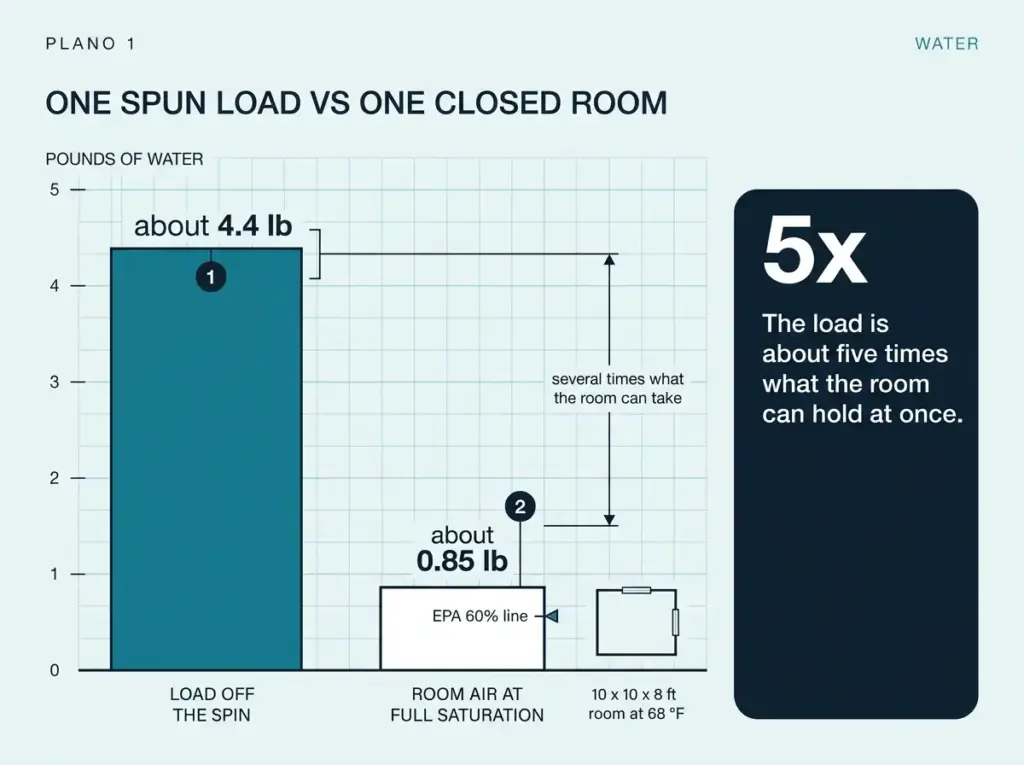
A university news release on how much water one load of washing puts into a room gives the figure as almost two liters, about 4.4 lb, released into whichever room the rack stands in. That is the weight a rack competes with. The spin does most of the work but not all of it, and a high spin only narrows the gap: NIST’s laundry-drying report puts the normal moisture left after the spin at 50 to 70 percent of a load’s dry weight, so a 10 lb dry load goes onto the rack holding roughly 5 to 7 lb of water.
The ruler for what the room can take is the EPA’s humidity band for a home, and the EPA puts it in one line: “If possible, keep indoor humidity below 60 percent (ideally between 30 and 50 percent) relative humidity.” Everything below gets measured against that 60, and a hygrometer on the wall is how you read it, inside a working band of 30-60 percent relative humidity.
How Little a Closed Room Can Take
Do the arithmetic for a bedroom of 10 by 10 feet with an 8 ft ceiling, which is 800 cubic feet. Air at 68 °F (20 °C) that is completely saturated, the most it can ever hold, carries about 0.85 lb of water vapor in that volume. The load brings 4.4 lb, roughly five times that. So the water has to leave by air exchange, or it leaves on the glass, the paint and the wall behind the rack.
And the room is not empty to begin with. NDSU Extension counts about three pints of moisture per person per day from the people in a house and about a pint from a ten-minute shower, so the laundry lands on top of water the house was already producing. The shut bedroom is the trap: it feels warm and dry to the hand while the reading climbs, and the first sign is a pane that fogs every morning.
Where the Rest Lands in January
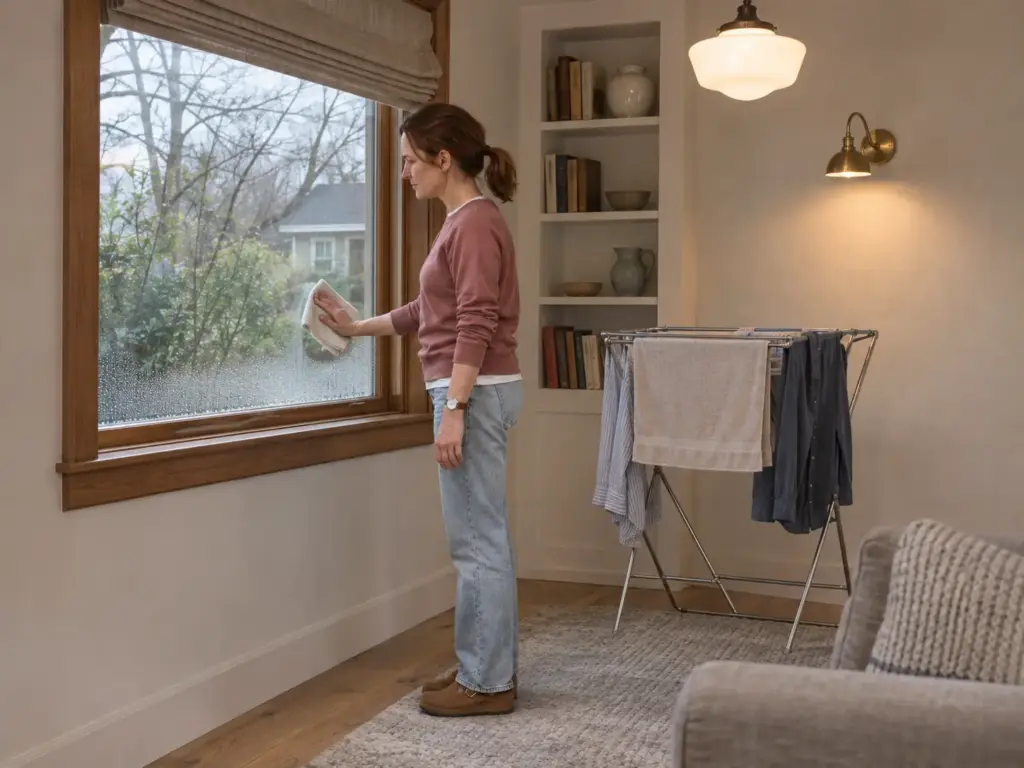
Winter changes the exit, not the amount. Cold air holds less moisture, so the same load that vanishes into July air ends up on the coldest surface in the room, because glass colder than the dew point of the room air collects water. What the EPA lists as the main sources of moisture on windows includes drying clothes indoors, and the pane is where it shows first: wet on the room side on laundry day, dry again by midweek. The wipe test that tells you whether the wet glass is the room’s or the window’s takes ten seconds.
A wall behind the rack that is cold and damp to the hand a day later, or a musty smell in that corner, says the same thing more slowly, and how long humidity stays high after a wet day sets how long to expect that spike to last.
Where the Rack Stands Before You Pick One
A better rack in the wrong room does nothing for the water, so the order below runs from the free move to the last purchase, with a reading after each. The rack itself comes near the end of that list.
Read the Room, Then Move the Rack
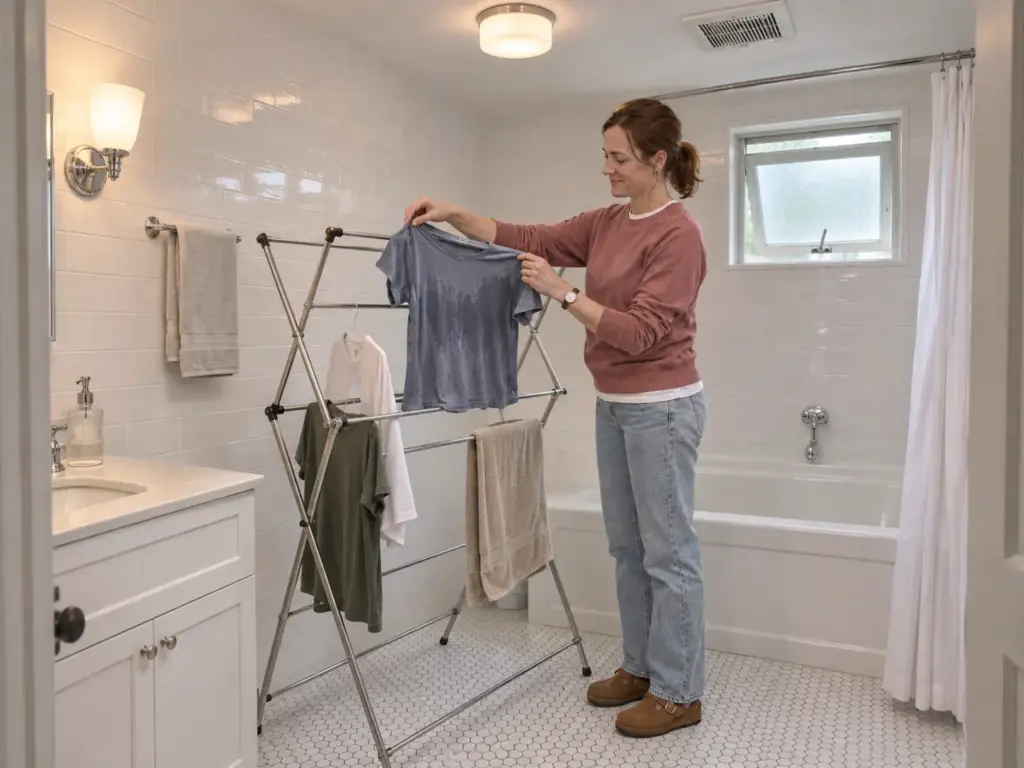
Take one reading across the room at the start of laundry day and another the next morning; how to take a humidity reading across a room covers the meter and where to hold it. The pattern that shows the load did it is a room that sits in the mid-40s percent all week and reads around 75 percent on laundry day, with the first mold patch turning up at a window sill.
Hold the meter at rack height, not by the thermostat. The air around a loaded rack runs wetter than the wall where the meter usually sits, and a wide gap between the two readings means the water is not being carried off.
The cheapest exit already exists. ASHRAE 62.2 asks for 50 CFM of local exhaust in a bathroom and 100 CFM in a kitchen, far more air than any fan clipped to a rack moves, so the bathroom with the fan running beats the living room with a rack in it, whatever the rack. After the move, read again. If the room is back under 60 percent by morning, the move worked and nothing else needs ordering, and how to dry a whole load indoors and keep the room under 60 percent covers the rest of that routine.
The Free Moves, in Order
Each move below changes one thing, and the reading after it says whether to go on.
- Move the rack to the room with the exit, a bathroom or a hallway by a window. The reading: the meter back under 60 percent by morning and a pane that is dry on the room side.
- Run the exhaust fan or crack a window. The reading: glass dry within the hour. The overshoot is a room that drops below 30 percent, the low humidity in winter that a closed house already runs into, so stop at the band.
- Spin the load a second time, on the highest spin cycle the washer offers. It costs nothing and takes water off before the rack sees it, though each extra increment buys less (NIST), so one extra spin is the useful one. The reading: a towel that is damp in the middle instead of wet.
- Hang the load on hangers from a closet rod, a shower curtain rod over the tub or a retractable clothesline across the laundry closet, spaced so the fabric hangs free. The reading: the whole load finishing together instead of the middle lagging.
- Put a fan at floor level, pointed across the whole load, so no single shirt takes all of it. The reading: the seams drying at the pace of the sleeves.
A load that goes up late dries slower, because why a room’s humidity climbs after dark comes down to the same arithmetic as the cold pane. So if the reading above only fails after dark, the hour matters more than the rack. A basement line, a plain clothesline strung between two posts, follows the same order, and a basement laundry area that stays dry without extra machines shows where a dehumidifier falls in it. The same order, written for the whole house, is the free fixes for a damp room, in order.
Heat, a Fan and a Dehumidifier Come Last
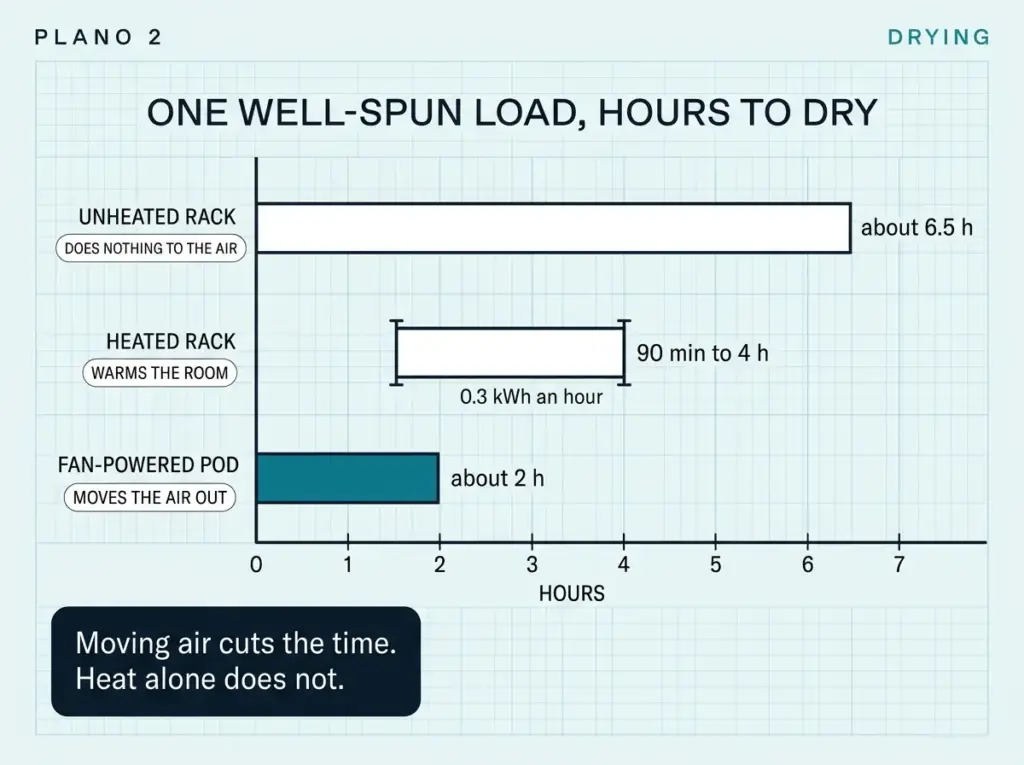
A heated drying rack at 300 W draws 0.3 kWh an hour, so a three-hour load is 0.9 kWh; multiply by your own rate. The watts warm the fabric and the room, and they do not move air. Which?, the UK consumer-testing group, timed a well-spun load at about six and a half hours on an unheated airer, 90 minutes to four hours on a heated one and about two hours on a fan-powered pod. Moving air did the most to cut the time, and the pod with the fan was the fastest of the three.
A heated rack earns its watts in a cold room with no airflow, and that is a separate decision from the one here. A dehumidifier is the last purchase, sized in pints, and only for a room with no window or fan to use. It works best in a smallish room with the door closed, and what to look for in a dehumidifier by room sets the sizing.
The Rack Types and the Flaw Each One Carries
With the room sorted, the type is the first real decision, and every type ships with one weak point. The type that looks best in a showroom is not always the one that survives a damp room, so each type below comes with what gives out on it.
Gullwing, Two-Level and Tower Racks
A gullwing or two-level rack has a steel frame and wings that fold up for a wide load. The steel survives.
What fails is the finish, with rust showing on racks sold as rust-resistant sometimes by the third use, and the width, which does not fit the room it was bought for. A tower, or tree rack, goes up instead of out, which saves floor and puts the wet weight higher, so its base needs flat, wide footing. A vertical tower rack on wheels rolls to the room with the exit, and any wobble in the base shows up on the first uneven load.
The yardstick for durability is the Brabantia HangOn, a winged steel rack with a five-year guarantee. It is also hard to find in stock, and the shorter compact version is a different rack with far less behind it, so it stays a yardstick here and goes no further.
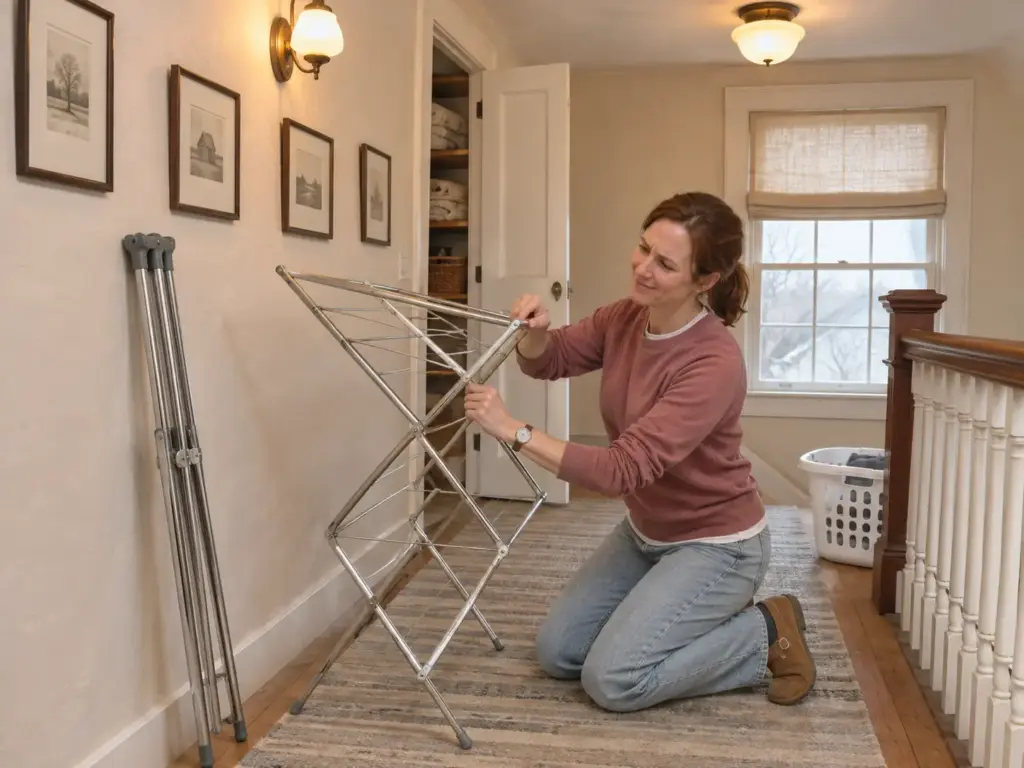
Open and close a new rack a dozen times on the hall floor before the first wet load, with a hand on each leg lock. Play in a hinge or a lock shows up as a rattle in the open position long before it shows up as a failure.
Accordion and Tripod Racks
The accordion rack is the cheapest and the narrowest folded, and it holds about eight garments. The hinge or the rod is the part that gives out, inside a year of regular use. The mesh top on a small accordion goes dry and brittle after around ten years, and the replacement top comes from the maker while the rest of the rack is still fine.
A tripod, sold sometimes as an umbrella rack, has the smallest floor print that still airs a whole load, because the load hangs on hangers. Tipping over is its failure: it tips on anything that is not flat and hard, and the plastic center hub cracks when the load hangs unevenly. A cracked hub can be patched with glue and tape, but a repair with glue and tape is a stopgap, not a fix. Carried from room to room, a leg lock that is starting to slip makes a small clack before it lets go.
Wood, Wall-Mounted and the Flat-Dry Mesh
Wood and mild steel are the materials that come back in a damp room. Wooden bars, from bamboo to an Amish-made floor dryer, take mold spots and warp, which is why the racks kept for decades are the ones that do not rust, warp or mildew.
A peeling coating on plastic-coated wire snags fabric the same way. A wall-mounted rack, a ceiling-mounted rack, an over-door rack and a heated drying rack are other types, and each is a separate decision. An aluminum frame belongs on the same list, judged by its joints and not by its weight rating.
Delicates change the choice. Silk and wool want to flat dry: a sweater dries lying on mesh, since a hanger stretches a wool shoulder, and socks and underwear want clips. That is where a rack earns its place beside a dryer: the loads the dryer should not tumble.
A Rack That Holds a Full Load on Its Own
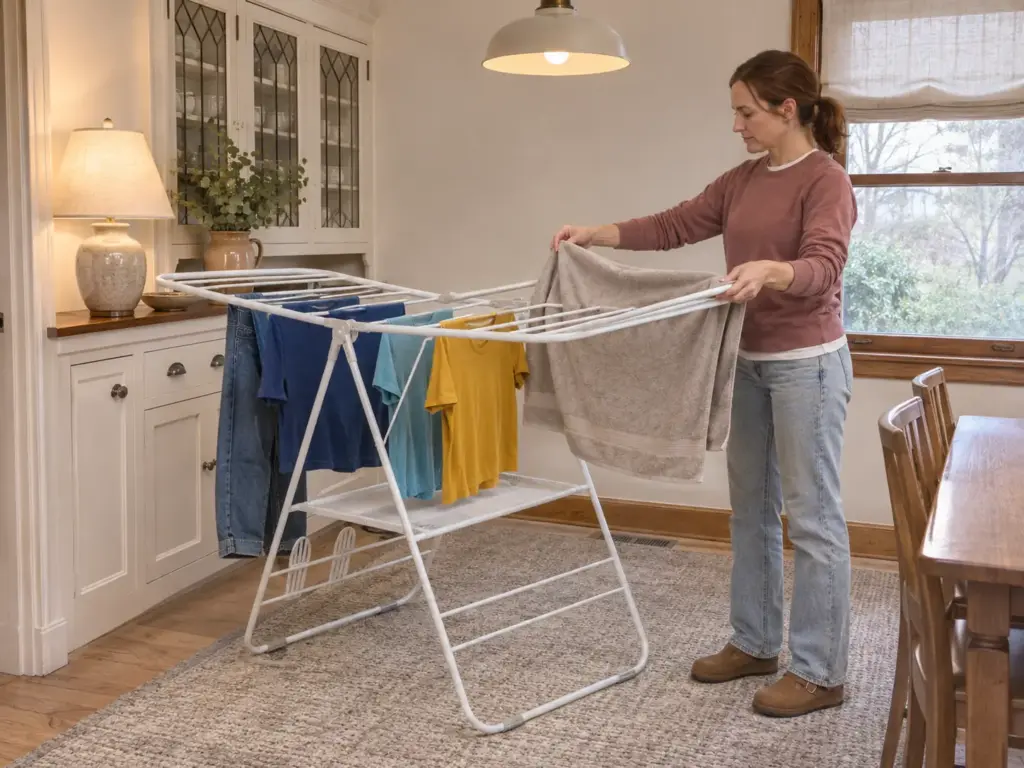
The question every rack answers badly is whether it holds a whole wash, 10 to 15 lb wet, without tipping or bowing. Weight capacity and load size are two different numbers, and the drying space on the bars is a third. A printed weight rating is a number with no load test behind it, so the frame has to answer.
What 10 to 15 lb Wet Means for the Frame
The frame decides whether a load stays up, whatever the rail count. Judge the joints, the leg locks and whether any plastic carries weight, and treat a declared load as the maker’s figure until the hardware backs it. The cheapest answer is already in most closets: a rod fitted a few inches below the ceiling holds a whole load on hangers and costs a fraction of any rack.
The Gullwing That Takes the Most
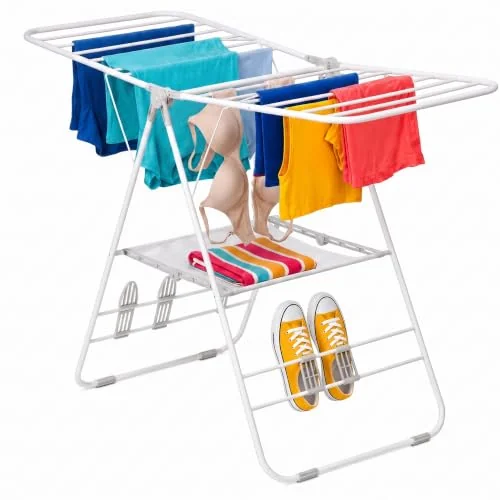
The Honey-Can-Do Heavy-Duty Gullwing has the highest declared load of the six racks here, 50 lb over 46 linear feet of drying line, with a shelf for sweaters and bars for shoes. It is steel, 57 in wide by 23.5 in deep by 37 in tall, and it folds to 3 in.
What It Costs You in Floor Space
Durability is the open question on this one, and the width is the other. At 57 inches it is a rack that does not fit a small room, and a rack bought for its rating can end up folded against the wall while the load goes on a closet rod instead. The same steel-frame type is what lasts when no plastic hinge carries the load, so if the room cannot take 57 inches, a narrower steel rack from the next section is the sensible move.
Bar Spacing and Floor Space Decide More Than Bar Count
More rails is not always more drying. A folded towel dries from the outside in, and a rack with its bars too close hands the air nothing to work on, so the gap between bars and the floor print matter more than the count.
The Gap Between the Bars
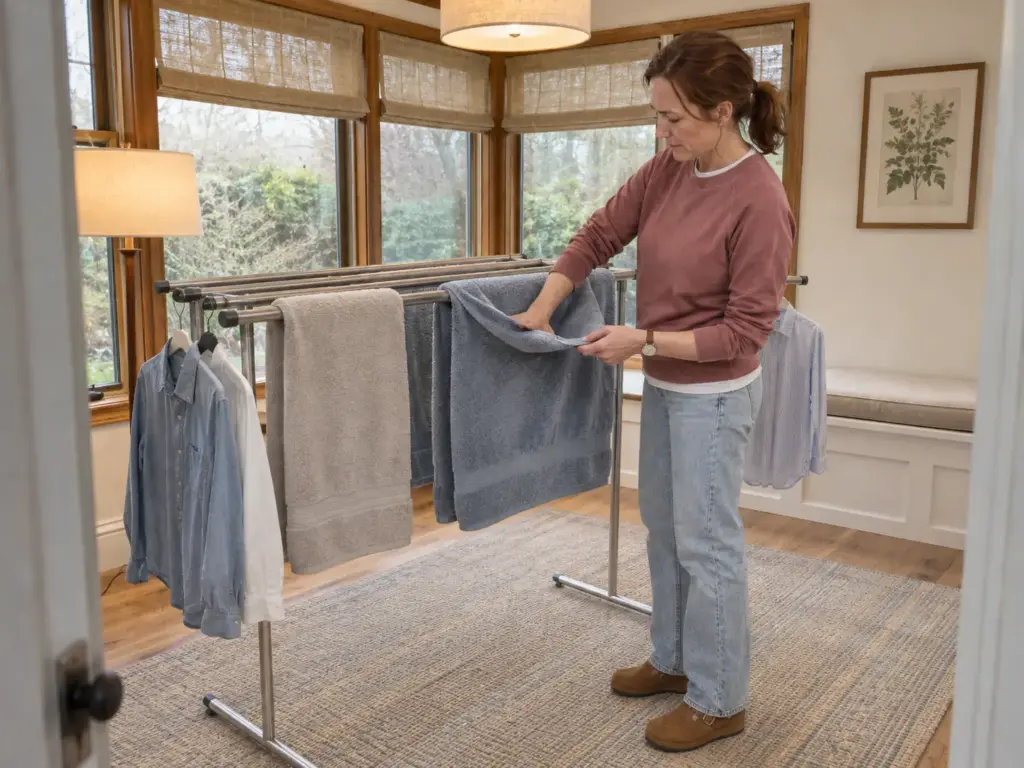
The HOMIDEC 12 Drying Poles rack is the only listing in this set that prints the gap between its rods, 9.4 in, on 12 rods of 28 in. It declares 50 lb on a carbon steel frame of 30 by 29.1 by 37 in that weighs 6 lb, and it comes with sock clips. That 50 lb is a printed figure with no load test behind it, and the same brand’s larger four-tier tower declares only 19.8 lb, so read the number as the maker’s hope.
Put the thickest towels on the end bars, where air reaches them from two sides, and keep the middle bars for shirts. A rack loaded to the last bar from the first hour finishes with the middle of the load still cold.
A Tripod for a Corner and Hangers
The Household Essentials 5009-1 collapsible tripod is 64.5 in tall and 26 in across, with a steel frame, hanger slots and 2.2 lb folded. It has the smallest floor print that still airs a whole load, because the load hangs on hangers instead of draped. Stability is the weak point: it tips on a floor that is not flat and hard, and the plastic center piece cracks when the load hangs uneven. A closet rod costs less than this class and holds more.
Whichever rack you choose, count the footprint at its open dimensions against its folded dimensions, check that it arrives assembled or goes together without play in the joints, and leave about eight inches between pieces so air can move. The spacing between bars decides how much of the fabric the air reaches.
A Cheaper Rack That Still Takes a Full Load
For most renters the question is how little a rack can cost and still stand up to a wet load, and cheaper comes with a flaw too. Each pick below carries it in writing.
The Gullwing at a Third of the Price
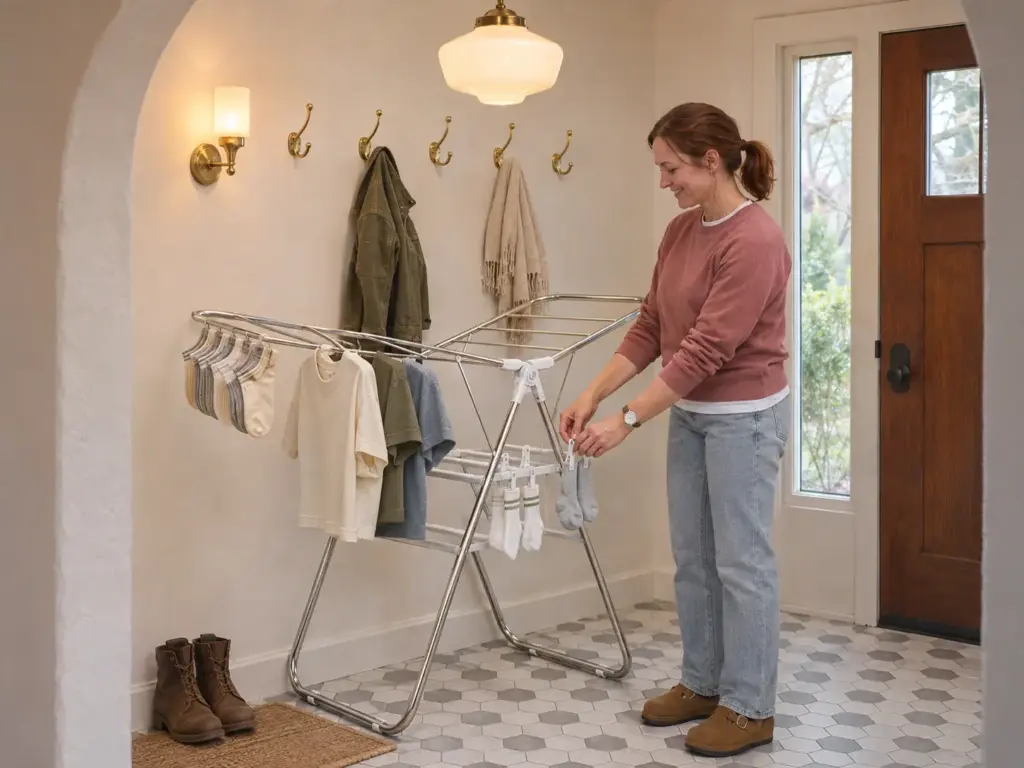
The SONGMICS ULLR505EW01 gives 60 lb declared and only 17 in of depth for about a third of what the premium gullwing costs.
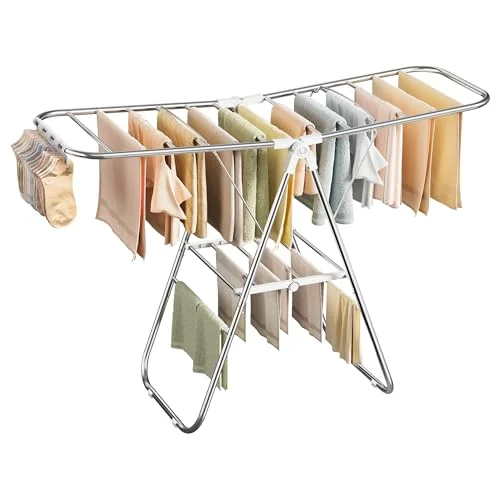
The size is the argument on this one. At 51.2 by 17 by 44.9 in, with stainless steel tubes and plastic connectors, it folds flat and slides behind a door, and the same compactness is why it falls short for a full adult wash.
The Narrowest Folds and the Doorway Rack
The Amazon Basics Foldable is an accordion in chrome steel, 14.5 by 29.5 by 41.8 in and 32 lb declared, and it folds flat. It is the cheapest rack here that survives a load, with the narrowest folded footprint of the group that still holds one. Its durability is the open question, because it carries the same hinge as the big accordions.
For a room shaped like a hallway, the Black+Decker 3 Tier Expandable Laundry Rack opens to 30 by 41 by 17 in and folds to a 3 in slab of 17 by 21 in, at 4.9 lb in steel. That fits a doorway or a closet. Rust at the third use is a documented pattern of folding racks, and this one also runs smaller than its picture suggests. The narrow rack works until the load is a pair of jeans and a bedsheet, and then it goes back to being a shirt rack.
Who a Rack Is For
How many American homes already own a dryer is the right place to start: ENERGY STAR says “About 80 percent of American homes have a clothes dryer, so the savings opportunity is huge.” A rack serves the other fifth, and the loads the other four households do not want tumbled. A closet rod costs less than any rack above.
What Is Still Standing After a Few Months of Folding
A rack that looks fine once assembled gets judged later, by the hinge, the coating and the bars after it has gone up and down a few dozen times in a damp room. Month two is where the first of them shows. No type comes through untouched, and the order of failure tells you what to check.
Hinges, Coating and the Mesh Top
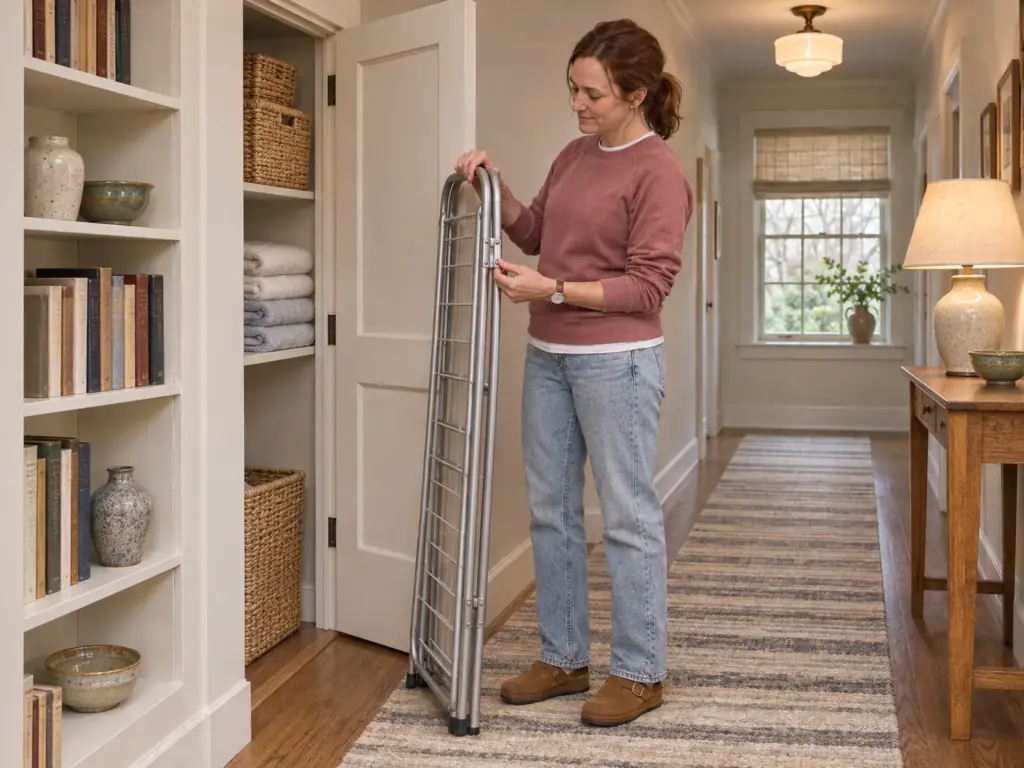
The accordion hinge gives out first, the accordion that holds eight things and breaks within a year. Then the leg lock that slips while you carry it, the plastic hub of a tripod that cracks, and the coating that peels and snags fabric. The racks that survive years of use share a pattern: steel, no mesh, no plastic hinge carrying the load. The premium wing racks set the benchmark on that point, though their brackets are where they fail first.
Two sturdy racks, each rated well above a single load, replace a dryer for a household. One mid-size rack is the one that gets replaced.
The month two check is short, and it reads the parts in the order they fail:
- The hinge: open and close the rack fully and look for play, or a pin that has started to walk out. On an accordion with a mesh top, check for brittle mesh.
- The leg locks: set the rack up and lean on one corner. A lock that gives is the one that clacked when the rack was carried.
- The coating, wherever fabric rubs it: a peeling coating at the contact points means the next wet shirt snags.
- The bars nearest the window or the wall: spots show there first.
A rack that passes all four is behaving as it did out of the box, and one that fails two is worth replacing before the cold weeks arrive.
The Bars That Take Mold Spots
Rust shows on folding racks sold as rust-resistant, sometimes by the third use, and wooden bars take mold spots and warp in a damp room. Mold here is a materials problem.
Wood is porous, so a bar that stays wet for a day holds that water long after a steel bar has shed it, and a rack stored in a spot that is already damp, such as a basement corner or the wall behind a bathroom door, takes on moisture again every time it is put away. Mild steel does the same with rust instead of spots. Wipe the bars, dry the rack fully before folding, and store it away from the wettest wall.
The rack that looks fine until the first cold week gives itself away that way: the pane starts to fog, and mildew shows on the wooden bar nearest the window. How to read the fogged pane as the verdict on the room turns that sign into a reading.
How to Fold and Store One So It Lasts
Leave the rack open and empty near the exit for a day with the bars wiped before it goes in the closet. Folding it while it is still damp shuts the water in at the hinge, which is where rust starts.
When the rack comes out of the closet in spring, check the hinge and the leg locks before a wet load goes on it. The room still sets the drying time more than any pick here, and whether a heated rack earns its watts is a cold-room, no-airflow question.
The Order Before You Buy a Rack
The rack holds the fabric apart and the air carries the water away, so the room comes first: read it, move the rack to the room with the exit, take water off with a second spin, and hang a load on a closet rod before anything gets ordered. Then the type, by its flaw. A steel gullwing takes a full load, a shallow gullwing or a doorway rack suits a small room, a tripod belongs on a flat, hard floor, and every one gets its hinge checked.
For later, look at two things on different clocks. A morning is enough for the glass: the reading on laundry day against a plain day, with a glance at the pane. A few weeks is what the hinge and the coating need before they show wear. A fogged pane or a hinge with play means the setup has drifted.
Tomorrow, take the reading before the first shirt goes up and again in the morning, put the rack where the fan runs or the window opens, and spin the load twice. If the reading still says the room cannot take it, a dehumidifier sized for one room is the next step, and which dehumidifier sizes suit a room that fogs its windows narrows it down, while why indoor humidity shifts with the cold explains why that answer changes in January.
Frequently Asked Questions
01What is the best type of clothes drying rack?
For a full wash load, a steel gullwing or two-level rack with a sturdy frame and no plastic hinge carrying the weight is the best type. A tripod suits a corner on a flat floor, and an accordion is the cheapest and wears fastest.
02Are clothes drying racks worth it?
Yes, if you want to spare delicates from the dryer or have no dryer at all. About 80 percent of US homes already own one, and a closet rod costs less than any rack and holds a whole load on hangers.
03Which clothes drying rack is the most sturdy?
The sturdiest racks are steel with no mesh and no plastic hinge under load. A printed rating of 50 or 60 lb comes with no load test, so judge the frame, the joints and the leg locks.
04Where should a clothes drying rack go in a small apartment?
Put it in the room that already moves air: a bathroom with the exhaust fan running or a hallway by a cracked window. A bedroom with the door shut has no exit for the water, whatever rack stands in it.
05How do you keep a clothes drying rack from rusting or getting mildew?
Wipe the bars, let the rack dry fully before folding, and store it away from the wettest wall. Wooden bars and mild steel are the materials that come back in a damp room.