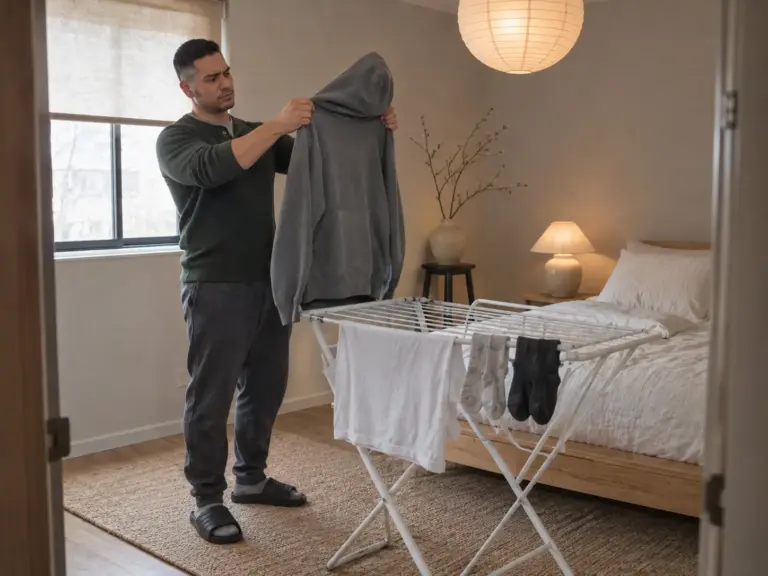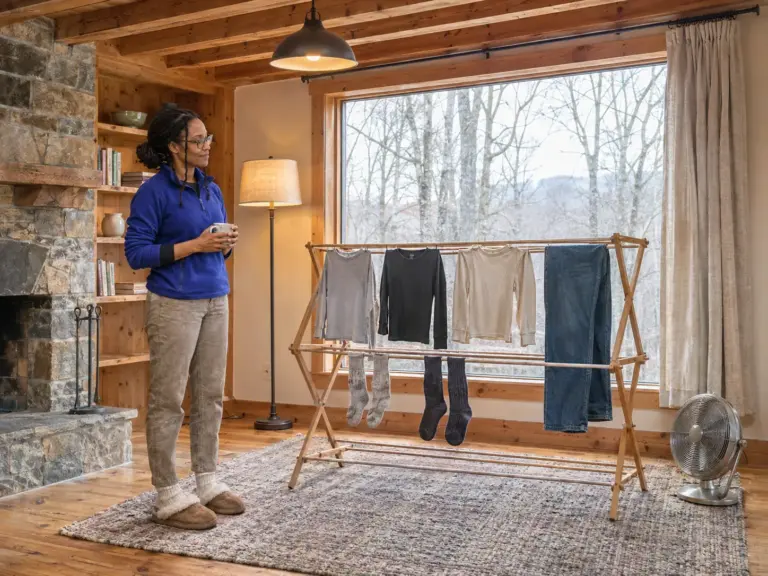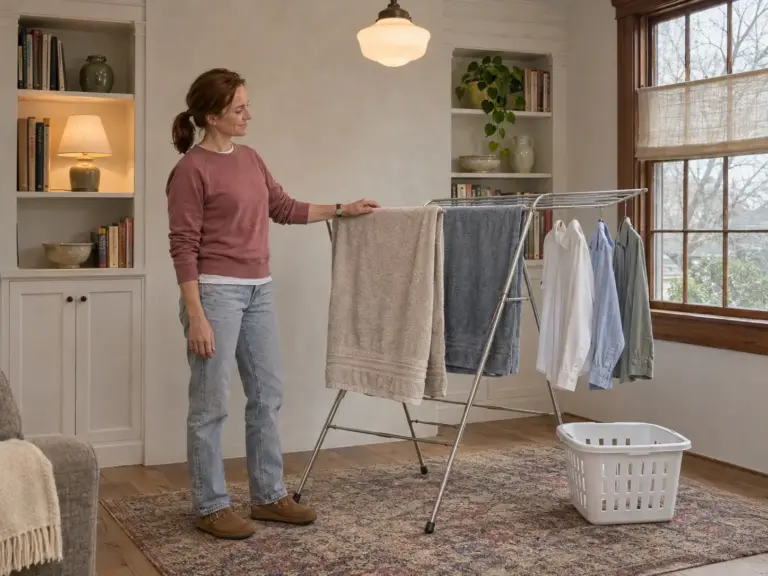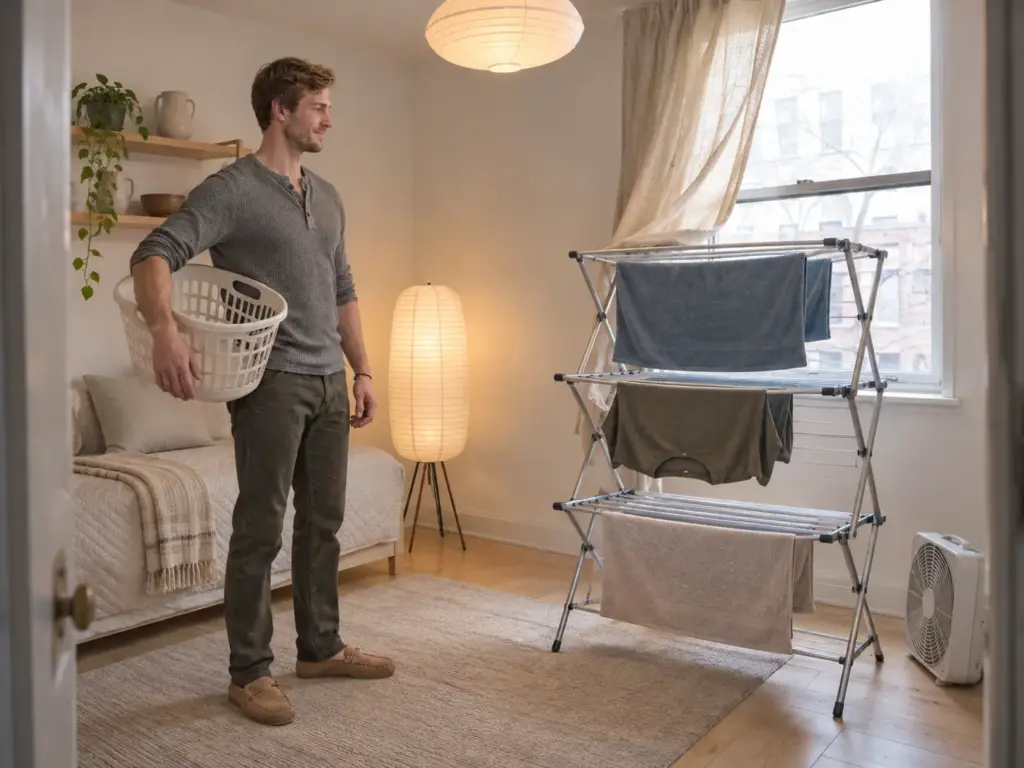
The heated airers that British shops sell are built for a 230-volt wall, and almost none of them ships to a US address as a heated product, so what a US shelf carries under this search is a different pair of machines: 230 to 300 W bar airers from small brands, and 600 to 2,000 W fan heaters wrapped in a bag. The best indoor heated clothes drying rack for an apartment is the one that dries tonight’s load without fogging the window, because the heat moves the water out of the fabric and into your room’s air, and the first cold pane of glass turns it back into liquid. That makes the real question the one below the shopping question: where does the water go once the bars have warmed it? This guide weighs the load and reads the room first, puts the free changes ahead of any purchase, writes the flaw under every rack and pod that ships here, runs the watts-and-hours arithmetic at your own electric rate, and says where a rack is the wrong answer.
Quick Answer
A heated rack is a 200 to 400 W warm frame, not a dryer: it moves the water from the cloth into your room’s air, so it wins only where that moisture can leave. For a US apartment, pick a bar airer, add a fan and a cracked window, and read the room’s humidity before and after.
Weigh the Load and Read the Room Before You Shop
You arrive with a rack in mind and a damp pile in the hamper, and neither one tells you the number that decides how tonight goes: how much water that pile is about to hand the room. So the first purchase is a reading, and the band that interprets the reading is public. Two measurements, a bathroom scale and a small humidity meter, do the work before a single bar is plugged in.

The Water in a Wet Load Goes Into Your Air
Weigh the load the moment it leaves the washer, with the basket subtracted, then weigh it again once it is dry. The difference is the water the room had to absorb, and the arithmetic is friendlier in US units than it looks: a pint of water weighs about a pound, so every pound the load loses is about a pint that went into your air. A heated rack speeds that evaporation along, so the water leaves the cloth as water vapor sooner. It removes none of the water from the room.
Step on the scale holding the full basket and note the number, then step on again holding the empty basket; the difference is the wet weight. Do the same with the dry load the next day. A heavy load of towels and jeans gives up far more than a small load of shirts, and the scale tells you which kind of evening is ahead before the meter does.
That explains how a closed apartment behaves on laundry night. In a small place with poor air exchange, one corner turns damp on every heavy load, and detergent, an extra rinse or a scrubbed drum change nothing, because the towels sour while they dry, long after the wash is over. The moisture was never a laundry-detergent problem; it is a drying problem, and the room is where it gets decided.
And the better the rack, the faster the room fills. A rack that finishes a load in four hours hands the room the same water as one that takes eight, only in half the time, so the meter climbs twice as fast. Speed is a reason to buy a rack and a reason to give the water somewhere to go.
The room matters as much as the load. In a bedroom of ten by twelve feet with the door shut, the same water raises the reading much faster than it would in an open living area, because the volume of air it has to spread through is smaller. The room that holds the rack is the room whose air receives the water, so the question of where the rack stands comes before the question of which rack.
The Meter, and the Band the EPA Gives
The EPA’s guide to keeping indoor humidity under 60 percent puts the target in two sentences: “Keep indoor humidity low. If possible, keep indoor humidity below 60 percent (ideally between 30 and 50 percent) relative humidity.” The reading that matters is the room’s, taken at chest height a few feet from the rack, and what the band looks like when you read it day by day shows how that number moves across a week. A heated rack never lowers it; it raises it for as long as the load is drying.
Place the meter at chest height on a shelf or an interior wall, a few feet from the rack, out of the fan’s direct stream and away from the window, since the warm air off the bars and the cold glass nearby both skew a reading.
Take three readings: one before the load goes up, one an hour in, and one when the cloth is dry. A humidity reading inside the EPA’s band has room for the load. A reading in the 50s leaves a narrow margin, so the fan and the window come before the rack. A reading at 60 or above means the room is already full, and the first job is bringing the number down.
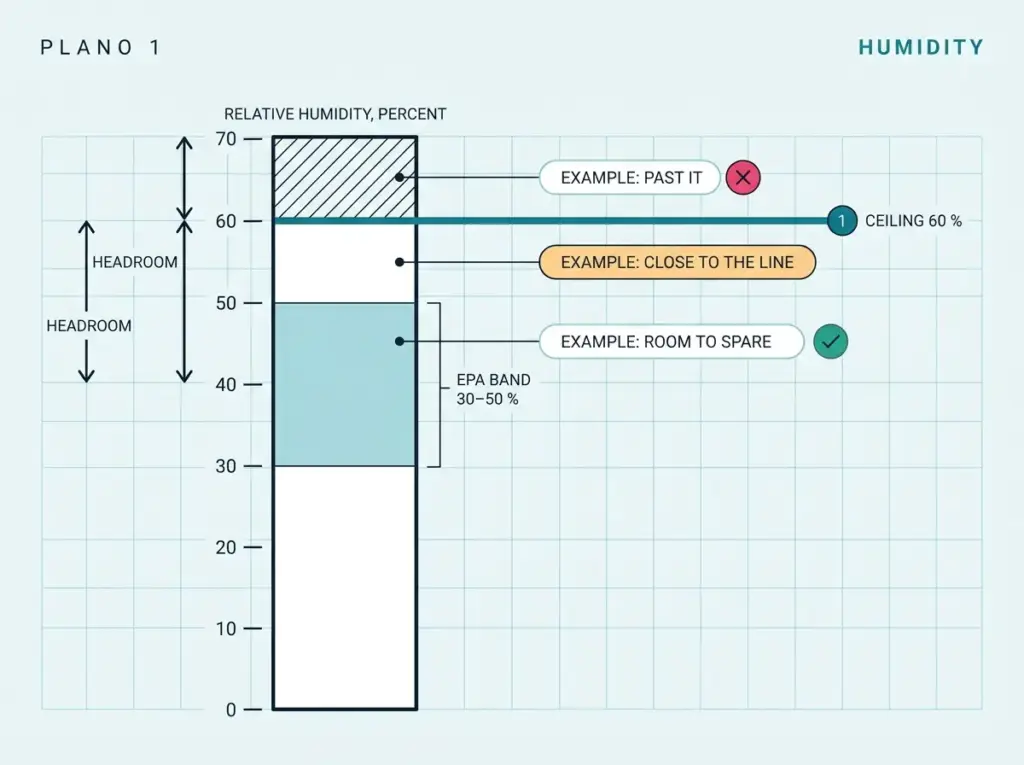
Headroom is the distance between today’s reading and the 60 percent line, and it decides how big tonight’s load can be. The EPA adds a clock to the same page: wet or damp material that is dried within 24 to 48 hours does not grow mold in most cases. A load on a rack is a small, slow spill, and the rack has done its job only if the cloth is dry inside that window.
The one device the EPA names for this job is a small humidity meter, and the AcuRite 00613 Wireless Thermometer and Hygrometer is the single-unit version: temperature and humidity on a display readable across the room, in a housing about 2.5 inches square. It costs less than any rack in this guide and changes more decisions than any of them. A meter this cheap can read a few points off, and a unit that quits within days turns up now and then, so the check is a second meter next to it for an hour before the first load. If the two disagree by more than a few points, how to trust a cheap humidity checker explains which one to believe.
What Fog on the Glass Tells You
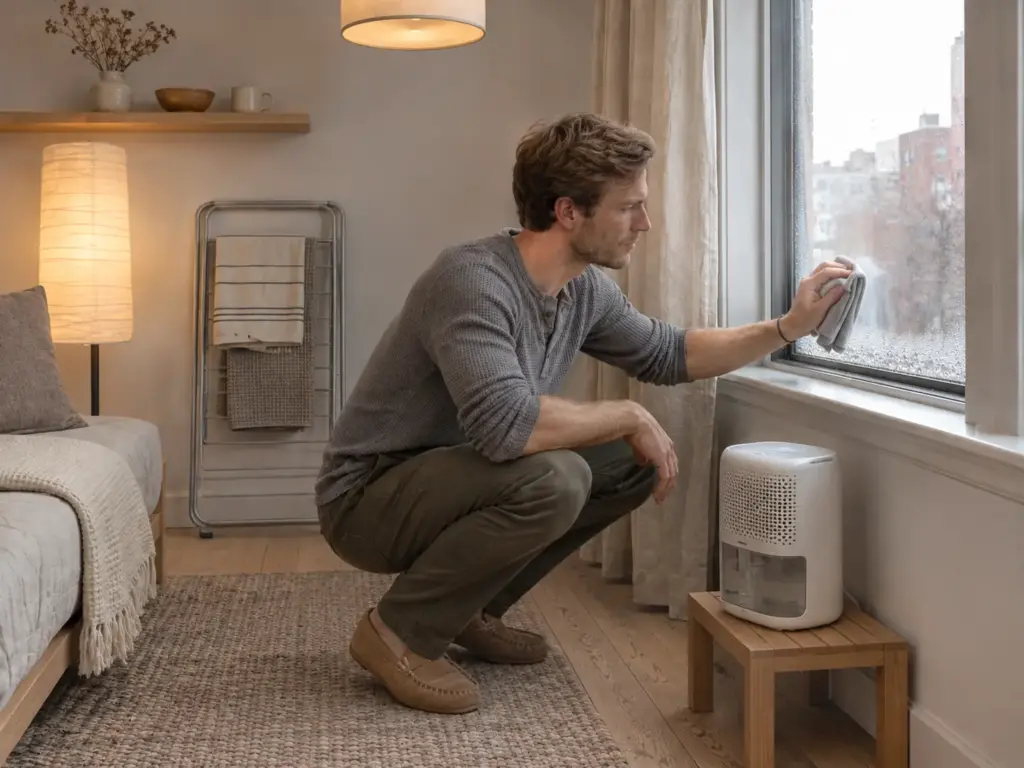
The EPA lists condensation on windows, walls or pipes as a sign of high humidity, and on laundry night it shows first in the lower corners of the glass. Fog that is still there after the load is dry means the room is holding more water than it can send out. The pane is only the first surface cold enough to collect it.
The 60 percent line is an average for the room, and the glass is colder than the room’s air. At 70 °F (21 °C) and 50 percent humidity the dew point is about 50 °F (10 °C); at 60 percent it is about 55 °F (13 °C). Any surface colder than that sweats, so on a winter night the window can fog while the meter still reads under the ceiling. When the two disagree, the glass is telling the truth about the coldest corner of the room, and the meter is telling the truth about its average.
Read the meter before the load goes up and again an hour into the evening. A reading near the top of the band at the start and fog on the glass by the end of the evening point to the same cause: the room has no way out for the water.
The Free Changes That Come Before Any Rack
With the reading taken, the changes that follow cost nothing, and their order matters more than the gear. Each gets a second look at the meter before the next begins, so the room shows which one moved the number. The likeliest comes first.
Spin the Load a Second Time
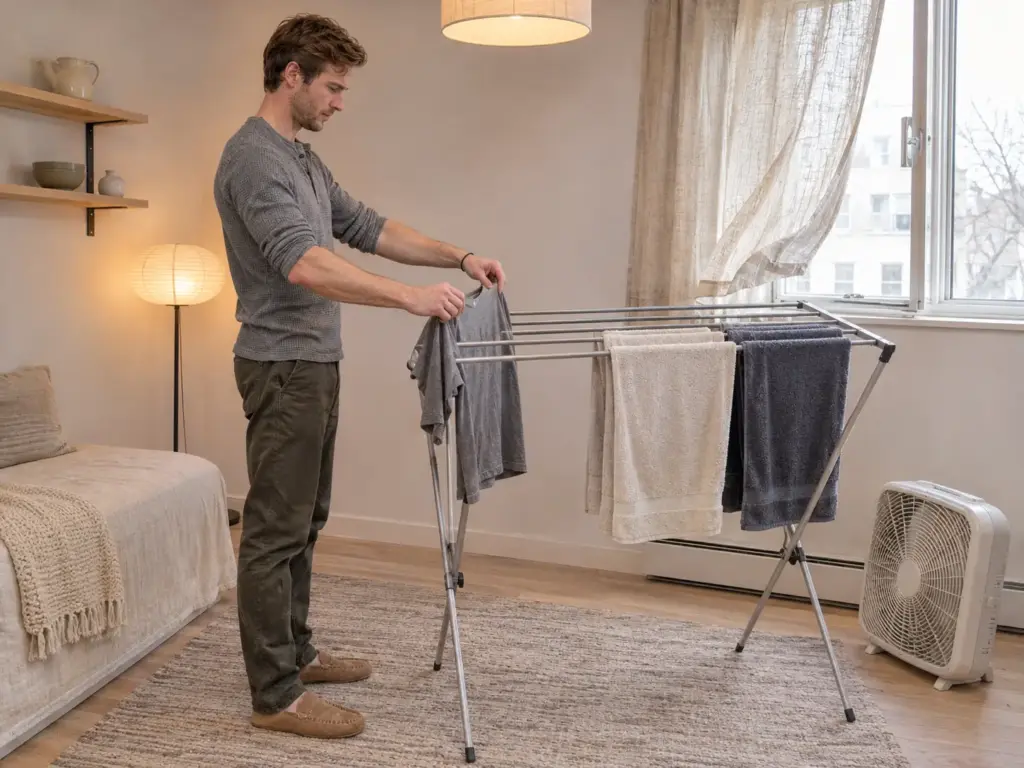
The cheapest water you will ever remove is the water the washer takes out for nothing but a few more minutes of spin. Many washers offer an extra spin cycle or a faster spin speed for sturdy cotton, and a delicates setting spins slower on purpose; use the fast one for towels, jeans and sheets and leave the slow one for anything the care label protects. Run the final spin again before the load goes near a rack and weigh it a second time: the scale shows the difference at once, and the meter shows it an hour later as a slower climb.
This works with every rack, heated or not, and it is the only step here that needs no floor space. If the reading still runs high through the evening, the free fixes for a room that reads high, in order covers the other ways to bring it down.
Spread It Out and Put a Fan on It
Crowding, not wattage, is why a rack seems to do nothing in one room and works in another. Spacing garments is the fix: leave a hand’s width between pieces, give thick items such as towels and jeans two or three bars each instead of one, and flip and rotate pieces between bars as the evening goes. Read the meter again; the load now shows more fabric to moving air, so the climb should come sooner and finish sooner.
Then add a plain floor fan on low (a box fan or a pedestal fan both work), three to six feet from the rack and aimed along its long side so the air crosses all the tiers and does not hit one spot. A bar airer warms the fabric but leaves still air at its surface, and still air holds the water close; a fan sweeps that layer away for a fraction of the rack’s running cost, and air circulation, more than extra heat, is what finishes the job. The fan is the part a bar airer is missing, and it is a better first purchase than any heated model in this guide.
Check the overlaps first. Wherever one towel lies on another, a damp strip outlasts the rest of the cloth. Move those pieces to the outside edge of the rack halfway through the evening and the strip goes.
A Cracked Window and a Cover Over the Rack
A window opened a hand’s width lets the water leave only if air can also come in somewhere else, a second window or an open door. With a single opening the window makes a draft and no exchange, and the damp air sloshes at the sill. The best geometry is two openings on opposite sides of the apartment, so air enters at one and leaves at the other and sweeps the room on the way. In winter the outside air does the work, because cold air holds very little water and takes the moisture out with it once it has warmed in your room.
A cover keeps the heat where the clothes are. The English Home’s test of makers’ covered units dried a small load in about five hours where the same makers’ open tiers took eight. Use the maker’s own cover on a heated unit; a bedsheet draped over bars belongs on an unheated frame, and no cover goes over the vents of a heating element. For the order of all of this across a whole apartment, see the guide to keeping humidity under 60 percent while you dry laundry indoors.
Put the rack in the main room, with the fan and the cracked window working, and keep it out of the closet: a small closed space is where the moisture collects, ventilation is poor, and the stale air and musty smell that come first are followed by mildew. Run the same load twice on the same rack, once draped over single bars and once spread across three bars with a cover over it, and the two finish hours apart. The gap comes from heat and air being kept in one place; the rack itself never changed.
Bar Airers That Ship to a US Address
The racks that British shops sell as heated airers are mostly 230-volt units that never reached this shelf, so what follows is what a US buyer can order: three bar airers with their wattage printed, sorted by what they draw and what they carry. Each has its flaw written next to it, in the card and in the paragraph around it.
Why the UK Favorites Are Missing From a US Shelf
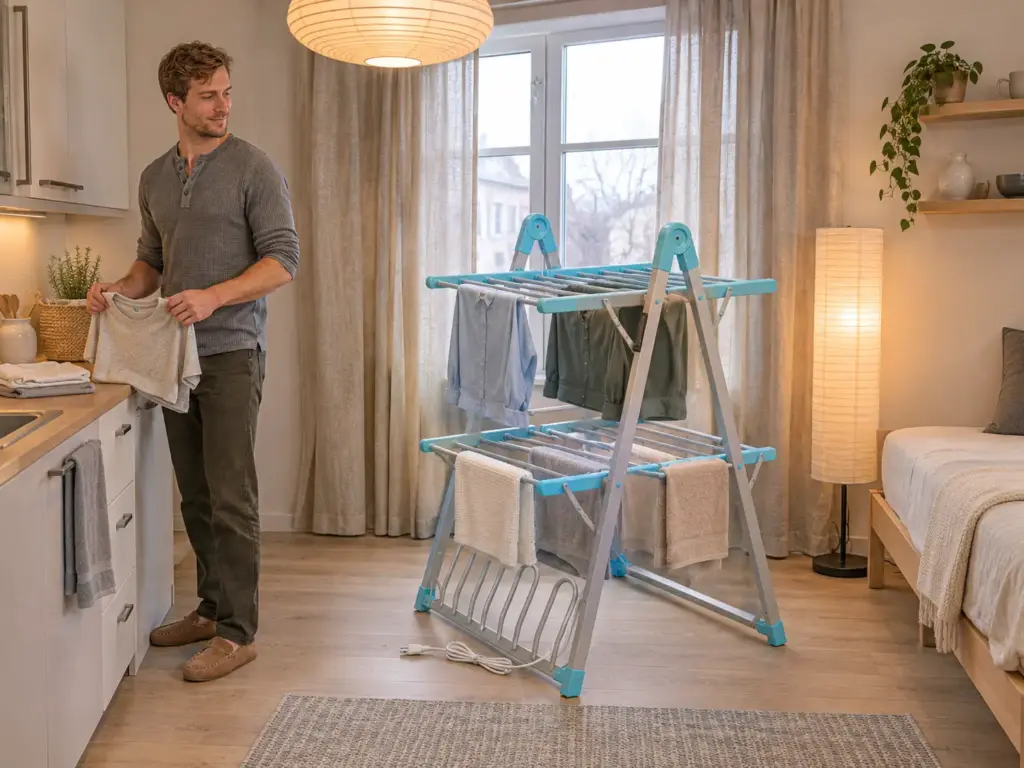
Dry:Soon, Minky, Beldray, VonHaus and Dunelm are names British shops sell, and none of them lists a heated airer on amazon.com; the 230-volt plug alone rules them out for a US wall outlet. Before ordering any heated airer, read four lines on the product page: the voltage (120 V for a US outlet), the wattage, whether a safety listing mark from a recognized lab such as UL or ETL is shown, and whether there is a shut-off timer or a thermostat. A page that prints none of the four leaves you buying blind, and a short warranty line or a missing build-quality detail is a reason to wait.
What ships here under this search comes as two machines: 230 to 300 W bar airers from small brands, and 600 to 2,000 W fan heaters in a bag. The wattage on the box tells you which machine you are buying.
The Tors + Olsson airers sold in the US show as out of stock on amazon.com, and the Black+Decker X-Frame heated airer is a 230-volt British model with no live US listing, which leaves a short list. For the unheated frames, what breaks first on each type of drying rack covers them in full; this page stays with the heated versions.
A 270-Watt Two-Tier With a Timer
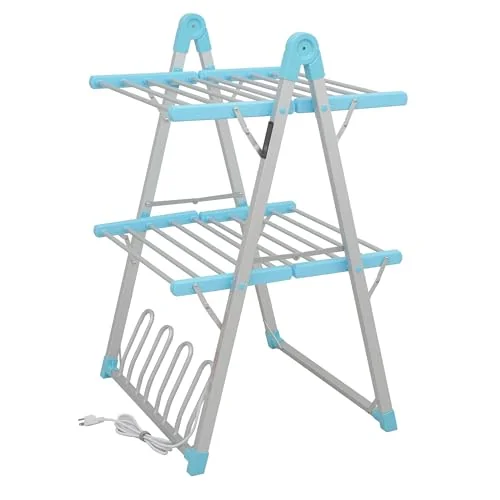
A bar airer is a frame whose rods are warmed by a resistive element. The maker sheets print 113 to 131 °F (45 to 55 °C) at the bars. British tests that put a thermometer on the bars measured anything from 88 to 131 °F (31 to 55 °C), took from 30 seconds to 16 minutes to warm up, and needed four to five hours for a small cotton load in a room at 66 to 68 °F (19 to 20 °C). The bars dry only what touches them: items laid flat across several bars finish while a garment draped over a single bar stays damp where it hangs free.
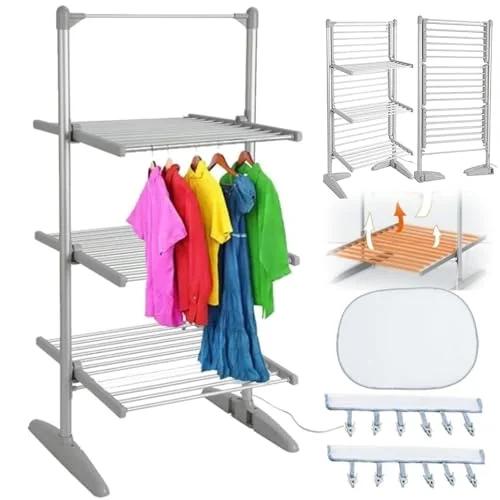
The SHARNDY ETW39AL-92S is the one bar airer on this shelf that prints its watts, its bar temperature and a shut-off timer together: 270 W, bars at 120 to 140 °F (49 to 60 °C), 20 clothes rods plus 4 for shoes, 120 V, a foldable frame about 41 by 26 inches whose folded depth is about 3 inches. Expect stripes on anything draped. The part of a long shirt that hangs free dries at the room’s pace, so it comes out dry at the bar and damp below it.
Lay pieces across two or three rods and the stripe disappears. Load the lower rods with the thickest cloth and keep the top rods for lighter pieces, since warm air rises through the tiers and gives the top the easier job.
After a season of use, dust and lint bake onto a warm bar as a gray film. It comes off with a damp cloth once the unit is unplugged and fully cooled, and it is the first sign that a bar airer has been working.
The Lowest Draw With Heated Wings
At 230 W, the BYFSRUS Towel Warmer With Wings is the honest low end of this category, about 0.23 kWh an hour. It has 18 rods, wings that fold out and are heated too, and a frame that folds to about 2.4 inches; unfolded it stands roughly 58 by 21 by 37 inches. The label promises a constant 113 to 131 °F (45 to 55 °C).
Take that label apart: the 230 W winged class is the one The Telegraph and The Guardian measured at the bars, and the readings came in at 88 to 91 °F (31 to 33 °C), well under the printed range. Warm to the hand, slow on denim.
Run it in a room that is already warm and keep it to towels, T-shirts and underwear. Jeans and a duvet cover belong to a bigger machine.
The Biggest Frame With Its Size Unconfirmed
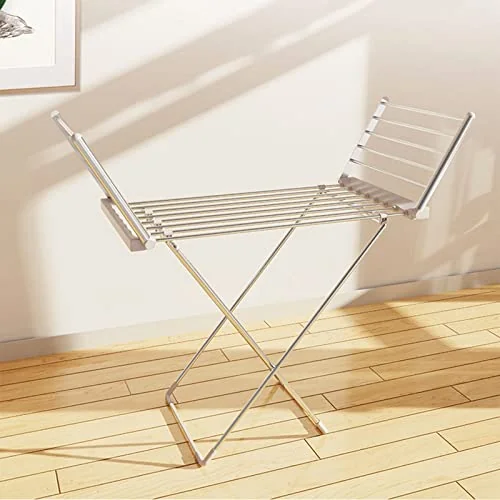
The Jiangtaom 3-tier airer is the biggest bar airer here that publishes a wattage, and the nearest thing to the three-tier models British shops sell: 300 W, bars at 113 to 131 °F (45 to 55 °C) in about five minutes on the maker’s sheet, an aluminum frame rated for about 22 lb (10 kg) per tier and 66 lb (30 kg) in all. If one evening means a family’s towels and school clothes, this is the frame with the rods for it.
The size is the sticking point. The maker’s text gives about 147 by 73 by 70 cm (58 by 29 by 28 inches), but the dimensions on the product page are placeholders (10 by 10 by 10 inches), so the footprint and the bar length cannot be checked before it arrives. With this brand you buy blind on size. Tape out a 58-by-29-inch rectangle on the floor and stand a chair at the far end before ordering; if the corner you pictured does not hold it, the BYFSRUS above is the smaller answer.
Watts, Hours and Your Own Electric Rate
A cost per hour counted in pence is no use to a US reader, but the formula behind it is two numbers multiplied, and the third is printed on your own electric bill. Everything below is in kilowatt-hours and ratios, so it keeps working when the rate moves.

Watts Times Hours Is the Whole Formula
Kilowatt-hours are watts times hours divided by 1,000. A 300 W bar airer is 0.3 kWh an hour, so a six-hour evening comes to 1.8 kWh. The 230 W winged unit is 0.23 kWh an hour and 1.4 kWh over the same six.
A 2,000 W pod runs through a kilowatt-hour every half hour, so three hours is 6 kWh and four hours is 8. Multiply any of those by the rate on your own bill; the EIA’s table of average US electricity prices by sector shows where yours sits, and the arithmetic stays right when the rate changes.
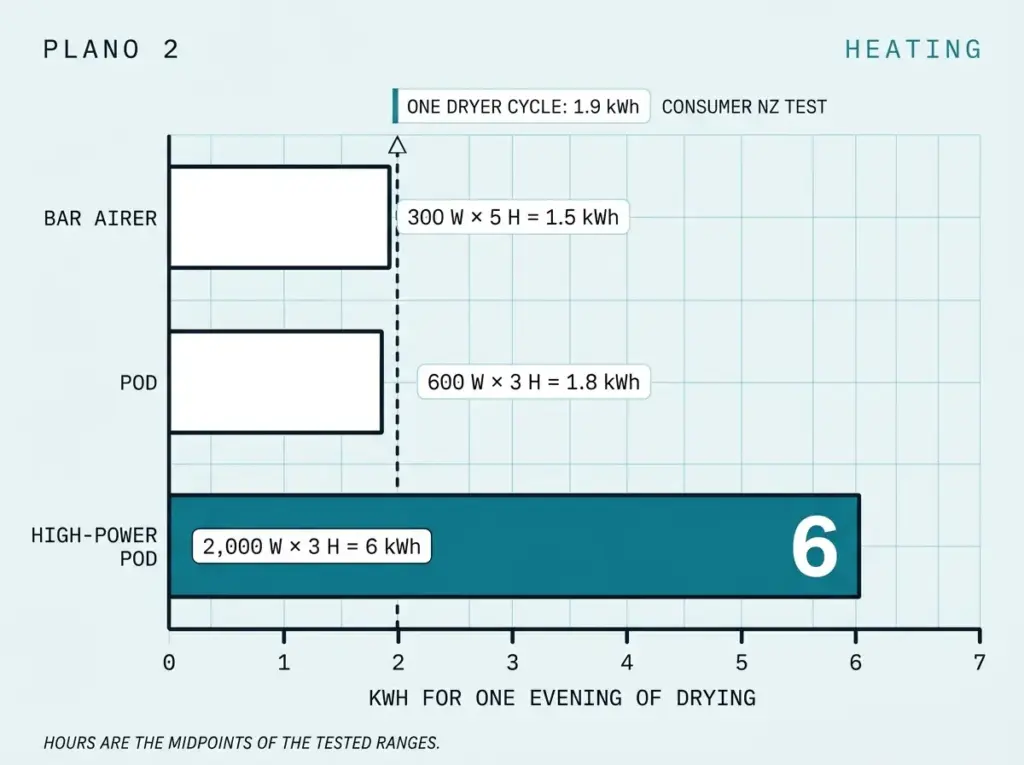
Pods of 850 to 1,200 W run about three times a bar airer’s cost per hour but finish a load in two to three hours instead of four to six, according to The Guardian’s pod tests. So a pod is cheaper per evening only if the bar airer would have run twice as long. A 600 W pod running three hours uses 1.8 kWh, about what a 300 W airer uses in six; the pod bought the evening back with the same energy.
Line the three evenings up for the same towels. The 300 W airer over six hours is 1.8 kWh, the 600 W pod over three hours is 1.8 kWh, and the 2,000 W pod over three hours is 6 kWh. The first two cost the same energy, so the choice between them is time, noise and floor space. The third costs a little over three times as much for the same wet towels, and that ratio holds at any rate on any bill.
Put a plug-in power meter between the rack and the wall for the first load and write down the hours the timer runs. That one evening gives you a kilowatt-hour figure that belongs to your rack, your room and your wash, and every estimate on this page can be replaced by it.
A Cold Room Turns the Cheap Option Into the Expensive One
The lowest wattage looks cheapest until the hours are counted. In a room at 59 °F (15 °C), Consumer NZ’s test of a heated drying rack needed 14 hours and 3.2 kWh for one full load, against 1.9 kWh and one hour in a dryer. Cold air pulls heat off the bars faster and holds less of the water that evaporates, so the meter keeps running while the cloth stays damp. Below about 64 °F (18 °C) a heated rack stops being the thrifty choice and starts being the slow one.
A load that needs 14 hours is 3.2 kWh on the airer; a 600 W pod finishing the same load in three hours would use 1.8. The rack belongs to a warm room, and a cold one calls for the cover, the fan, or the dryer. If the apartment sits at 64 °F (18 °C) or below through the evening, the cheapest kilowatt-hour you can save is the one you do not spend heating bars in a room that will not let them work. A bar airer left running through a cool evening produces a line on the bill that looks fine every night and adds up across a winter, while the cloth is only damp-dry by morning.
What the Dryer Already Does for the Same Load
About 80 percent of American homes have a clothes dryer, and an ENERGY STAR certified heat pump dryer uses around 70 percent less energy than a conventional one, according to ENERGY STAR’s page on clothes dryers. Against the 1.9 kWh the dryer used in that same test, a 300 W airer running six hours lands at about the same number, so at six hours the rack saves no energy at all; its case is the fabric and the apartment with no machine. The rack’s saving shrinks in a US building, where the machine is already there, and the rack settles into a supplement: delicates, one wet load, or an apartment with no machine at all.
What the rack does well is gentleness. There is no tumbling and no hot air on elastic and delicates, which is a point about fabric and nothing more. A load that will run longer than the timer allows is a load for the dryer or the building’s laundry room. A bigger rack never fixes that.
Pods and Covers, the Fast and Hungry Option
A pod is a small fan heater and a bag, and it trades running cost for time: the choice is whether the load must be dry tonight. Two very different machines sell under one name, and the wattage is what tells them apart.

A 600-Watt Pod for Delicates and One Load
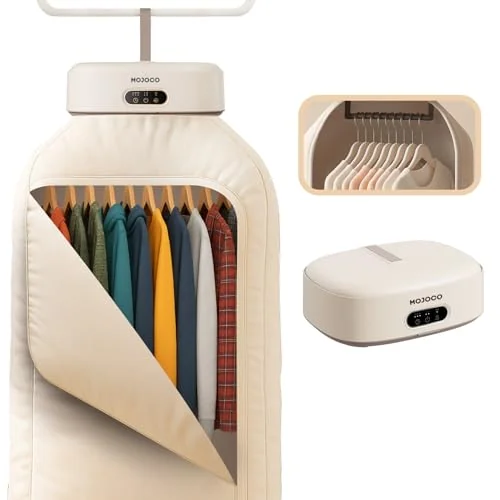
The MOJOCO MJC-T03 draws 600 W, the lowest in the pod class, with two heat modes, a built-in timer and a folded size of about 8.3 by 8.7 by 7.9 inches.
A pod works by pushing heated air up through a cover that sits over the frame, so the clothes dry in a warm moving pocket and the room’s air is not asked to do the work. That is why the same cloth dries faster than on a bar airer that warms only its rods, and it is why a pod needs the cover closed and the vents clear: air that cannot circulate through the load does nothing.
It is listed for about 9 garments and 22 lb, which is one load of delicates and the cheap way to put warm moving air inside a cover. Speed is where it splits: fast on a few garments, slower than expected once the load is full. Treat it as the machine for tonight’s small load and give a full wash the bar airer’s hours.
A 2,000-Watt Heater With a Cover for the Rack You Own
The KPCB Tech portable dryer is the other half of the US market: a 2,000 W PTC heater with a timer and a remote, plus a zip cover that fits over a rack you already own (the rack is not included). It is the one way here to dry a whole rack in a single evening, and it pays for that in kilowatt-hours. At 2,000 W it uses a kilowatt-hour every half hour, so four hours is 8 kWh, more than four times the 1.9 kWh the dryer used in the Consumer NZ test.
The wall matters too. At 120 V, 2,000 W pulls about 17 amps, more than the 15 amps a standard household circuit is rated to carry, so this heater wants a 20-amp circuit with nothing else running on it. If you do not know which circuit you have, that question goes to an electrician before the first load.
The Cheapest Covered Dryer, and the Timer’s Limit
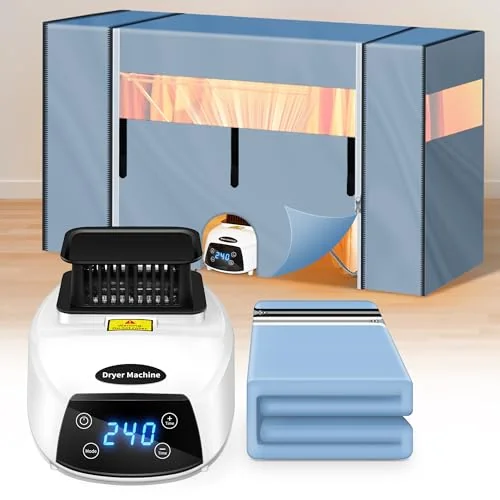
The NEBEUUO 900 W two-layer dryer is the least expensive working version of the pod idea: a 900 W PTC heater, a two-layer frame for 24 garments, an Oxford cloth cover, a timer that runs to 180 minutes, and a frame that folds flat for storage. Its structural limit is that timer. Three hours is the length a real load needs in a warm room, and a full load in a cool one can outlast it, so the unit stops before the cloth is done. A covered heater shut over damp cloth is also where the sour smell starts; leave the cover unzipped when the timer ends.
What a Cover Does That Extra Watts Do Not
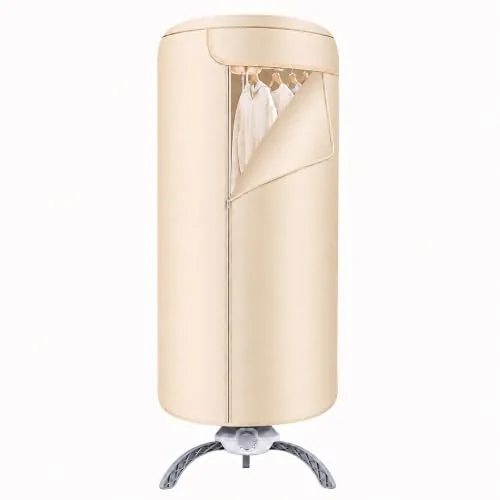
A cover does more for drying time than extra wattage, because the heat stays where the clothes are. A covered 600 W unit can match a bar airer in about half the time, and that is a result of trapped warm air and nothing in the element. Before buying a bigger rack, the sensible move is a cover over the one you have, used with the fan and the window.
The cover is also where the damp collects. A cover rolled up wet smells of damp when it comes out of the closet, and a load left overnight under one comes out sour on a rack that worked fine by day. The vents and the zipper line are where condensation drips onto the floor after a long run, and a pod puts its water into the room exactly as a bar airer does, so everything in the next part applies to it.
Lay a towel on the floor under the zipper line before a pod runs, and hang the cover open to dry before it is folded. A cover that went into storage damp is the one that smells in the autumn.
The Water Has to Leave the Room
Whichever machine dries the cloth, the water is now in the air, and what happens to it next decides whether the evening ends with dry clothes or a fogged window. The order is a fan, a window, an open door, and then a dehumidifier sized in pints.
A Fan, a Cracked Window and an Open Door
The free step is a plain floor fan across the rack, a window cracked, and a door or second window open so air can enter. The fan moves the wet air off the fabric and the open door gives it somewhere to go. Read the meter again after about twenty minutes; if the climb has flattened, the room is sending out what the rack sends in, and you can stop there. Time the load for the hours you are home, starting after dinner and finishing before bed, because a rack that is still working at bedtime is a rack running unattended.
A Dehumidifier Sized in Pints, Not in Hope
A dehumidifier takes the water out of the air instead of waiting for a window, and it is sized in pints a day; how to size a dehumidifier in pints a day walks through the arithmetic, and the same method works for a drying room. A full-size unit pointed at a plain rack dries faster than a heated rack alone on damp days. The mini units are the ones that disappoint; the idea holds.
The Frizzlife DH80 is the small one that works with the door shut: a semiconductor unit with a 135 oz (4.1 L) tank, 28 dB in night mode, a 1 to 24 hour timer and auto shut-off. Its rating is 40 oz a day, which is 2.5 pints, at 86 °F (30 °C) and 80 percent humidity, a warm and damp room. In a 60 °F (16 °C) winter room a semiconductor unit removes far less, so it belongs to one small room and cannot carry a whole apartment.
One room, door shut, the rack and the dehumidifier inside it: dry the room and leave the apartment alone. Keep the dehumidifier running after the cloth is dry, until the meter is back inside the band; the walls, the fabric and the furniture hold some of the water too and release it back into the air once the load is out. The percentage to set a dehumidifier to gives the set point for the room the rack dries in, and what to look for in a dehumidifier before you buy is where this decision continues for the whole branch.
After an evening with a load on the rack, pour the dehumidifier’s bucket into a measuring cup. Every 16 oz is a pint the room had to give up, and since a bucket catches less than the load released, the number is a floor under the real figure.
Why a Closet Makes It Worse
A closet is a small closed space with no air exchange, which is where moisture collects and mold starts. Shut a rack and a mini dehumidifier inside one and leave them on for hours, and the air comes back moist with the clothes still damp, because the water has to leave the room and nothing is taking it out. The closet becomes a drying room in all but name, and it invites mold into a tiny space.
Put the rack in the main room instead, shut that room’s door, and place the dehumidifier inside with it. The water now has a whole room of air to spread through and a machine to meet it. For a single room of that size, small dehumidifiers for a single room compares the units by pints, decibels and bucket.
The Plain Rack You Already Own, and What Wears Out First on a Heated One
Before paying for heat, look at what the same load does on a rack with none. After a season, look at what fails on a rack that has it. The plain frame is the baseline every heated model is measured against.
What an Unheated Rack Does in a Warm Room
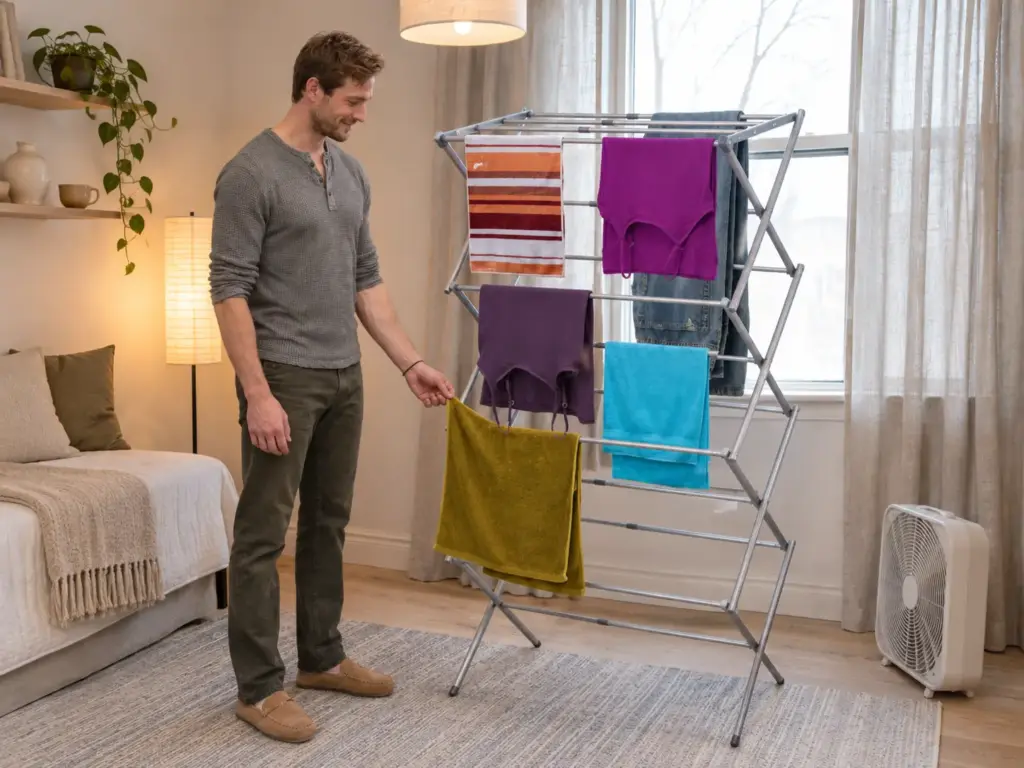
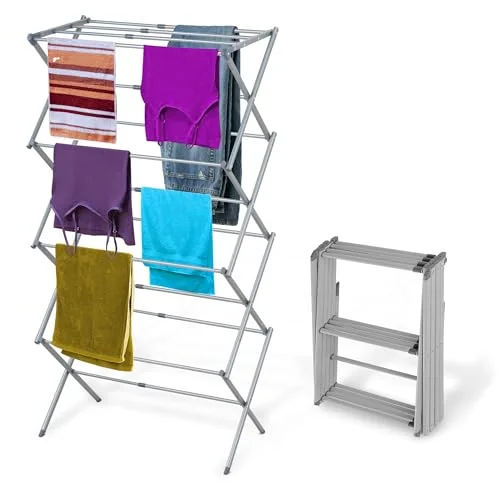
The BLACK+DECKER BD05905 is the baseline: 4 tiers and 14 rods for 30 lb of wet laundry, 57 inches tall, folding to about 4 inches, carbon steel, assembled without tools, and 0 W. It dries by air alone, which is exactly what the free changes in this guide work with, and in a warm room with a fan the load on it can finish nearly as fast as one on a heated airer that is not covered.
Heat does two things for wet fabric: it raises the vapor pressure of the water in the cloth so more leaves each minute, and it warms the air at the surface so that air carries more away. A plain frame gets only the second, from the room. A room at 68 to 72 °F (20 to 22 °C) with a fan is already a heater for it, and a heated rack adds the most where the room is coolest and the fan is missing. The frame adds no heat, so in a cold room it is the rack that leaves the towels damp by morning.
Whether this particular frame earns a place at all depends on what you already have: if you own a rack, the fan and a dehumidifier will do more than any heat will, and the 30 lb capacity is the main thing a new frame gives you. For the wider comparison, which drying rack lasts longest in a small apartment lines up the unheated types by what breaks first.
Where the Heat Fails First
The recurring repair on a bar airer is the heat itself. The frame keeps standing and folding and simply stops warming, and it shows in the second or third winter. A power button that sticks is the other repeat. Neither one is loud, which makes them easy to miss until the cloth that dried by morning last year is still damp this year, and the bar is cold to a hand.
When the heat quits, a plain frame with a dehumidifier beside it is the setup that remains, and it often outperforms the airer did. That is a reason to think of a heated rack as a supplement from the start. The frame is the durable part; the element is the part with a life.
Wiping, Airing and Storing
Three small wear points show up first on a heated rack: lint and dust that bake onto the bars as a gray film, a cover rolled up wet that smells of damp, and rubber feet that leave marks on a floor. Three habits decide how long the rack lasts:
- Wipe the bars with a damp cloth when the unit is unplugged and fully cooled.
- Hang the cover open to dry before it is folded away.
- Air the frame in the room before it goes into storage.
When a Rack Is the Wrong Answer
Some rooms and some loads are not rack problems at all. The answer is a machine, a door, or a person with a license, and saying so is part of picking a rack well.

The Closet, the Bathroom and the Room Nothing Leaves
A closet used as a drying room and a room with no way to exchange air share one flaw: the water has nowhere to go, the smell returns at night, and a load left overnight comes out sour on a rack that worked all day. The EPA’s indoor humidity range for a home is 30 to 50 percent, and that is the range the room has to return to once the load is dry. When it will not return, finding where a high reading comes from names laundry as one source among several, and the others need looking at too.
Keep the bathroom out of it. A heated rack, a plug and a wet room do not belong together, and the maker’s manual is the authority on where the unit can stand. It never runs on an extension cord, never unattended and never overnight, and its bars are a hot surface that stays out of reach of children and pets. A load that is still damp at bedtime is the one that sours by morning, because why humidity climbs at night comes down to the same room and the same air, with a door shut and a few more hours.
A Duvet and Any Load Too Big for a Rack
A duvet and anything that does not fit a rack’s capacity are a machine’s job: the dryer in your unit, or the building’s laundry room. A bigger rack does not fix it. The load that overflows a 30 lb frame dries in layers, with the middle damp long after the surface feels done, and that damp middle is the load that sours.
Matching the load size to the rack is the whole job here, and a heavier load is the sign to hand it to a machine. A rack is for the pieces a machine would punish, a sweater or a sports top, and for the wet load that is one wash too many for the building’s dryer schedule.
The Wall That Stays Wet and the Outlet That Runs Hot
Three signs say the problem is the building, whatever the laundry is doing: a wall that stays damp behind the paint, mold that returns after the load is gone, and fog that stays on the glass for hours after the rack is off. Why the glass fogs on the room side explains what the pane is reporting, and how to stop condensation on the windows covers the room-side water when a rack keeps running into winter. A wall that stays wet calls for a contractor, and a larger rack will not help. A gray-green line along the lowest corner behind the rack after a season of loads is the building asking a question that no rack can answer.
The outlet is the other half. A plug that is warm to the touch or discolored is an electrician’s call, never a fix to attempt. A 2,000 W heater pulls about 17 amps at 120 V, so the circuit question from the pods applies to every plug in the room that carries one. Leave the rack off until the outlet has been checked.
There is a simple test for whether the laundry was ever the source. Take the rack away for a week and keep the meter in the room. If the corner stays damp and the reading stays high a week after the last load, the water is coming from the building, and the next steps are the leak, the vent and the wall, in that order.
Pick the Watts, Then Give the Water Somewhere to Go
What holds up once the page is closed:
- Weigh the load and read the room before anything is bought; the meter says whether tonight’s load fits.
- The free changes come first, in order, with a reading between them: a second spin, a spread-out load, a fan, a cracked window.
- The US shelf sells 230 to 300 W bar airers and 600 to 2,000 W pods, and the wattage says which machine it is.
- Kilowatt-hours, multiplied at your own rate, are the comparison; a cold room can turn the thrifty rack into the slow one.
- Whichever machine runs, the water has to leave the room, and a plain rack with a dehumidifier can beat a heated rack alone.
- A closet, a duvet and a wet wall are not rack problems.
Later checks depend on the part. The bars’ heat shows itself on the first cold evening of next winter; the gray film on the bars wants a look after a season of use; the cover’s smell is checked when it comes out of storage; and the meter’s reading goes against a second meter every few weeks, since a drifted sensor misleads quietly. Why indoor humidity shifts with the cold in winter explains why the same load fogs the glass in January and not in May.
Tonight, weigh the wet load, put the meter in the room and read it before the rack goes up; read it again an hour later. Tomorrow, set the watts and the fan from those two numbers.
Frequently Asked Questions
01What is the best heated clothes drying rack?
For a US apartment, a bar airer of 230 to 300 W beats a pod of 1,000 W or more on cost per load. Pair it with a fan and a cracked window so the moisture leaves the room.
02What is the most economical way to dry clothes indoors?
Spin the load a second time, space it on a plain rack, add a fan and a cracked window, and read the room’s humidity. Heat and dehumidifiers cost more and come after those free steps.
03Is it worth getting a heated drying rack?
Only as a supplement for delicates, one wet load, or a building with no dryer. About 80 percent of US homes already have a machine, and in a cold room a heated rack can use more energy than one dryer cycle.
04Can you use a drying rack indoors?
Yes, in a room that can exchange air, with humidity kept under 60 percent. The water in the clothes goes into the air, so a fan, an open window or a dehumidifier has to take it out.
05How much electricity does a heated drying rack use?
A 300 W bar airer uses 0.3 kWh an hour, about 1.8 kWh over six hours, while a 2,000 W pod uses a kWh every half hour. Multiply by the rate on your own bill.