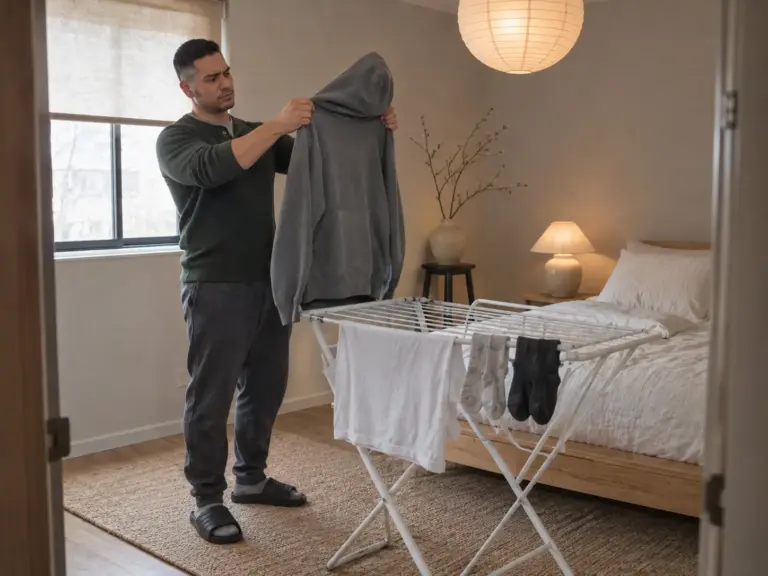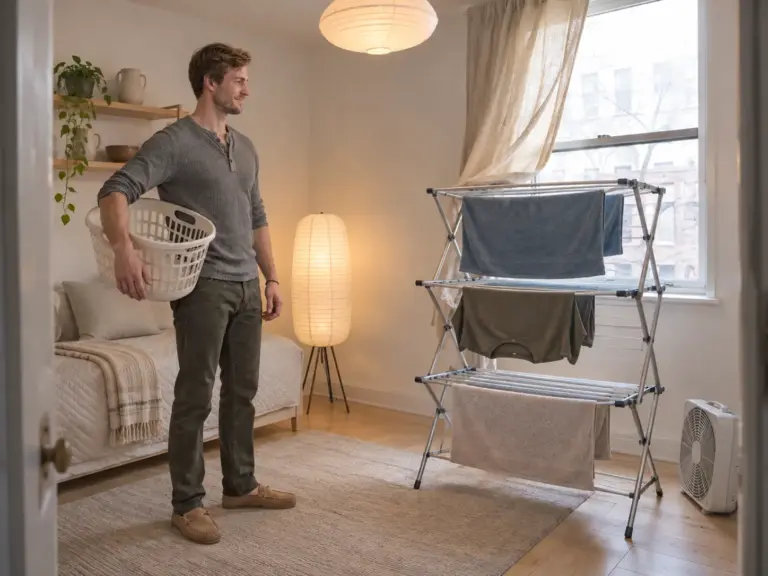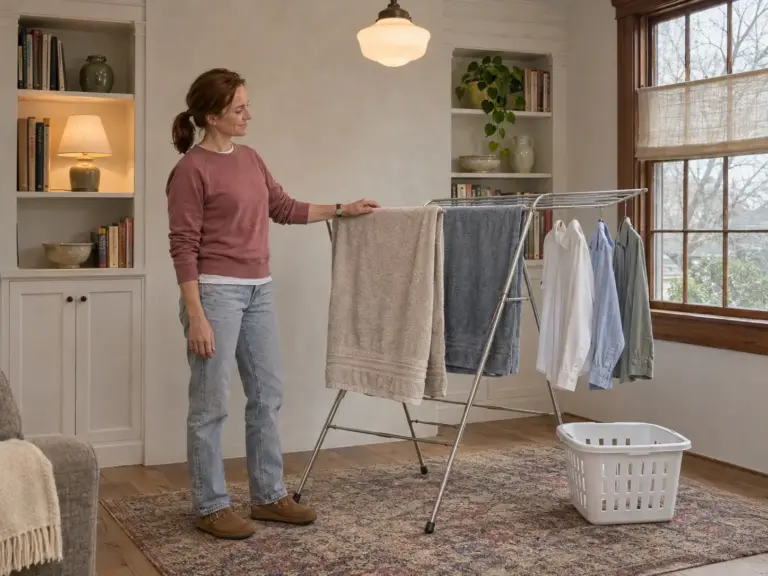
The wash goes onto the rack at nine with the heat running and the window glass clear. By morning the thin pieces are done, the jeans are still cold and stiff at the knee, and a second load hung the next night is still damp at lunch. Same rack, same fabric, a different number of hours.
How long it takes to air dry clothes in winter is a range, a few hours for a tee and most of a day for a thick sweater, and the room moves that range more than the cold outside does. Drying is evaporation, and evaporation needs air that can still take water plus heat to pay for it: a warm, low-humidity room supplies both, and a cold damp day supplies neither.
Below you get the hours by fabric, why they bend, how outdoors compares, the reading to take before you hang, the changes that shorten the clock in order, and the point where a slow load is telling you about the room.
Quick Answer
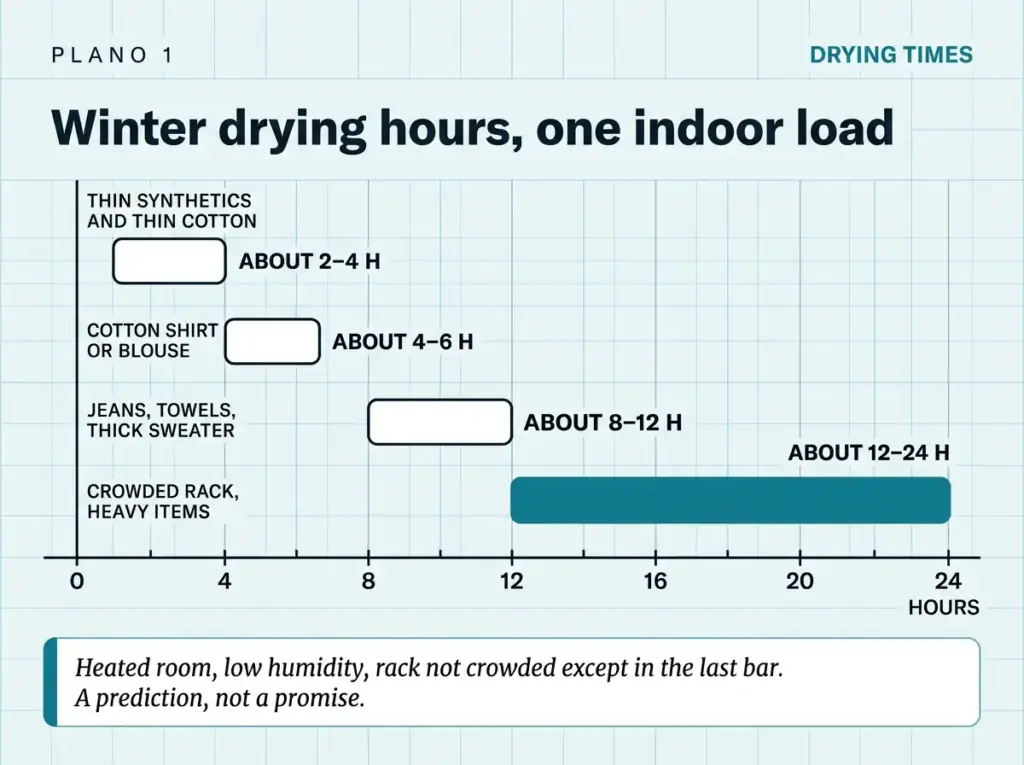
In a heated room, thin synthetics and light cotton dry in 2 to 4 hours, shirts in 4 to 6, jeans, towels and thick sweaters in 8 to 12, and a crowded rack in 12 to 24. Humidity and airflow in the room move those hours more than the outdoor cold does. Past 24 hours, suspect the room.
Winter Drying Times, From a Thin Tee to a Wet Pair of Jeans
No single number covers a rack of mixed fabrics, so every range below comes with its condition: a heated room at normal room temperature, a rack that is not crowded, a laundry load that came out of a full spin cycle. Fabric thickness moves the hours most, which is why the ranges run from a thin tee to wet denim. Read them as what to expect tonight and tomorrow morning; what bends them comes after.

Thin Synthetics and Cotton Shirts Are a Matter of Hours
A heated room with the air at a normal indoor temperature and the humidity near the low end of the usual band is the fastest drying space most renters own in winter, quicker than a 50 °F (10 °C) day outside. In it, light synthetics and thin cotton are done in about 2 to 4 hours, and a cotton shirt or blouse in 4 to 6. Hang them at bedtime and they are wearable at breakfast, because in a heated house with dry air thin clothes on a rack are dry by morning.
The first number comes from the fabric’s weight and the second from how much water the spin left in it. A full 15 to 18 lb load comes out of the washer holding roughly 3 to 5½ pints of water, and every pint has to leave through the air of your room. Spin speed shifts that figure more than anything you do at the rack, so a second spin is the cheapest hour saved.
Jeans, Towels and a Thick Sweater Take the Night
Jeans, towels and a thick wool or cotton sweater run 8 to 12 hours, so they take the night, and the slow end of that range can stretch to a full day. Denim and terry hold water in thick layers and in seams, and water in the middle of a thick layer has to travel to the surface before the air can take it. The legs of a pair of jeans feel dry first; the waistband, the pocket linings and the seams stay cold and damp long after.
Press the back of your fingers against the waistband and the pocket seams before anything comes off the rack. Evaporation keeps wet fabric cold, so a cold seam is a damp seam even when the legs feel dry.
A Crowded Rack Adds Half a Day to Anything
A rack crowded with heavy pieces takes 12 to 24 hours, because wet pieces touching each other trap a pocket of saturated air between them and nothing carries it away. The same shirt can be dry in two hours in one room and still damp the next morning in another, so treat these ranges as a starting point for a clothes airer or a rack of any kind. For the whole indoor routine, from the order of the fixes to the humidity ceiling, there is the full order for drying a week of laundry indoors.
Why a Heated Room Dries a Wash Faster Than a Cold, Damp Day
The ranges above bend, and the bend has one cause that fits in two numbers: how much water the air can hold at its temperature, and how much it already holds. Those two numbers are the difference between the same wash in two rooms.

Warmer Air Has More Room Left for Water
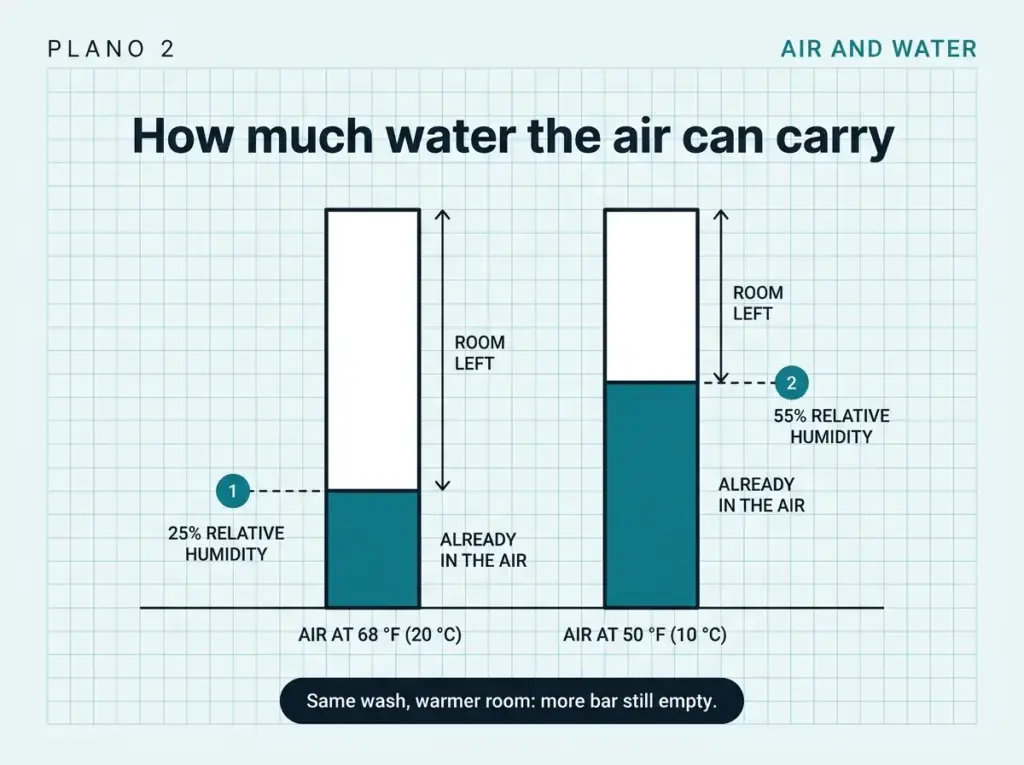
Temperature changes what a humidity reading means. According to the National Weather Service’s explanation of relative humidity, “Warm air can possess more water vapor (moisture) than cold air,” so the same amount of water in the air, its absolute humidity, reads as a lower relative humidity in a warm room and a higher one in a cold room.
Run the numbers: air at 68 °F (20 °C) holds close to twice the water of air at 50 °F (10 °C). A room at 68 °F and 25 percent relative humidity has about three-quarters of its capacity empty, plenty of space for a wet shirt’s water, while air at 50 °F and 55 percent is already more than half full. Same shirt, two different clocks.
Every Pint That Leaves the Fabric Costs the Room Heat
Drying also costs heat. Penn State’s water-science course puts the energy to turn liquid water into vapor, the latent heat of evaporation, at about 540 calories per gram, roughly 970 BTU per pound.
A pint of water weighs about a pound, so a spun load holding 3 to 5 pints asks the room for roughly 3,000 to 5,000 BTU. Divide by 3,412 BTU per kilowatt-hour and that is about 0.9 to 1.5 kWh of heat pulled out of the air around the rack. A heated room pays that bill without noticing. A cold room has to pay it out of air that is already cold, and a room that cannot carry the vapor away hands it straight back to the fabric.
The Same Load in Two Rooms
Put the two rooms together. At 68 °F and 25 percent with the heat running, the wash has heat to spare and air to take the vapor, and the thin pieces are done by morning. At 50 °F and 55 percent with the radiators off, it has neither, and the same wash is still damp the next afternoon. A cold room that is dry is slower than the heated one; a cold room that is damp is slowest of all.
The glass shows which room you are in. A pane that stays clear all evening says the vapor is leaving the room, and one that starts to fog says the air is reaching its dew point at the cold surface, so the vapor is staying in. The same physics explains why the safe indoor ceiling drops as the glass gets cold, which matters the first time a cold week meets a wet load.
Drying Outside in Winter: Dry, Moving Air Works and Damp Cold Doesn’t
The heated room has just beaten a cold day, and the reverse can happen too. Whether the line outside is worth using depends on the same two readings, humidity and moving air, and not on the season.

Freeze-Drying Is Real, but It Needs Dry, Moving Air
Below 32 °F (0 °C), ice in a wet garment goes straight to vapor without melting, which is sublimation, and clothes really do freeze-dry on a clothesline. It only happens when the outside air is dry and moving: at the same temperature with more moisture in the air, the load barely dries at all. Even on a good day, clothes hung outside in winter can take up to 12 hours and may need finishing indoors.
A Still, Damp Day Loses to the Living Room
Picture 38 °F (3 °C) and breezy under a gray sky, a line that stays loaded all day, and towels that come in stiff and half dry at dusk, when the same towels would have been done by lunch on a rack in a heated room. A load on the line tends to take a day in summer and two or three days in cold weather, against overnight on a rack inside.
An outdoor winter day is a bet on wind and dry air. Read the outdoor air the way you read the room, humidity and wind, before you line dry anything. A retractable clothesline under a porch roof keeps the rain off but does nothing about damp air.
Bring the Load In to Finish and Count That as Part of the Clock
Plan on bringing the load in to finish, and count that time as part of the clock. A garment dried outside in winter comes in stiff and cold, and the stiffness is not dryness. Press the seam before folding anything, and if it is still cold, give it a few more hours on the rack inside.
Read the Room Before You Hang the Wash
Two numbers turn a range into a prediction, and a meter on a shelf gives both. The reading you take before the wash goes up tells you where in the ranges tonight will land.

Take the Reading at Sitting Height, Before the Wash Goes Up
Take the reading at sitting height, in the room where the rack stands, before the wash goes up.
The AcuRite 00613 Wireless Digital Indoor Thermometer and Hygrometer is a 3 by 2.5 by 1.3 inch box that shows temperature and relative humidity with the day’s high and low, and the high and low show what the room did overnight. Where it sits and how many readings to take are covered in three readings from one meter. Its accuracy is uneven: some units read inconsistently and some quit within days, so check the first reading against a second meter, and how to trust a cheap humidity checker shows how. A second meter set at the rack reads what the load is doing, and a difference of several points between the two is the wash’s own water.
The 30–50% Band, the 60% Ceiling and What They Mean for a Load
The EPA’s indoor humidity range is 30 to 50 percent humidity, and 60 percent humidity is the practical ceiling for a home. Above the band the room is the bottleneck, and below it the air is hungry for water. A room at 30 to 40 percent lands on the short end of the ranges in this article; one at 55 to 60 percent lands on the long end or past it. High indoor humidity also raises the likelihood of mold and mildew in the room, and a load that adds water to a room already at its ceiling sends that water to the coldest surface it can find.
The Signs the Room Is Already Full
The indoor air tells you it is full before the meter does. The coldest pane starts to sweat, which is why the glass fogs on the room side, the air feels clammy, and the wash stops progressing after about eight hours, with the last dampness sitting in the seams and the waistband. Any one of those means the room has stopped taking water.
Take one reading before the first wash of the week goes up and another after it comes down. The difference is what the load added to the room, and it is the number to compare from week to week.
The Moves That Cut the Hours, in the Order to Try Them
With a reading in hand, the changes that shorten the clock cost nothing, apart from the fan. Try them in this order and look at the room between steps, so you know which one worked.

Spin the Load Again and Roll the Thick Pieces in a Towel
An extra spin sends the load to the rack holding pints less water, which makes it the cheapest hour saved. For jeans and thick pieces, lay each one flat on a towel, roll it up and press the roll hard, and the towel takes what the spin left. Skip the extra spin for delicates, where another cycle is wear for little gain. The next reading should show it: the pieces feel lighter going onto the rack, and the meter at the rack climbs less.
Space the Rack and Turn Each Piece Once
Space garments at least an inch apart and turn each one once after a few hours, so the side that faced the room faces the air. The same rack with the same load dries on a shorter clock, because every piece gets a pocket of moving air.
Spacing clothes matters most on a crowded rack. If everything cannot be spaced, split the laundry load across two evenings. What the load sits on matters too, and which rack types hold up past the second month covers what fails first on each.
Put Moving Air Under and Through the Rack
Moving air across the fabric is worth as much as a machine pulling water out of the air. In one enclosed-room test a dehumidifier alone dried a load in about 4 hours 45 minutes, and adding a fan pointed at the rack cut it to roughly 2 hours. Any box fan or table fan helps, and the number to compare is airflow per watt, since the size of the fan tells you little.
The Lasko Pivoting High Velocity 12-inch utility fan publishes 289 CFM on about 100 W, and its 270-degree pivot aims along the length of the rack instead of at the ceiling. Run for 8 hours, it uses 0.8 kWh. It is a utility fan and it sounds like one: the noise at the speeds that move the most air is the weak point, and it decides whether the fan runs overnight.
Aim low. The bottom layer of a crowded rack is the last to dry, and a fan aimed at the middle leaves it wet, so set the fan on the floor and tilt it up through the rack.
Run the fan for the first hours, then switch it off. At 100 W a full 24 hours is 2.4 kWh, the same order as one cycle in an electric dryer, and once the pieces are dry the air is only costing watts.
A smaller route to the same airflow is the Honeywell TurboForce Air Circulator HT-900, a 2.6 lb tabletop circulator with three speeds and a 90-degree head, and the cheaper of the two. It is small enough to sit on the floor beneath the rack and aim up through it. Its durability is uneven, since some units have stopped working inside a year.
A fan bought for the rack also becomes the room’s summer fan, and the noise is what decides whether it runs at night. Ventilation matters as much as the fan: a window cracked open on the far side of the room gives the damp air somewhere to go, as long as the cold air coming in does not drop the room well below room temperature.
Read the Room Again Before You Add Anything Else
Read the room again before you add anything else. If the meter at the rack is back near the shelf’s reading and the glass is clear, the room can take this wash and you can stop. If the reading is still high, the free fixes for a room that reads too high come before any device, because a fan that runs while the reading stays high only moves the same damp air around.
Where 24 Hours Turns a Slow Load Into a Room Problem
A wash that is still damp after a day has already had the free moves. Past 24 hours the clock is no longer about the fabric, and the line comes from the standard for wet buildings.

The 24–48 Hour Window Is a Building Number
According to the EPA’s guide to mold and moisture in the home, “It is important to dry water-damaged areas and items within 24-48 hours to prevent mold growth.” A wet wash is a small, slow spill, and on that clock a load still damp at 24 hours is a moisture problem, not a slow one. The same guide gives the useful half of it: mold spores will not grow if moisture is not present. Dry the load and the surface dries with it.
A Load That Stops Progressing After Eight Hours
A closed bedroom already near 55 to 60 percent has nowhere to put a load’s water. Picture a load that has been up for a day and a half, a room that smells faintly of the bottom of a laundry basket, and a meter on the shelf reading 61 percent. The wash stalls somewhere around the eighth hour, with the last dampness in the seams and the waistband.
A load left in the drum or the basket for a few hours before it goes up is a separate problem: it comes out with a musty smell, and no amount of rack time takes that out. That is a fabric problem solved in the washer, so hang the wash soon after the cycle ends. How the room behaves once the rack is empty is in how long a high reading stays high after the load comes down.
A Dehumidifier Beside the Rack for the First Hours
A small dehumidifier run next to the rack for the first two or three hours breaks the stall and lets the room finish the job, which works better than running it all day.
The Midea Cube 20 Pint Dehumidifier is an ENERGY STAR-listed unit rated for 20 pints a day and 1,500 square feet, with a humidity setting from 35 to 85 percent and a continuous-drain hose that lets it run a whole drying session without a bucket swap. The bucket fills fastest in the first hours, which is also when the stall breaks, and the tank, far more than the machine, is what gets abandoned; the hose answers it. Reliability is the weak point: some units have failed after a few hours of use, and the machine is heavy with an awkward bucket.
A compressor unit also pulls less water from a cold room, so set it in the heated one. In a bigger enclosed space a 50-pint unit can cut 12 to 24 hours to 4 or 5, and sizing a dehumidifier in pints to the room does the arithmetic.
Shut the door of the room with the rack. In an open apartment a dehumidifier works on every room it can reach, and in one closed room it works on the air around the wash.
When the Load Was Never the Problem
Some rooms cannot take a wet load however long the wash waits or however good the rack is. For those, the answer is not another accelerator. The sections below say which room that is and what to do instead.

A Closed Bedroom That Reads High Before the Wash Goes Up
If the meter reads 55 to 60 percent before the wash goes up, the load stalls whatever the rack and the fan, and its moisture ends on the coldest surface in the room. A room dried in all winter also drifts upward: the glass starts to run on the coldest nights and the rack begins to smell by February, even though nothing about the routine changed, because the humidity creeps up a little each week. The rack that starts to smell is the sign that the room, not the fabric, has been over its band for weeks. The wash is one source among several, and finding where a high reading comes from rules out the rest.
A Bathroom Fan That Vents Into the Attic Is a Building Fix
A bathroom exhaust fan that vents into the attic instead of outdoors puts every shower’s moisture into the building, and a longer wait or a bigger rack does nothing about it.
The same goes for a window that runs with water on the coldest nights, and what makes the glass run overnight, hour by hour separates the causes. A load that sat in the drum belongs here too. These are air-exchange, building and fabric problems. If the question is the wall behind the pane, a professional is the answer, because mold on a wall is a building matter.
Why 270 Watts of Heat Only Moves the Water Around
A heated airer warms the fabric but does not remove the water.
The SHARNDY Electric Heated Clothes Drying Rack draws 270 W with a timer shut-off and folds down to 2.83 inches. That is about 0.27 kWh an hour, so a 5-hour evening is about 1.4 kWh, and every ounce it releases goes into the same room’s air. The heat sits in the upper tiers, so the bottom layer dries slower, especially bulky garments. For the heat branch of the decision, which heated racks ship to a US address and what each one costs to run sorts the options by watts and hours.
When the Answer Is the Machine Dryer or a Vented Room
For a room that cannot take the load, the answers are the tumble dryer (a heat pump dryer does the same job on less power), a room with an exhaust fan or an open window, or a dehumidifier sized for the room, and the free move still goes first. Air comes before heat: a fan, a cracked window or a dehumidifier send the water out of the room, while a heated airer only warms it. If the reading is high and stays high, a stalled load lands on the wall, and keeping the bedroom walls under 60 percent is what preventing that looks like.
Read the Room Tonight, Then Press the Seam in the Morning
The hours depend on the fabric and the load, and they bend with the room’s temperature and humidity far more than with the cold outside. A heated room at low humidity dries a wash overnight, and a cold damp day does not. Read the meter before you hang, spin again, space the rack, turn each piece once, and only then add air. A wash still damp at 24 hours is a room problem, and the answer is air exchange, a dehumidifier or the machine.
Check the room again after two or three weeks of drying in the same place: the reading on the meter, the glass on the coldest nights, the smell of the rack. A reading that creeps up week by week is the room filling, and why the overnight wash meets the wettest air explains why a load hung at bedtime lands on the room at its peak.
Tonight, read the room before the wash goes up, put the thin pieces where the air moves, and press the seam of the jeans in the morning. Read the meter again after the load is down. If the number is high, reach for air before heat, and if the room cannot take a wet load at all, use the dryer.
Frequently Asked Questions
01How long does it take to air dry clothes in winter?
In a heated room, thin synthetics and shirts dry in 2 to 6 hours, jeans and towels in 8 to 12, and a crowded rack in 12 to 24. Humidity and airflow in the room move those hours the most.
02Can I air dry my clothes in the winter?
Yes, you can air dry clothes in winter, indoors in a heated room or outside on a dry, breezy day, and both work when the air can still take water. A still, damp day outside loses to the living room, and a room above 60% humidity cannot take the load.
03Can you air dry clothes in 50 degree weather?
Yes, if the air is dry and moving, a line outside at 50 °F (10 °C) can dry a load, though it may need finishing indoors. With high humidity it can stay damp for most of a day.
04Can clothes air dry in 2 hours?
Thin synthetics and a light cotton item can, in a warm, dry room with a fan moving air across the rack. Jeans, towels and thick sweaters take far longer.
05How long does it take to air dry clothes with a fan?
A fan aimed through the rack shortens the clock because moving air carries the vapor away from the fabric. In one enclosed-room test, adding a fan to a dehumidifier cut a load from about 4 hours 45 minutes to roughly 2 hours.