You cross the bedroom carpet in socks, sit on the edge of the bed, reach for the lamp, and the switch bites. Same switch plate, same sharp snap, and the hallway door a few steps back gave you nothing. The question of where do static shocks happen most in the house has an answer with a shape, because a charge builds on you as you move across fabric and drains the instant you touch the first piece of metal, and those two places are rarely the same spot. This guide walks that route from the front door to the pillow, names the room that carries most of both halves, and ends on the one reading that decides what to change.
Quick Answer
Static shocks are worst where a charge builds on you (carpet, upholstered seats, synthetic bedding) and where the first metal you touch drains it (a door lever, a switch plate, a bed frame). The carpeted bedroom at night carries the most of both, so that is the room to read with a humidity meter first.
Dry Winter Air Loads the Whole House
Before a carpet or a doorknob matters, the air has already decided whether a charge can stay on you at all. Dry air lets it stay and moist air lets it leak away, and the heating season is when most houses cross from one to the other. So the map of static shocks starts as a map of humidity.
Why the heating season is when it starts
Winter heating starts from air that arrives from a cold outdoors with very little moisture in it, and a furnace that warms it does not add any back. The same water vapor spread through warmer air reads as a lower relative humidity, so the number on a meter slides down every time the heat comes on. That is why the first cold week brings the first shock of the year, usually at a door lever or a switch plate you touched all summer without a thought.
And the slide keeps going. A reading from the first cold week is not the one you will have in January, so treat any early number as a starting point and read about how indoor humidity shifts as the winter cold deepens before you decide a room is fine.
The band to check each room against
The reference is the EPA’s, and it is wider than most advice makes it sound. According to the EPA’s guidance on controlling indoor humidity, “Keep indoor relative humidity below 60 percent indoors, and ideally between 30-50 percent.” The 60 is a ceiling set for dampness and mold; the 30 to 50 is the target band, and the shocks tend to show up when a room slips toward the bottom of it or under.
Apply that band one room at a time. A house has no single humidity: the kitchen, the bathroom and a closed bedroom can read very differently at the same moment, and how dry a room feels is no substitute for the number.
A room that keeps shocking you all winter will usually read near the low end or under the band. If a room reads comfortably inside it and still bites, that is a different problem, covered near the end. Low humidity is the usual suspect in a heated house, but it is not the only one.
The order of fixes, what to change first and what to leave for later, lives in the full order of fixes for static shocks, and this guide does not repeat it. What it adds is the piece that guide cannot: which room in your house to work on first.
The Charge Builds on Carpet, Fabric and Shoes
Dry air only lets the charge stay; something has to put it there, and that something is movement over an insulating surface. In an ordinary house you meet those surfaces in a fixed order over one evening, so they read best as a route.
Wall-to-wall carpet and the socks that cross it
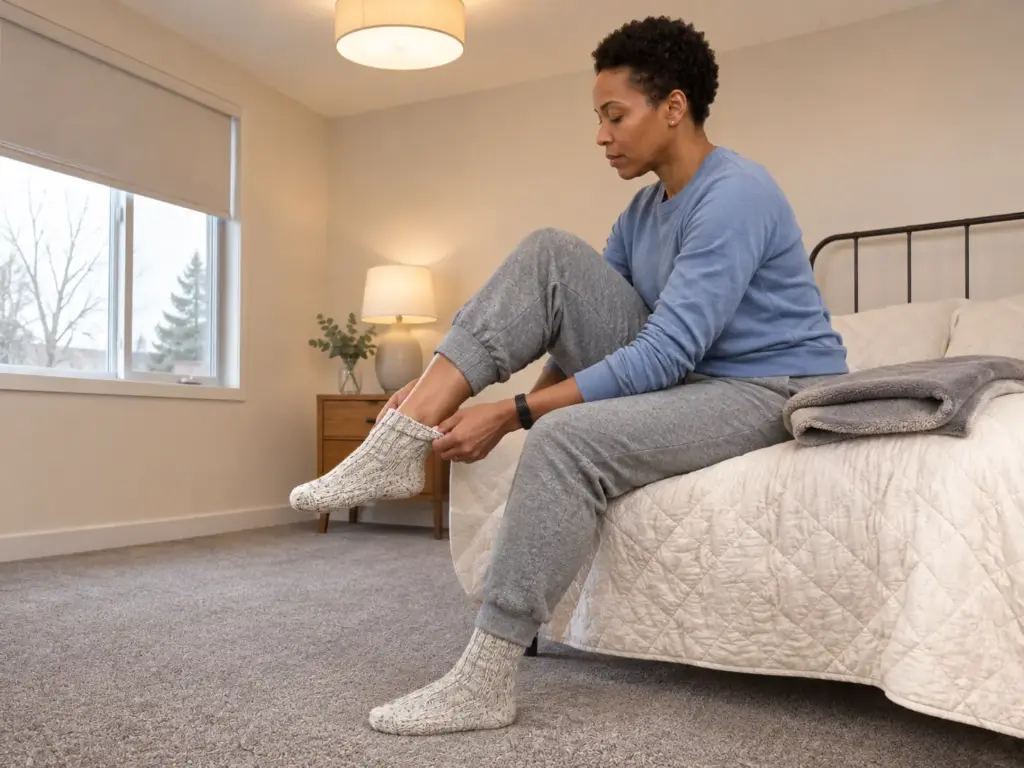
The route usually starts at the floor. Every step across wall-to-wall carpet, rugs or a hallway runner in socks and everyday clothing (wool and synthetic are the usual setup) rubs a little charge onto you, and nothing carries it away because the carpet, the sock and the dry air all insulate. The shock is not made at the doorknob. It arrives there, carried the length of the room.
The surface itself gives the clearest clue. The same pair of socks on the same carpet or area rug does far less in July. Neither the socks nor the carpet changed; the air did, which makes a shock map a winter map.
Footwear is the one free change on this stretch: a different sole in the one room where the bite happens costs nothing, and it shows quickly whether the floor was the start of the route.
Swap the footwear in one room only, and leave the humidity alone for a few days. If the bite at that spot fades, the floor was the start of the route. If it does not, the air in that room is carrying more of the load than the surface is, and the meter is your move.
Upholstery, bedding and synthetic fabric
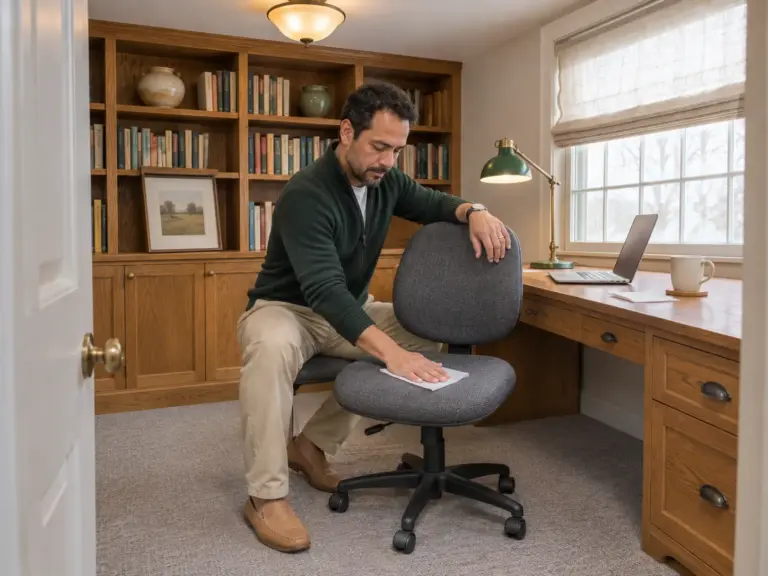
Next comes the couch. Sliding across a cushion in a fleece or nylon top, pulling a throw off the back, standing up from synthetic upholstery: each one separates two surfaces that had been pressed together, and the charge stays with you when they part. Bedding does the same at the end of the evening, because sheets and a synthetic comforter slide against everything you wear. By the time you stand up from the bed you have been collecting charge for hours without touching a single piece of metal.
A dog’s coat and a dog’s bed ride the same surfaces and add to the route in some houses, and when a dog’s coat or bed is part of the route is covered on a separate page. The bed, meanwhile, is the last stop and the one most households never think of as a surface at all.
The seat of a car, which is the same effect
The car is the same route in miniature. You slide across the seat getting out, the charge is built on the seat, and the discharge waits at the metal of the door frame as your hand closes on it. A couch frame behaves the same way, and that makes both a decent test: if you are bitten at a car door in January and never in July, you are not looking at a car problem. You are looking at the same dry air that loads the hallway.
The Shock Lands on the First Metal You Touch
The charge is on you now, and the shock comes from the first thing that can take it, which is almost always metal. The spots are easy to list; the more useful part is why the same one bites every time.
Doorknobs, switch plates and bed frames
Look back over the route and count the conductors: a metal door lever, a switch plate and its screws, the head of a metal bed frame, the base of a lamp, the car door. Each is a place where the charge you collected finds a way out in one snap. A wooden frame and a painted wall give it nowhere quick to go. Metal does, and so the bite always sits on metal.
Why the same spot bites every time
The spot is not special; it is the first conductor on the same route. You walk the house in the same order every evening, so the same piece of metal is always the first to meet a hand carrying the charge. Move the rug and the bite moves with it, to whichever metal is now first. That is useful, because it means the bite is describing your route, and says nothing about the lever.
The free change: the key goes first
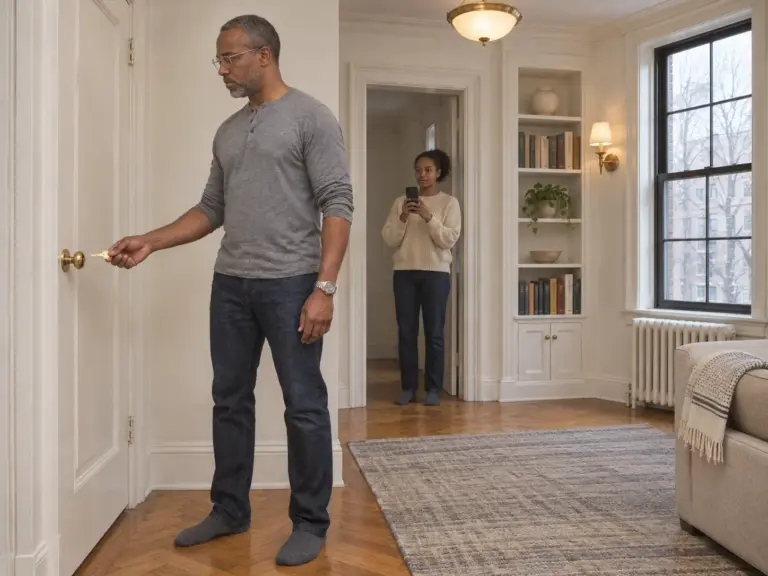
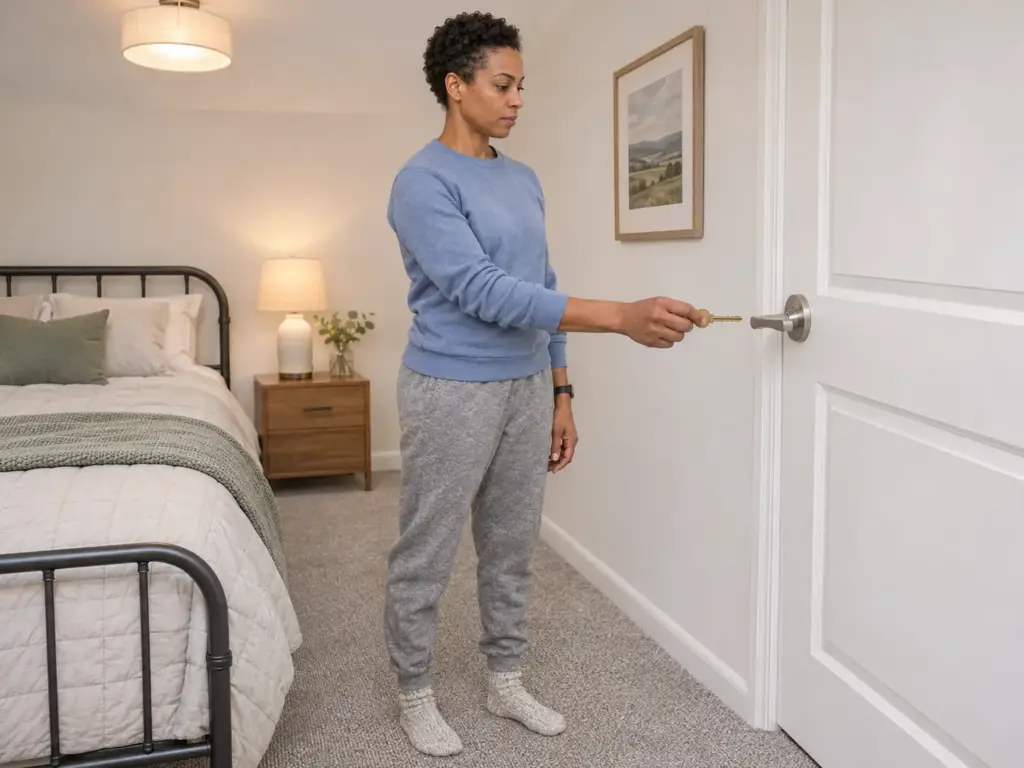
Hold a key or a coin, any small metal object, and touch the metal with it before your hand does. The spark jumps from the key to the lever, and your fingertip, half a second behind, has nothing left to take. It costs nothing, it needs no reading to start, and it works at every spot on the route, from the bedroom door to the car door.
Then read the result. A spark at the key and a fingertip that feels nothing confirms that the charge is on you and that the route is the one you drew. A fingertip that still gets bitten at other spots means the route is longer than you thought, and the start of it is somewhere you have not looked yet.
Park the key where the route ends, on the nightstand beside the lamp or on the hook by the door, so it is already in your hand before the hand reaches the metal. A key you have to dig for is a key you will skip.
Why the Bathroom Feels Fine While Other Rooms Shock
Take the same house and the same person, and one room never bites: the bathroom after a shower. That contrast is the strongest hint about the air that this article has, and a meter in each room turns the hint into numbers.
Where the shower’s moisture goes
Showers put water in the air; the EPA says cooking and showering add to indoor humidity. The question for a shock map is where that shower moisture ends up.
Moisture moves through a house only as fast as air moves through it, and that air movement is slow in a heated house with the doors closed, so a shut door keeps the shower’s share in the bathroom while the bedroom down the hall carries on at winter-dry. Treat that as a mechanism to confirm with a meter, and nothing firmer than that. With the bathroom door closed and no air moving down the hall, the bedroom keeps its low humidity.
The bathroom exhaust fan is where a popular idea goes wrong. Leaving it off so the steam drifts down the hall sounds like free humidity for the whole house, but the EPA’s advice runs the other direction: run the fan or open a window while showering, and use a fan that vents to the outdoors. That moisture belongs outside, and a bathroom left damp invites mold on its walls long before it lifts the bedroom’s number.
One meter per room, read at the same hour
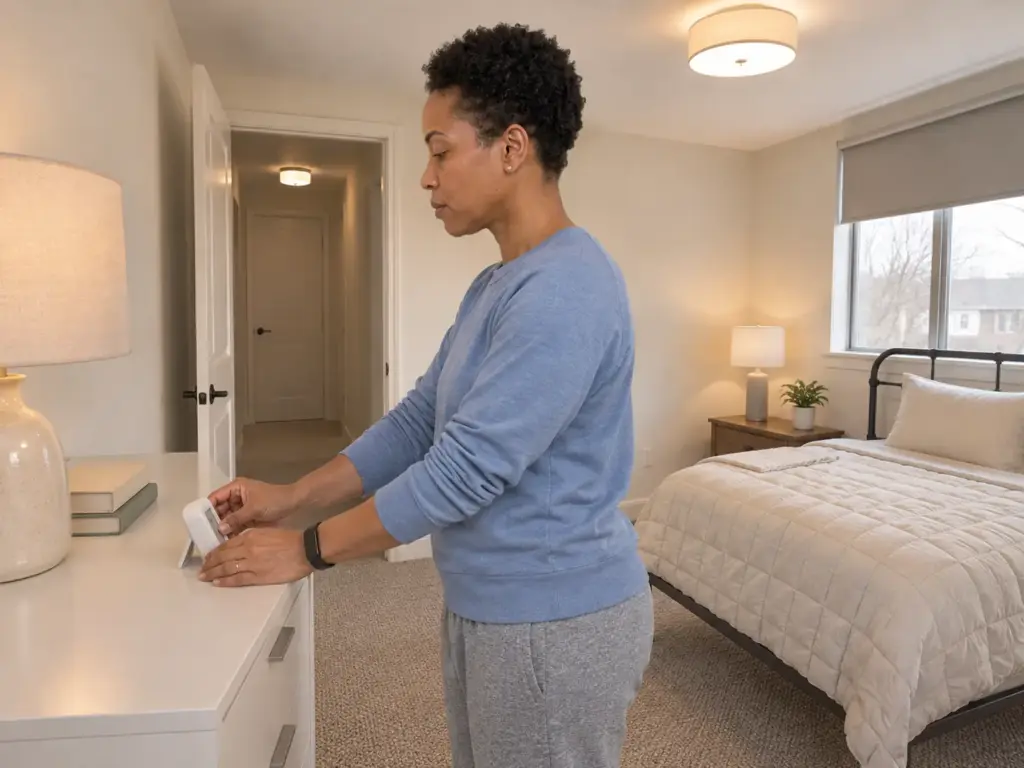
Humidity is a number per room, so the check is one hygrometer moved through the house, or a few cheap ones left where they are. Read each room at the same hour (a reading at breakfast and a reading at bedtime cannot be compared), and put the meter at the spot that bites.
The first one I would put there is the Govee H5075 Bluetooth Hygrometer Thermometer. The maker rates its humidity reading at plus or minus 3 points, which is loose at a threshold but still separates a room inside 30 to 50 percent from one sitting at 20. It has a 3-inch screen with a comfort indicator, high and low records, and a Bluetooth link rated to about 164 feet that logs 20 days in the app. The weak point is reliability: some units have quit within six months, and the Bluetooth link is unreliable in some houses, so read the screen and treat the app as a bonus.
How to take the reading so the number means something is laid out in three readings with one meter.
A meter at the spot that bites reads differently from the same meter on the kitchen counter, because cooking puts moisture right where the counter is. Pick the position once, at hand height beside the metal that shocks you, and keep it there for every reading.
Picking a meter without overpaying
The meter does not need to be fancy, and the EPA says as much. In the EPA’s brief guide to mold, moisture and your home, a humidity meter is “a small, inexpensive” instrument sold at many hardware stores.
The plain version is the TempPro TP50 Digital Hygrometer Indoor Thermometer: one AAA battery, a DRY, COMFORT and WET icon, high and low records, a magnetic back and a table stand, humidity rated at plus or minus 2 to 3 points, and no app at all. It reads the room right now, which is all the first pass needs, and its high and low records show whether a room swings overnight. Longevity is where it disappoints: more than one unit has stopped working after about a month, so a frozen display is a reason to swap the battery first and the unit second.
If you are weighing meters against devices, what each product changes, meter first puts them in order. And a monitor that also reads air quality is a different purchase with a different job, covered in a monitor that also reads air quality, against a plain hygrometer.
The Bedroom at Night Carries the Most of Both
Of every room on the map, one stacks both halves: a carpet underfoot, synthetic bedding against everything you wear, a metal bed frame and a lamp within reach, a shut door and the heating running. That is the bedroom at night, and it is also the room a single snapshot misreads.
Carpet, bedding and a metal frame in one room
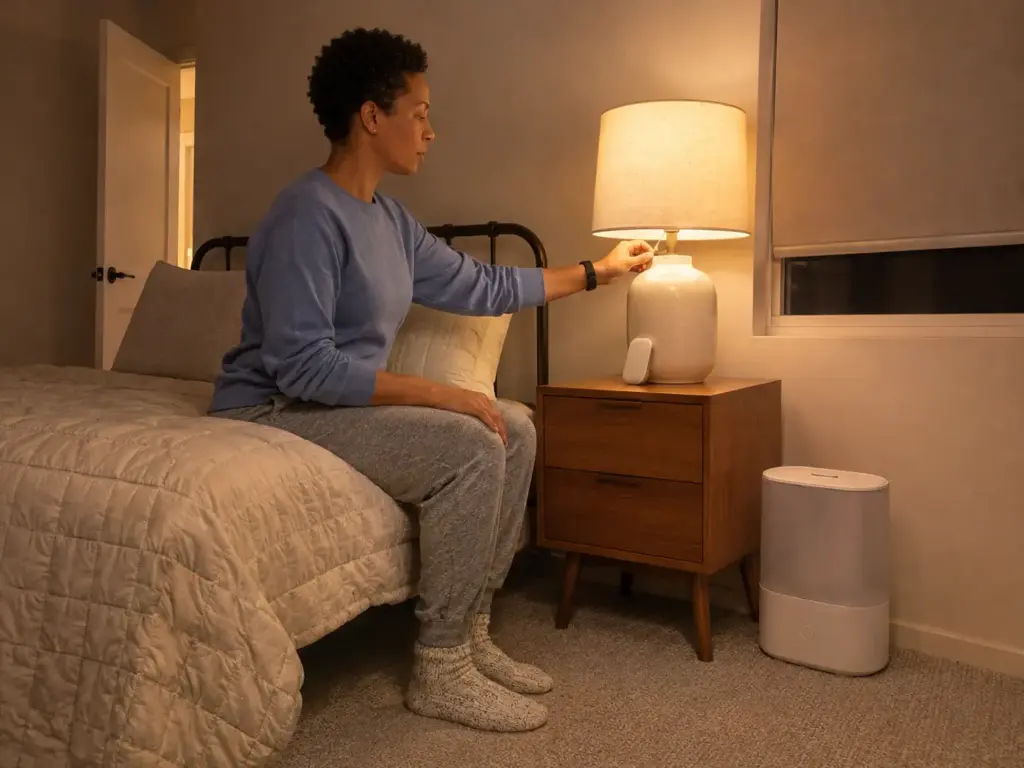
Count what a bedroom holds within an arm of the bed. Carpet underfoot, sheets and a comforter, a bed frame, a lamp with a metal base, a switch plate by the door.
The living room has the couch but its metal is across the floor; the hallway has the carpet and the door but no bed; the bathroom has metal and almost no charge. Only the bedroom puts the build points and the discharge points close enough that the charge has no time to leak away on the walk. That is a reading of how a house is arranged, not a count taken across houses.
The band for the room is the same 30 to 50 percent, and what a good bedroom reading is covers the bedroom’s version of it. What changes in the bedroom is when the number gets read.
What a week of overnight readings shows
A reading on a weekday afternoon catches the room with the door open and the light on the wall. The night is different. The door closed, the heat cycling and a sleeper breathing in a shut room all push the number around, and why bedroom humidity changes overnight explains the mechanism behind it. A daytime snapshot misses all of that, so the bedroom wants a week.
The sensor for the job is the SensorPush HT.w Temperature & Humidity Sensor, Water Resistant, Bluetooth. It keeps 45 days of readings on the device itself, so the week is there without a phone sitting beside the bed, and it records dew point next to humidity and temperature. The flaw is the connection, which is unreliable in some homes, and some units have lost battery life by about eight months. The on-board memory is the safety net when the link drops.
Read the week this way. The first number to look at is the night’s average. Scratch that: the night’s lowest figure, because a low that lasts while you sleep does the work the average hides.
If that low sits under 30 percent most nights, this is the room that needs the change. If it dips under only on the coldest nights, you are watching a seasonal drift that the winter shift will deepen.
The one-room change, after the reading
The change comes after the reading, and the free pair comes before the change: the key at the lamp, the footwear swapped at the bedroom door. Run those for a few nights. If the bite at the lamp switch fades while the meter still sits low, you have quieted the spot and not changed the air, and the low reading is still worth acting on.
When the night low sits under the band, a room humidifier sized for that one room is the move, and what to do when the reading sits too low goes through the options before a device. A whole house humidifier is the wrong size for a problem that sits in one bedroom: it humidifies rooms that already read inside the band.
The Levoit Classic 300S Ultrasonic Smart Humidifier, 6 L is a top-fill ultrasonic unit with a 6-liter tank the maker rates for up to 60 hours, a built-in humidity sensor with an auto mode, a sleep mode, and a stated coverage of 505 square feet (about 47 square meters), which is a single-room number. Run it on auto, set to hold the band, rather than at full mist all night. Output is the letdown: in some rooms it barely moves the reading, and some units have broken after about a month, so the first week of readings after it arrives tests the unit as much as the room.
The overshoot is the other end of the same dial. Set the target too high and the coldest surface in the room, the window glass, collects condensation first; the EPA’s ceiling of 60 percent exists because of mold. And the reading in the bedroom will not match the one in the hallway, which is the reason the meter stays beside the bed.
A humidifier’s built-in sensor reads the air right at the unit, which is not the air at the pillow. Keep the separate meter across the room, by the bed, and believe that number when the two disagree.
A Shock From Everything Points at the Wiring, Not the Air
The map has one exception, and it is the one that sends a reader to the wrong fix. If the shock comes from many surfaces at once, as a tingle instead of a snap, the map is the wrong tool.
A dry-air shock is a single sharp spark at the first piece of metal, over in an instant. A shock from walls, a TV and light switches in the same afternoon, a tingle that keeps going through a metal lamp, or a shock that has been seen to stop when one particular plug or power strip is out of the wall: none of these follow that pattern. Raising the humidity will not touch them, and a humidifier bought for them is the wrong purchase.
That is a wiring question, and it belongs to an electrician. Nothing here asks you to open an outlet or test anything yourself. The useful move with the pattern is to describe it to the electrician exactly as it feels: which surfaces, whether it is a snap or a tingle, and whether it ever stops.
And if the shock is a single sharp spark but keeps coming back after the humidity is up in the band, when a fix stops working is the page to read.
Start With a Key and a Bedroom Reading
A static shock has two kinds of spot: the surface where the charge builds on you, and the metal that drains it. Dry heated air lets the charge stay, a meter in the room tells you how dry that room is, and the bedroom is the room to read first because it holds both kinds of spot within an arm of the bed. The free changes go ahead of any device, and wiring, the exception, goes to an electrician.
The winter reading drifts, so leave the meter in the bedroom for several cold weeks and look at the lowest figure of each week, not only the first. If a humidifier is running, its tank and the scale on it get a second look after the first month, because both the water and the unit’s output show by then.
Tomorrow’s first move costs nothing: put a key in your hand at the bedroom door and touch the metal with it. Tomorrow night’s reading is the meter’s overnight low in the bedroom. If it sits inside 30 to 50 percent and the snap still comes, go back to the wiring section.
Frequently Asked Questions
01Where in the house do static shocks happen most?
In the carpeted bedroom at night, where carpet, synthetic bedding, a metal bed frame and a lamp are all within reach of the bed. That is a reading of how a house is laid out. A meter in the room tells you how much of it the air is responsible for.
02Why am I getting a lot of static shocks at home?
Dry heated winter air lets a charge stay on you, and carpet, upholstery, synthetic bedding and socks are what put it there. The next piece of metal you touch takes it. Read each room with a meter before changing anything, because the rooms of one house rarely read alike.
03How do I stop static shocks at home?
Touch metal with a key before your hand does, change your footwear on the carpet where the bite happens, and read the room’s humidity against the 30 to 50 percent band. The order for the remaining fixes lives in the full static shock guide.
04Does static electricity go away on its own?
Each shock clears itself, because the charge drains at the first piece of metal you touch. It comes back as soon as you build more, and it keeps coming back while the air stays dry, so the cause stays until the air changes.
05Why do I get shocked by the car door or the couch frame?
The charge builds on the seat as you slide across it, and it drains at the first metal your hand reaches, the door frame or the couch frame. It is the same effect as the hallway carpet, on a different surface.